What to Check Before Buying Organic Athleisure (Certifications, Fabric, Labor)
October 2, 2026

Quick Summary
| Factor | What to Look For | Common Red Flags | How to Verify | Difficulty to Check Online |
|---|---|---|---|---|
| Certifications | GOTS logo with license number; OEKO-TEX STANDARD 100 label | "Organic" or "eco-friendly" text without certification; generic sustainability claims | Search the GOTS Certified Suppliers Database using the license number | Easy. Databases are public |
| Fabric Type | 100% certified Peruvian Pima cotton, organic cotton with GOTS certification, or merino wool with RWS certification | Blends with unspecified "performance" fibers; polyester/nylon labeled "recycled" without third-party proof | Check product descriptions for fiber content percentage and origin; look for specific cotton variety (Pima, Supima) not just "cotton" | Medium. Requires reading fine print |
| Labor Standards | Fair Trade Cotton logo; GOTS social compliance (covers fair wages, safe conditions); brand publishes supplier list | No mention of factory locations; vague "ethical" claims; brand refuses to disclose manufacturing partners | Look for Fair Trade certification; check if brand maps its supply chain publicly | Hard. Most brands don't publish |
| Chemical Safety | OEKO-TEX STANDARD 100 certification; natural or low-impact dyes mentioned | "Moisture-wicking" or "stain-resistant" without explaining the finish; no dye information; treated with antimicrobial coatings | Verify OEKO-TEX certificate number on the label-check database; note this tests to limits, not zero-tolerance for PFAS | Medium. Certificate search is easy, but interpreting limits requires research |
| Environmental Impact | Specific fiber origin (e.g., Peruvian Pima); water and carbon footprint disclosed; biodegradable packaging | Generic "sustainable" without metrics; recycled polyester without clarifying it still sheds microplastics when washed | Check for life-cycle assessments or environmental reports on brand site; ask whether fiber is petroleum-based or plant-based | Hard. Brands rarely share full LCA data |
| Durability & Stretch | Long-staple fiber (Pima, merino); elastane/spandex for stretch; knit density disclosed | Short-staple "organic cotton" (feels nubby, pills faster); high synthetic blend | Read reviews for pilling, bagging, or thinning after washing; according to testing by a sustainable fashion editor, natural fibers hold shape better when staple length is long | Medium. Requires real-user reviews |
Two certifications that actually close the loop
A hangtag can say "organic" and still leave you with more questions than answers. The proof layer is never the front of the tag. It's the certification you can search in a public database.
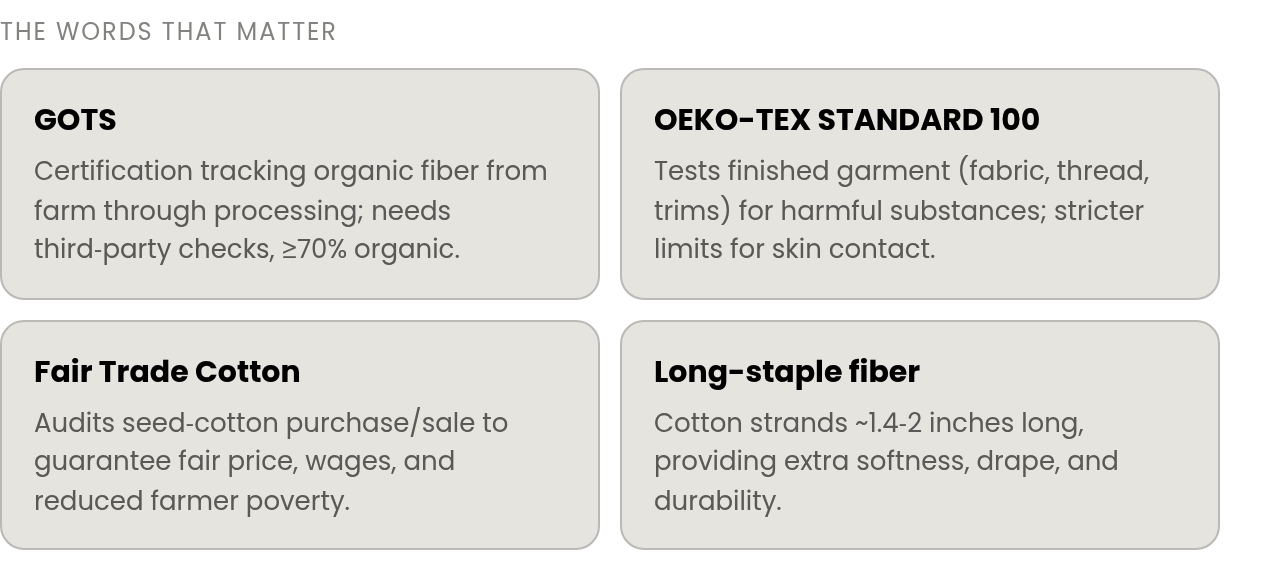
GOTS and OEKO-TEX do different jobs, and the strongest pieces carry both. GOTS tracks organic fiber from the farm through each processing stage: ginning, spinning, dyeing, stitching. It requires third-party verification at every step, as certification overview writers at PERFORMANCE DAYS explain. Higher grades tighten that threshold.
But GOTS does not test the finished garment for every substance that could irritate your skin. That's where OEKO-TEX STANDARD 100 enters. It examines the actual product you're going to wear: fabric, thread, buttons, zippers. It tests against a list of harmful substances, and it applies stricter limits to anything that sits close to your skin. One caveat: OEKO-TEX bans intentional use of PFAS and tests to defined thresholds. It doesn't promise zero detection. No textile certification can realistically promise that.
If a brand shows you a GOTS logo, search the license number in the public database. The Combined Products provision means a logo can show up when only one component, like a removable liner or a cover, is certified. Mattress shoppers run into this with certified covers over non-certified interiors. A mattress brand's GOTS certification explainer walks through how this works. The same loophole exists in activewear. A waistband or liner can carry the certification while the main fabric stays outside the scope. You can check whether the finished product itself is listed as certified, not just the factory or fabric supplier.
Why "organic" alone won't tell you if it's soft or fairly made
Organic tells you how the cotton was grown. It says nothing about whether the fabric feels soft against your skin or whether the grower got paid properly.
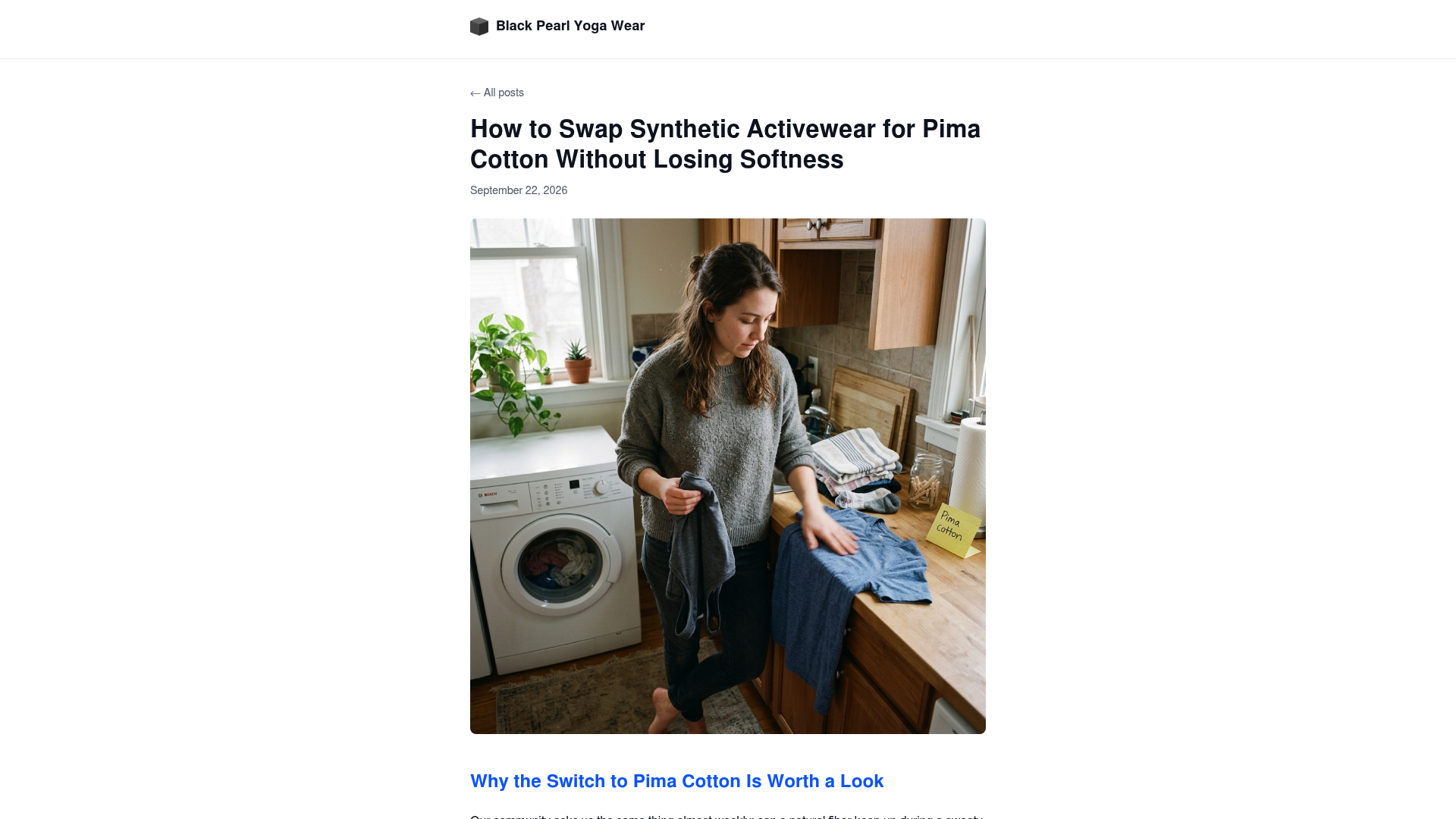
Textile people will tell you organic cotton is often short-staple. That means it can feel rougher, pill sooner, and wear out faster than a long-staple cotton. Certified Peruvian Pima, the fiber in Black Pearl's pieces, gets its softness from fiber length. That length gives the fabric its drape and durability. Not the organic label.
For your money to actually reach the grower, look for Fair Trade Cotton certification paired with full traceability like GOTS. Fair Trade audits the purchase and sale of seed cotton so everyone handling the Fairtrade Price and Premium is certified. The goal is fair prices, fair wages, and less poverty in farming communities. A Better Cotton logo is a weaker signal. It shows a sourcing commitment, but it breaks the physical link between the finished garment and the grower. You won't know whether the leggings in your hand actually contain that certified fiber.
Why natural fibers matter once you start sweating
You're mid-workout. You're hot. You're sweating. Your leggings are tight against your skin. That's not automatically dangerous, but it does change the conditions between your skin and whatever is in your clothes.
Your skin is your largest organ. It absorbs some of what it touches. During exercise, three things happen at once: your body temperature rises, sweat makes skin more permeable, and fitted fabric rubs. That combination can make chemical residues in fabric more available to your skin, especially from polyester activewear treated with PFAS or dyed with azobenzene disperse dyes. Azobenzene disperse dyes are a class of dyes common on polyester. Some are known skin sensitizers that migrate more easily when you're sweating.
Synthetic fabrics also shed microplastics during wear and washing. Some researchers believe synthetic clothing is one of the largest sources of microplastic pollution globally. Inside your house, those fibers hitch a ride on household dust. So the plastics in performance wear aren't only an ocean problem. They can become an indoor air and dust problem too.
Natural-fiber organic athleisure skips many of those chemical finishes. Organic cotton, merino wool, and Pima cotton are naturally breathable, moisture-managing, and biodegradable. Merino and alpaca wool can regulate temperature and resist odor without the itch factor. For stretch, brands often include a small amount of elastane or spandex. That keeps the piece wearable without turning it into a plastic wrapper.
What to keep with you while you shop
- Certifications are the proof layer. "Organic" printed on a product page is just the marketing layer.
- GOTS and OEKO-TEX answer different questions: one follows organic textile processing, the other checks the finished garment for restricted substances.
- A logo only counts when the license or label number searches cleanly in the relevant public database.
- Softness depends heavily on staple length. Organic alone does not guarantee a soft hand.
- Fair-labor claims are strongest with certification, supplier disclosure, or traceable farm-to-factory documentation.
- Organic status means the cotton was grown a certain way. It does not automatically tell you about softness, durability, stretch recovery, or pay.
- Natural fibers reduce petroleum-based contact, but read blends carefully for elastane, polyester, coatings, and trims.
Why the fabric on your skin matters more than you'd think
You don't usually think about chemistry while you're setting up for a plank. But the fabric pressed against your skin during exercise is not inert.
Research suggests the oil in your sweat can act like a chemical taxi service. It may make some additives from synthetic fabrics more available for skin absorption. Phthalates, BPA derivatives, PFAS treatments. They may all move more easily when you're hot, sweaty, and wrapped in tight polyester. The dyes used on polyester are another layer. That post-workout itch isn't always just dried salt.
The hidden cost of "performance" finishes
Mainstream gym clothes usually start as plastic: polyester, nylon, spandex. Their "performance" properties come from chemical treatments applied to those fibers. Water repellency, quick dry, stain resistance. Each one requires a finish that wasn't there naturally.
Organic athleisure starts from a different place. The fibers do the work because of how they're made, not because of what's sprayed on them. A fabric that never needed a chemical coating doesn't carry that question of what you're absorbing mid-squat.
We're not talking about feel-good marketing. The health case against synthetic activewear rests on several mechanisms working together: treated finishes, dye chemistry, sweat, heat, and friction. The issue isn't one scary ingredient. It's the way exercise creates better conditions for transfer from fabric to skin.
Why labor practices belong in your purchase decision
Choosing organic athleisure isn't only about what touches your skin. It's also about who made the garment and under what conditions. Fair-labor certifications signal that brands trace and audit their supply chains. That reduces the chance that workers are exposed to the same chemical load you're trying to avoid.
When a brand manufactures locally and keeps close factory relationships, transparency is easier to check. Some brands work directly with family-owned farms for organic cotton. Those aren't abstract values. They're traceable supply chains you can confirm.
Women shoppers increasingly treat labor practices as part of brand loyalty. The purchase becomes a small act of care that extends beyond your own body to the people who produced the garment.
The environmental toll you're not seeing
Every laundry cycle releases fibers into water. Synthetic fibers create a persistence problem that natural fibers don't. They shed during wearing, washing, and drying. Those particles now show up in oceans, soil, household dust, and human organs.
Natural fibers biodegrade. They return to soil instead of accumulating in ecosystems. Organic cotton farming avoids the pesticides and synthetic fertilizers that damage soil health and contaminate water. Conventional cotton farming uses heavy pesticide and insecticide loads. Some of those chemicals can remain as residues on fibers even after manufacturing.
Choosing organic athleisure means fewer petroleum-based textiles, fewer chemicals washing into rivers, and clothing that can break down at end of life instead of sitting in a landfill for centuries.
Natural-fiber activewear still has a performance paradox. Cotton absorbs moisture, which works for dry-climate workouts but can feel heavy in high-humidity, high-sweat sessions. Merino wool thermoregulates differently. Fabric choice has to match workout intensity and environment. Just carrying an organic label isn't enough.
Most natural-fiber activewear includes a small percentage of elastane for stretch. Some brands use natural rubber instead. That distinction matters. A sports bra with limited elastane and mostly organic cotton creates far less petroleum-derived fabric contact than a conventional bra that wraps your torso in treated synthetic fibers. The goal is not purity at all costs. It's reducing unnecessary exposure while keeping the garment wearable.
Decoding certifications without falling for the logo
When you see "organic" on a pair of leggings, you're looking at marketing until you find the certificate. The question is who verified it and what they actually checked.
What the two certifications actually verify
GOTS (Global Organic Textile Standard) verifies organic textile processing. OEKO-TEX STANDARD 100 verifies the finished product was tested for harmful substances. They are not interchangeable.
Most brands don't explain this split clearly: GOTS doesn't certify the raw fiber itself. It certifies the product's post-harvest processing. The cotton entering the supply chain must already be certified organic under a separate standard, such as the USDA's National Organic Program. GOTS picks it up from there. That means a GOTS logo alone doesn't prove the cotton was organically grown. It proves that once the fiber entered the textile chain, the later stages met GOTS environmental and social criteria.
OEKO-TEX STANDARD 100 tests the actual product. Every component: thread, buttons, zippers, the fabric itself. This is your safety check. But certification shows compliance with a standard, not a promise that every possible trace substance is absent under every future wear-and-wash condition.
What label grades actually tell you
GOTS has two label grades. The stricter one leaves minimal room for conventional blends. The lower organic-content designation still requires processing facilities to meet GOTS social and environmental standards. The certificate is the proof, not the word.
That gap explains why you'll see far more "organic cotton" claims than actual GOTS logos. The word is loose. The certificate is not.
For wool, the equivalent trust signal is RWS, the Responsible Wool Standard. GOTS applies to cotton, not wool. If you're shopping merino activewear, RWS is the label to verify.
How to verify a certification is real
-
Look for the GOTS logo with a license number printed next to it. Search that number in the GOTS Certified Suppliers Database. A logo without a number is decoration.
-
Check that the license is current. GOTS certificates expire annually. A brand that was certified last year but lapsed this year can still have old hangtags floating around.
-
Confirm what the certification actually covers. The finished product itself should be listed as certified, not just the factory or fabric supplier.
-
For OEKO-TEX, use the Label Check tool. Enter the case-sensitive label number. If it doesn't come back with a result, the label isn't official.
The red flags we watch for
"Organic" or "eco-friendly" without a certifying body is the most common one. Self-declared sustainability claims cost nothing to print and mean nothing without third-party verification.
Generic phrases like "responsibly sourced," "earth-friendly," or "conscious collection" are marketing language. They suggest values without committing to measurable criteria or giving you a way to verify them.
Missing certification numbers are another tell. A logo without a searchable license number is a graphic, not a certificate. Brands that hold legitimate certifications usually display the numbers because they want you to check.
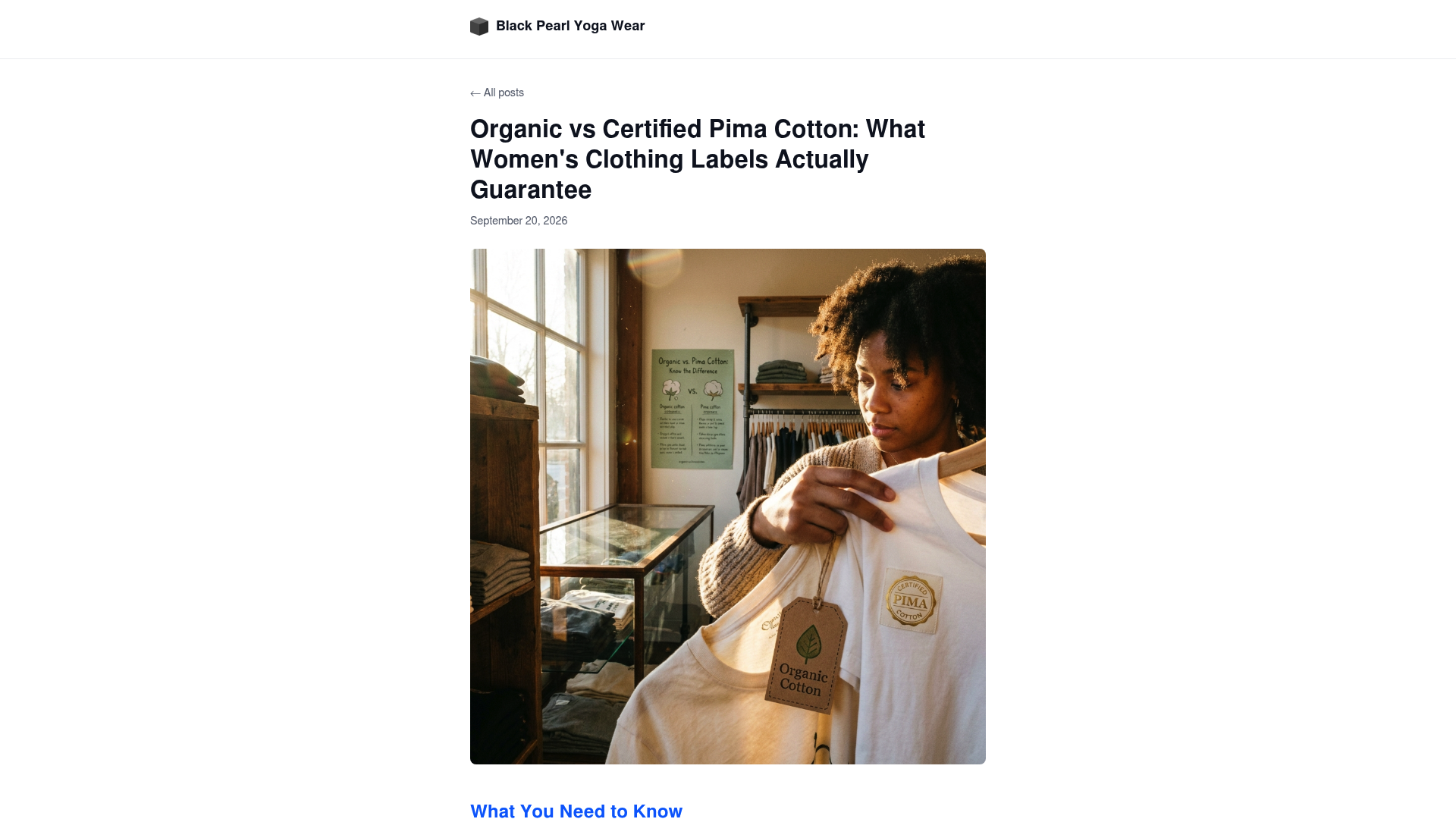
If you're weighing Peruvian Pima cotton against certified organic cotton, ask what the label is actually proving. Pima is a fiber type known for long-staple softness, but "Pima" alone doesn't tell you how it was grown or processed. Certified organic Pima cotton with GOTS processing gives you both the hand feel and the verified environmental and labor standards. That certification is what closes the gap between the fiber's reputation and the supply chain's actual practices.
Fabric fundamentals: from Peruvian Pima cotton to blends
Flip a legging inside out and you'll often see something like "95% organic cotton, 5% elastane." That's the central compromise in organic athleisure. Pure certified Peruvian Pima cotton feels cloud-soft and breathes beautifully, but it won't stretch. The moment a brand adds performance like recovery at the knees or four-way stretch for a vinyasa flow, it's blending in synthetics, even if the label says organic.
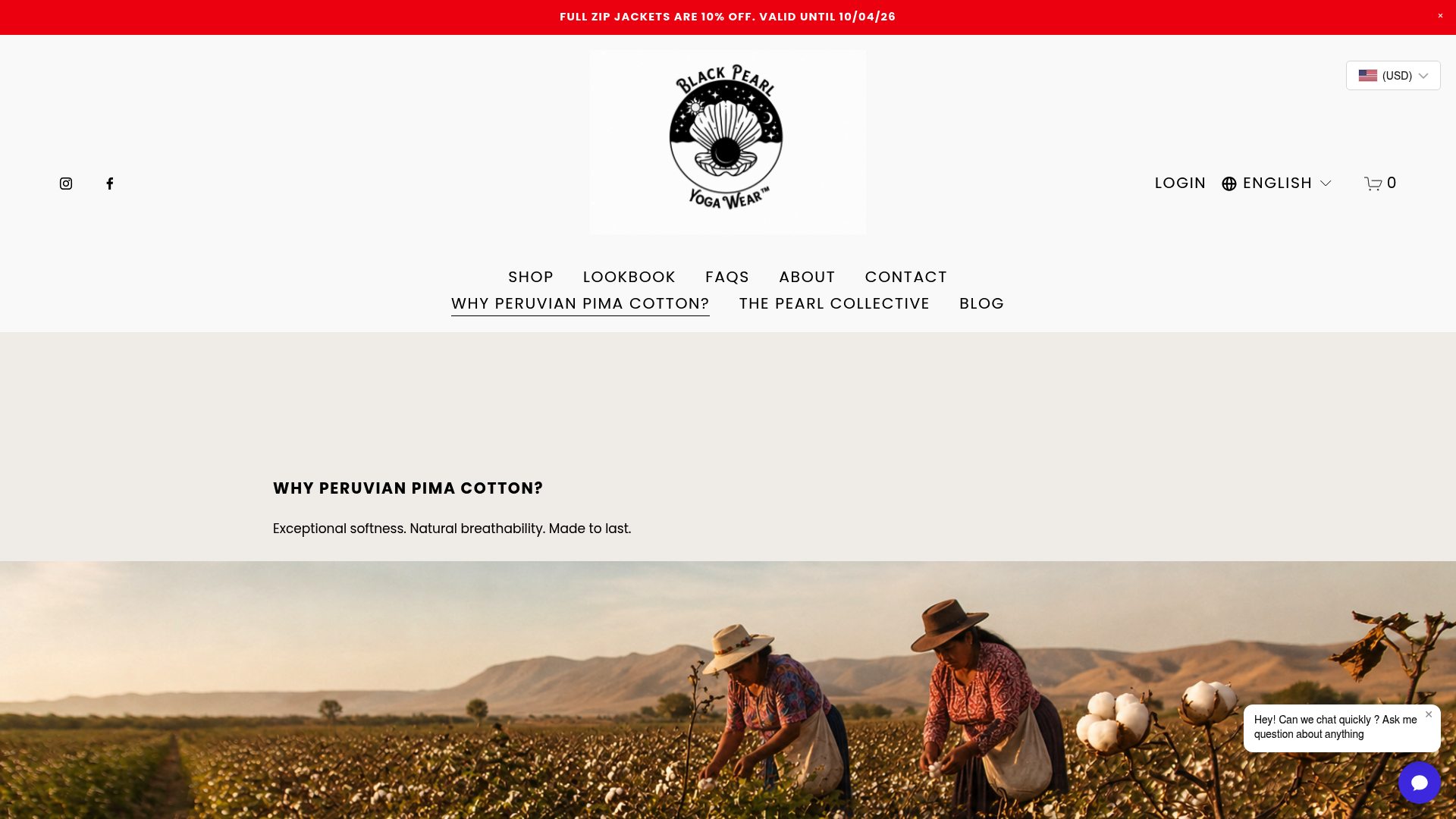
A useful fabric check separates three claims that often get collapsed into one: how the crop was grown, how the textile was processed, and how the finished piece performs on your body. A product can be strong on one and weak on another. The best habit is to pair certification review with the plain fiber-content tag.
What certification labels actually verify
-
Check for dual support: processing certification plus fiber-origin detail. Look for farm-level language alongside textile-chain certification so the brand isn't relying on one logo to do all the work.
-
Verify OEKO-TEX STANDARD 100 testing without overreading it. It examines the finished good, but it is still a compliance standard with defined test criteria.
-
Confirm which garment components the certification covers. A certified organic tank top can still carry conventionally produced elastics and synthetic ink without much explanation on the hangtag.
The stretch trade-off in pure organic cotton
Peruvian Pima cotton's extra-long staple gives you durability and a silky drape. It doesn't give you elastic recovery. That's why even certified organic leggings usually include a performance fiber for compression and bounce-back.
-
Look for minimal elastane in certified pieces. Natural-fiber activewear brands keep synthetic content low. Higher percentages tip into conventional performance-blend territory where the natural fiber becomes the minority story.
-
Know cotton's moisture behavior before buying for hot yoga. Organic cotton absorbs moisture readily. That sounds appealing until you're in a heated vinyasa class. Cotton holds moisture rather than wicking it away, so it works better for moderate-intensity sessions than high-sweat HIIT.
-
Merino wool blends offer odor resistance without synthetics. Merino is naturally odor-resistant, thermoregulating, and moisture-wicking without the itch factor. You'll pay more per piece.
Reading fabric content for hidden synthetics
The fine print tells you where a brand compromises the organic claim for performance you might not need.
-
Flag "recycled polyester" additions in otherwise organic blends. Some regenerative-certified products blend recycled synthetics with natural fibers and still earn sustainability badges. Recycled polyester fibers can break down more easily and may release more chemicals during sweaty wear than virgin synthetics. That creates a health-versus-landfill trade-off.
-
Avoid "superwash" merino wool if you're choosing natural fibers for chemical avoidance. Superwash treatment coats wool with synthetic polymers to remove its natural scales. That reintroduces the plastic layer you were trying to avoid.
-
Test stretch and recovery at home before cutting tags. Pull the fabric across the widest part of the garment and hold for 10 seconds. If it stays stretched after release, the elastane content is too low or degraded. The piece will bag out after a few wears no matter how certified the cotton is.
Labor & ethical production: fair practices checklist
Labor is the hardest part of organic athleisure to verify online. A fiber label tells you content. A certification logo can send you to a database. Working conditions often sit behind private supplier contracts unless the brand chooses to disclose them.
Start with concrete signals. Fair Trade Cotton certification, GOTS social criteria, a published supplier list, and clear factory-location information are stronger than broad promises about ethical production. The more specific the brand is, the easier it is to tell real accountability from values-based copywriting.
A good labor page should answer practical questions: where the garment was cut and sewn, whether the brand has long-term factory relationships, who audits the facility, and whether workers handling dyes, finishes, or raw cotton are protected from hazardous exposure. If the page only says "made responsibly" without naming a standard, that's not enough to verify.
Traceability matters because cotton changes hands several times before it becomes a sports bra, tank, or legging. Farm, gin, spinner, dyer, mill, cut-and-sew facility, warehouse. Every handoff creates room for the claim to weaken. Certifications and supplier maps help close those gaps because they show the brand knows its chain beyond the final factory.
Small brands may not have polished supplier maps, but they should still be able to answer direct questions. Ask where the cotton is grown, where the fabric is knitted or woven, where the garment is sewn, and which certification covers each step. A credible brand won't treat those questions as inconvenient.
The red flags stay familiar: no factory locations, no certifying body, no license numbers, no explanation of worker protections, and no willingness to identify manufacturing partners. Ethical production is not proved by warm language. It's proved by documentation, traceability, and the ability to show how claims survive each stage of production.
Environmental footprint: from seed to laundry to compost
When you pull on a pair of certified Peruvian Pima leggings, you're wearing water, energy, shipping miles, and eventually a question about what comes next. The environmental story doesn't stop at the farm gate. It spans the full arc from seed to disposal.
Water use and chemical runoff: where certified Pima earns its keep
Organic farming skips synthetic pesticides and fertilizers. That reduces chemical runoff and protects farmworkers. It also means lower residue against your skin.
The trade-off: Peruvian Pima cotton grows in water-intensive coastal valleys. Some brands address this by sourcing from farms with drip irrigation or rainwater capture. Transparency varies. If a brand claims low-water Pima without naming the farm or showing you a certification license number, treat it as marketing.
Synthetic activewear avoids farm-level water use because polyester comes from petroleum. But polyester production carries its own burdens: wastewater from manufacturing, dye chemistry, and dependence on fossil-fuel feedstocks. Certified Pima cotton never touches that petroleum supply chain.
Carbon footprint and shipping: the Peru-to-US question
Peruvian Pima cotton travels thousands of miles before it reaches your closet. That distance carries a carbon cost. Sea freight, the standard mode for garments moving from South America to the U.S. or EU, is slower and less carbon-intensive than air cargo. But it isn't zero.
Some brands consolidate shipments, choose sea freight over air, or manufacture closer to the fiber source. If a brand doesn't say where it manufactures, assume the fabric crosses multiple borders before reaching you. That's not automatically wrong, but it's a variable worth knowing.
The carbon payoff tends to come later. Organic methods build soil organic matter rather than depleting it with synthetic inputs, which supports carbon sequestration over time. Over a garment's full life cycle, natural fiber's lower manufacturing emissions and biodegradability can outweigh the shipping penalty. But only if you keep the piece long enough to spread that footprint across years of wear.
Microplastic shedding: the synthetic blend trade-off
Many athleisure pieces blend natural fiber with elastane for stretch. Elastane is synthetic. Every wash of leggings with synthetic stretch can release plastic-based fibers into the water supply. These particles are often too small for most wastewater treatment plants to catch, and they accumulate in waterways and ecosystems over time.
The proportion matters. A mostly natural-fiber legging with a small amount of stretch is not the same environmental bet as a fully synthetic polyester-nylon blend. Higher synthetic content generally means more potential shedding, more petroleum-derived material against the skin, and less straightforward disposal.
Some brands use natural rubber instead of elastane, or knit structures that provide mechanical stretch without synthetic fiber. These pieces shed zero microplastics, but the trade-off shows up in durability and recovery. Natural rubber degrades faster under repeated stretching, and mechanical stretch fabrics can lose shape after heavy use. You'll replace them more often, which shifts the environmental cost back to production.
If you choose a blend, use a microfiber-catching wash bag or a filter on your machine. Skip fabric softener. It coats fibers and accelerates breakdown, which can increase particle release with every wash.
End-of-life options: take-back programs and natural fiber disposal
When your certified Pima athleisure finally wears out, natural fibers have real end-of-life advantages. Cotton is biodegradable. Pieces made mostly from cotton can be composted or broken down more readily than synthetics, though any synthetic trim or elastic should be removed first. Synthetic activewear resists biological breakdown and sheds microplastics as it sits in a landfill.
Some brands offer take-back programs. If a brand advertises one, check whether they recycle the garments themselves or partner with a third-party textile recycler that may downcycle fibers into insulation or rags. True circularity, turning old leggings into new leggings, remains rare and expensive for natural-fiber blends because separating elastane from cotton requires chemical processing that cancels out some of the environmental benefit.
Your best end-of-life move is to buy fewer, higher-quality pieces that last long enough to justify their production footprint. A well-made natural-fiber sports bra worn consistently over years has a meaningfully lower per-wear environmental cost than a cheaper synthetic piece worn a handful of times and tossed.
Washing practices that extend garment life and reduce impact
- Wash certified Pima cotton athleisure in cold water to preserve fiber strength and reduce energy use. Hot water weakens cotton faster.
- Air-dry pieces instead of using a dryer. Heat shrinks natural fibers and uses a lot of energy.
- Wash every 2 to 3 wears instead of after every single workout. Certified Pima's breathable long-staple fiber handles light wear well.
- Use a microfiber-catching wash bag or install a filter on your washing machine to capture synthetic particles before they enter waterways.
- Skip fabric softener. It coats fibers, accelerates breakdown, and reduces the moisture-wicking performance of natural fabrics.
The real environmental payoff from certified Pima athleisure comes from wearing it longer, washing it less, and disposing of it thoughtfully. Certification gets you past the farm gate. What you do after that determines whether the footprint was worth it.
References
[1] I Tried The Best Sustainable Activewear Brands For 2026 - https://www.thegoodtrade.com/features/best-sustainable-activewear/
[2] MATE the Label | Dress Clean® - https://matethelabel.com/?srsltid=AU7gw4WAJd0sgF1tm-DoSo6TOz_89JLEmIlw5aG4KuREMNSD2q1IggLz
[3] My Top 7 Natural Material Activewear Brands | The Hidden Problems With ... - https://www.worldchangerco.com/post/my-top-6-natural-material-activewear-brands-the-hidden-problems-with-polyester-activewear
[4] 13 Plastic-Free, Natural Activewear Brands That Are Sustainable - Ecocult - https://ecocult.com/plastic-free-sustainable-activewear-natural-fibers-organic/
[5] Organic Activewear: The Complete Guide - Wayve Wear - https://wayvewear.com/blogs/read-our-blog/organic-activewear-guide?srsltid=AU7gw4W898B4TRZX5AxSC-aEi6cd1F9uyWV6kKwU-o-fzHdtDVAbqXes
[6] Certified Suppliers Database - Global Standards - https://global-standards.org/suppliers/certified-suppliers
[7] Can You Show Me Your GOTS Organic Certification? - https://help.avocadogreenmattress.com/en/articles/4649975-can-you-show-me-your-gots-organic-certification
[8] A Complete Guide to GOTS: Everything You Need to Know - https://vottera.com/blogs/news/what-is-gots-complete-guide?srsltid=AU7gw4VAXYetNBys3yHqQOdbmpd7KvYq78jX3XW9G6oaIokPe4AKdAvf
[9] What Is GOTS Certified? Meaning & How to Verify - Q for Quinn - https://www.qforquinn.com/blogs/news/what-is-gots-certified-organic-cotton-anyway-and-why-buy-into-it?srsltid=AU7gw4WyiaFKUq1m-dU4z5xCWaK_P538p8SdT_8l5f54EIB92CJdXMd1
[10] OEKO-TEX® Label Check - https://www.oeko-tex.com/en/label-check/
[11] The Best Natural & Plastic Free Activewear Brands 2026 - Bottlecup - https://bottlecup.com/blogs/news/the-best-natural-plastic-free-activewear-brands?srsltid=AU7gw4WRAJC8RVCBX7vj8uiMRGXz-weJDnk8i4vURC5pyVa1Bn8F6GYD
[12] Textile Certifications Overview - PERFORMANCE DAYS - https://www.performancedays.com/loop/trends-forum/focus-topic/2025-03-certifications-which-ones-matter/certifications-overview.html
[13] Sustainable Fashion and Apparel Design: Standards | Certificates - https://guides.library.cornell.edu/c.php?g=662121&p=5277662
Common Questions
Can I trust a garment that only has a GOTS logo but no other organic certification?
Trust it only after you verify what the logo covers. Search the license number, read the certificate scope, and look for separate language about the cotton's farm-level organic status. If the brand will not show the certificate or explain the fiber origin, the logo is not enough.
Does OEKO-TEX STANDARD 100 guarantee my activewear is completely PFAS-free?
No. It is a strong finished-garment safety screen, but it is not an absolute forever-chemical absence guarantee. Use OEKO-TEX as one important filter, then also check whether the brand avoids water-repellent, stain-resistant, antimicrobial, or other performance finishes that could add chemistry you do not need.
Why does organic cotton activewear feel rougher than I expected?
Because "organic" describes farming, not hand-feel. Softness comes from fiber quality, yarn construction, knit structure, and finishing. If you want a smoother garment, look for a named long-staple cotton such as Pima or Supima, then confirm the environmental and labor claims separately.
If I buy Fair Trade certified athleisure, does my money actually reach the farmer?
Fair Trade is one of the stronger signs that the crop-level transaction was audited, but it still works best when paired with traceability. Look for the Fair Trade mark, then check whether the brand can show where the cotton was grown, where it was processed, and how the finished garment stayed connected to that certified supply chain.
Will natural-fiber activewear work for high-intensity workouts in humid climates?
Sometimes, but cotton is usually better for lower- to moderate-sweat movement than for humid, high-output training. For hotter sessions, compare cotton with merino or other natural-fiber blends and read reviews from people using the garment for the same activity you plan to do.
How do I know if a GOTS logo applies to the whole garment or just one part?
Do not rely on the logo alone. Search the license number in the public database and read the listed product scope. You want the finished garment or relevant textile product identified clearly, not just a supplier, fabric, trim, or removable component.