Organic vs Certified Pima Cotton: What Women's Clothing Labels Actually Guarantee
September 20, 2026
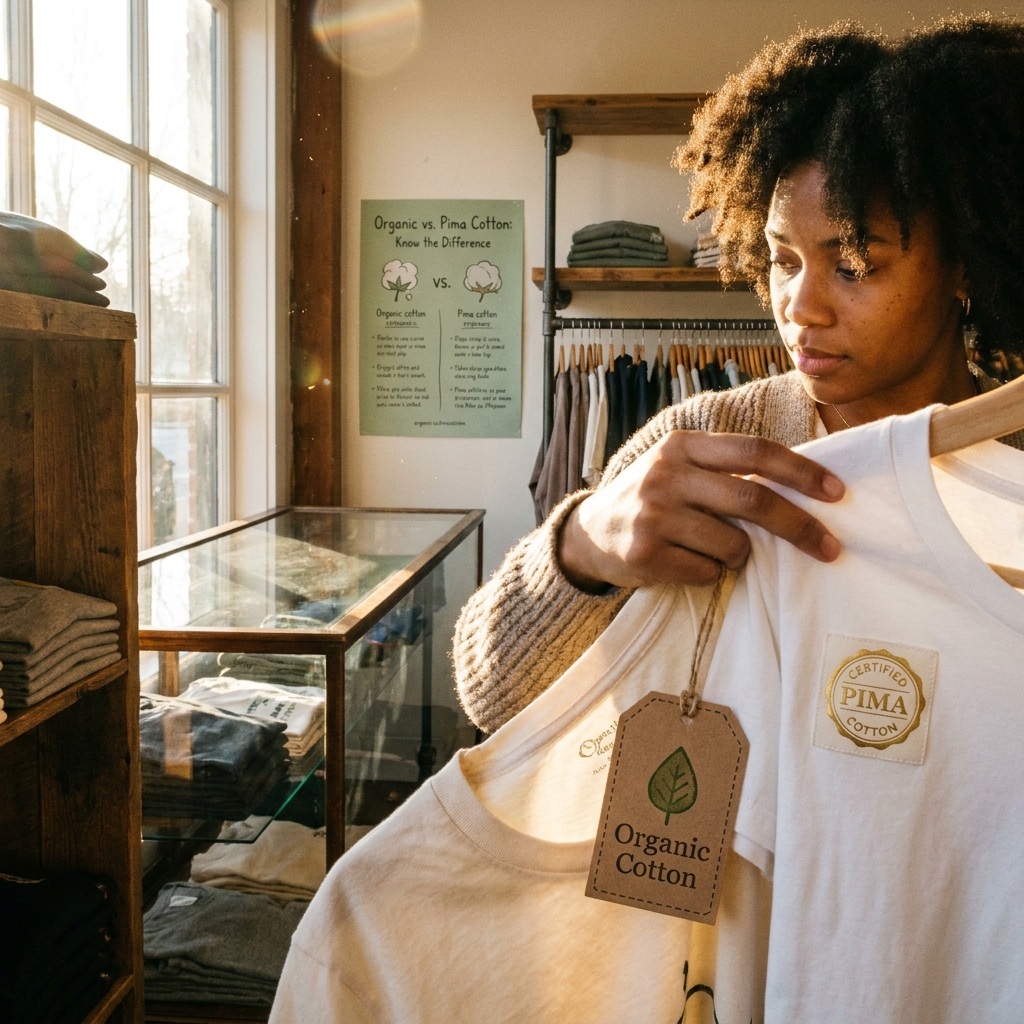
What You Need to Know
Organic cotton is under 1% of global production. Organic pima is even rarer, with yields about 28% below conventional per bale. GOTS requires third-party verification through processing. Organic cotton is usually short-staple, so it feels rougher, nubbier, and wears out faster than long-staple fiber. Black Pearl's pieces are made in Peru from 100% certified Peruvian Pima cotton, whose softness comes from long staple length. A Better Cotton logo signals only a brand's sourcing commitment. It breaks the physical link between the finished garment and the grower.
Read the certification, not just the word "organic"
An organic label tells you how the fiber was grown. It says nothing about how the garment feels. It also says nothing about whether your money reached the woman who farmed it. That gap matters when you shop for pima cotton activewear for women, because "organic" and "soft" are two separate promises. Most shoppers fold them into one.
So my advice up front: don't buy the word. Buy the standard behind it. Softness comes from staple length, not organic status. Farmer impact comes from traceability, not a feel-good badge. Certified Peruvian Pima cotton, the fiber in Black Pearl's pieces, earns its hand-feel from long, smooth strands. The certification is what confirms it. A bare "sustainable cotton" claim with no named standard guarantees you almost nothing.
What the major organic cotton certifications actually require
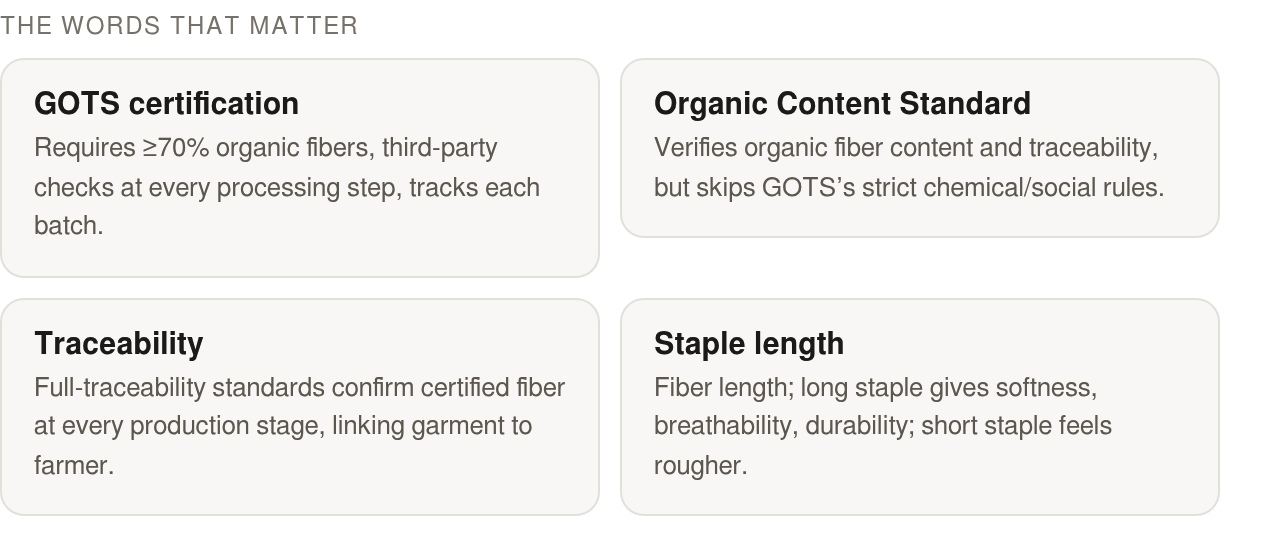
The big three work at different levels. GOTS covers the whole supply chain and requires verification by an independent third-party certifier, as PERFORMANCE DAYS lays out. The Organic Content Standard verifies organic content and traceability but skips the strict chemical and social processing rules GOTS enforces.
That distinction is the whole game. As FashionUnited notes, OCS provides third-party verification of organic material, while a Better Cotton logo only means you bought a majority-cotton product from a brand committed to sourcing Better Cotton. Traceability and clean processing are not the same thing.
Does an organic label mean softer cotton?
No. This is the myth I correct most often. Textile experts cited by Wirecutter's shopper guide say it plainly: organic cotton doesn't produce softer fabric. It's usually short-staple, so it feels rougher, nubbier, and wears out faster.
Organic cotton also sits at under 1% of global production, and organic pima is rarer still. Lower yields, about 28% below conventional per that same reporting, mean bigger land and water footprints per bale. Organic status alone doesn't guarantee the smallest environmental cost.
How the certification type decides who your purchase helps
For your money to actually reach the farmers who grew the fiber, a full-traceability certification that verifies content across every stage does more than a commitment-based logo that breaks the physical link between garment and grower. The empowerment loop closes tightest with the stricter standard.
| Fiber / Standard | Certification type | Softness | Breathability | Environmental claim | Grower link intact? |
|---|---|---|---|---|---|
| Black Pearl Peruvian Pima | 100% certified Pima | High (long staple) | High | Certified fiber | Yes |
| GOTS organic (short-staple) | Threshold + traceability (70%+) | Lower | Moderate | Input claim | Yes |
| OCS organic | Content + traceability | Varies | Varies | Content only | Partial |
| BCI / Better Cotton | Commitment / mass-balance | Varies | Varies | Sourcing pledge | No |
Read which certification, not just whether one exists. GOTS guarantees organic input at 70% content. Certified Peruvian Pima, like the fiber in Black Pearl's pieces, earns its softness from the long, smooth staple. And skip the "sustainable cotton" line with no named standard behind it.
Peruvian Pima: which standards track the fiber from field to cart
A certification only helps women farmers in Peru if it tracks the fiber all the way from her field to your cart. That one detail separates a real guarantee from a marketing badge. It changes how you read every label on pima cotton activewear for women.
Some certifications verify the physical content in the garment you're holding. Others verify only that a brand made a purchasing commitment somewhere upstream. Knowing which model a label uses tells you whether your money actually reached the grower.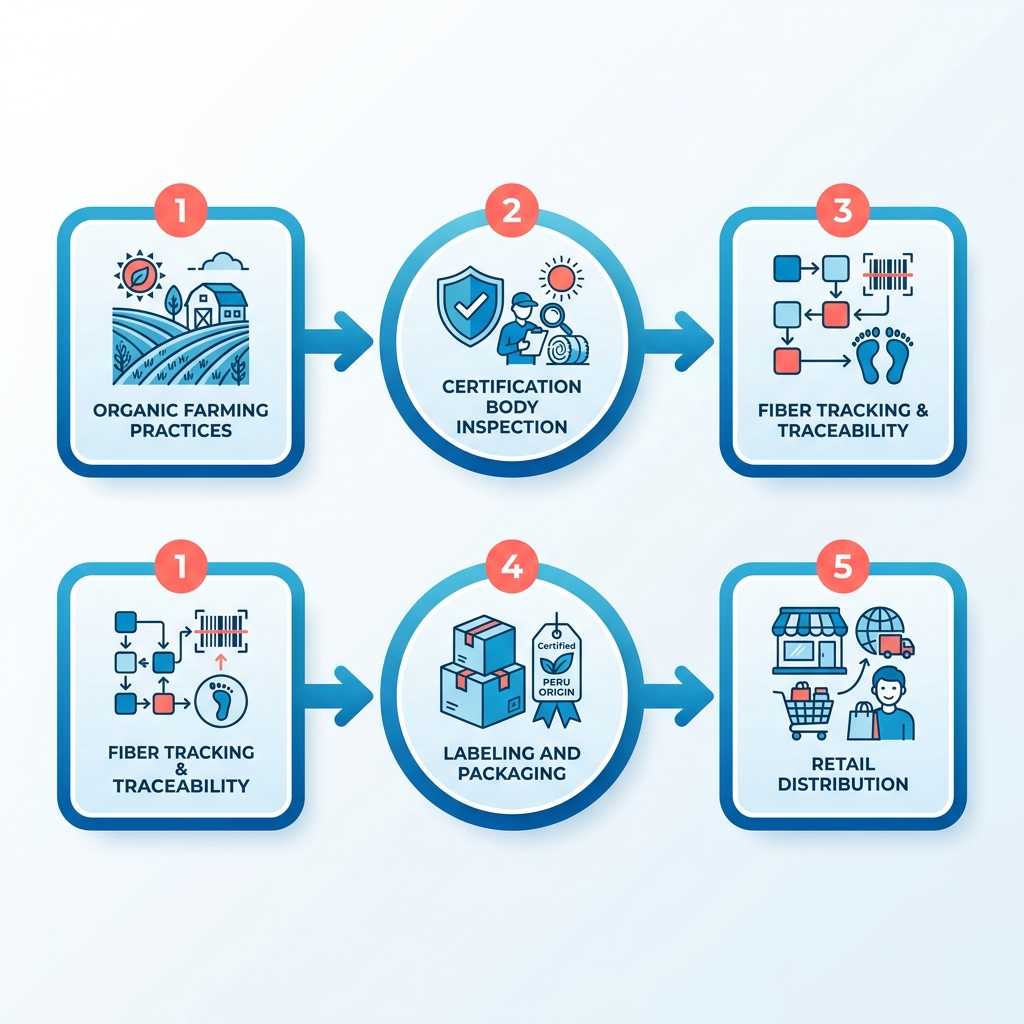
Traceability closes the loop; commitment logos don't
A full-traceability standard verifies the certified fiber at every production stage. A commitment-based logo only signals a brand's sourcing intention, so the physical link between your garment and the farmer can break.
GOTS sits at the strict end. It tracks every batch through transaction certificates and requires independent third-party verification at each processing step, from spinning to dyeing to final stitching. That documented chain of custody keeps the grower connected to the sale, so no undeclared fiber can slip in along the way.
The Better Cotton Initiative sits at the other end. As FashionUnited explains, the BCI logo doesn't mean your product physically contains traceable Better Cotton. It means you bought a majority-cotton item from a brand committed to sourcing it. Good intention, broken thread.
So the two sources look like they contradict each other on whether a label guarantees content. Both are right, depending on the model. Threshold-and-traceability standards guarantee physical content. Mass-balance and commitment schemes don't. The lesson isn't "look for a certification." It's "read which certification."
Fair Trade is the standard that reaches the woman who farmed it
For the empowerment loop to close, you need a standard built around the producer, not just the fiber. Fairtrade is that standard.
The Fairtrade Small Producer Organization model exists exclusively for small-scale producer organizations. It audits the purchase and sale of seed cotton so that everyone handling the Fairtrade Price and Premium is certified. The goal is fair prices, fair wages, and reduced poverty in farming communities.
Pair that with a traceability standard and you get both promises at once: verified fiber and verified income for the people, often women, who grew it. One certification proves the cotton is real. The other proves the payment landed where it should.
One caveat before you trust any label
Every fashion certification is voluntary. As FashionUnited notes, there's no official mandate forcing a company to verify its sustainability claims. That's why the certifying body matters as much as the word on the tag.
| Certification | Verifies physical content? | Reaches the farmer? | Best signal for |
|---|---|---|---|
| GOTS | Yes, via transaction certificates | Indirect | Verified processing chain |
| Fairtrade Cotton | Via audited seed cotton | Yes, direct to producers | Farmer income |
| Better Cotton (BCI) | No, commitment only | No physical link | Brand sourcing intent |
| OEKO-TEX Standard 100 | Tests finished goods for harmful substances | No | Chemical safety proof |
Skip the badge-only claims if farmer impact is your reason for buying. A "Pima" or "Supima" word alone tells you the fiber type, not who benefited. Look for the pairing of traceability plus Fair Trade instead.
Softness, breathability, durability, fit: it all comes down to staple length
The performance gap between organic cotton and pima has almost nothing to do with farming method. It comes down to fiber length. Line pima up against a generic organic tee and you're really comparing a long, extra-fine strand against a shorter, coarser one.
That one difference drives softness, breathability, durability, and how a piece holds its shape over time. Organic tells you how the plant was grown. It says nothing about whether the yarn will pill at the seams by month three.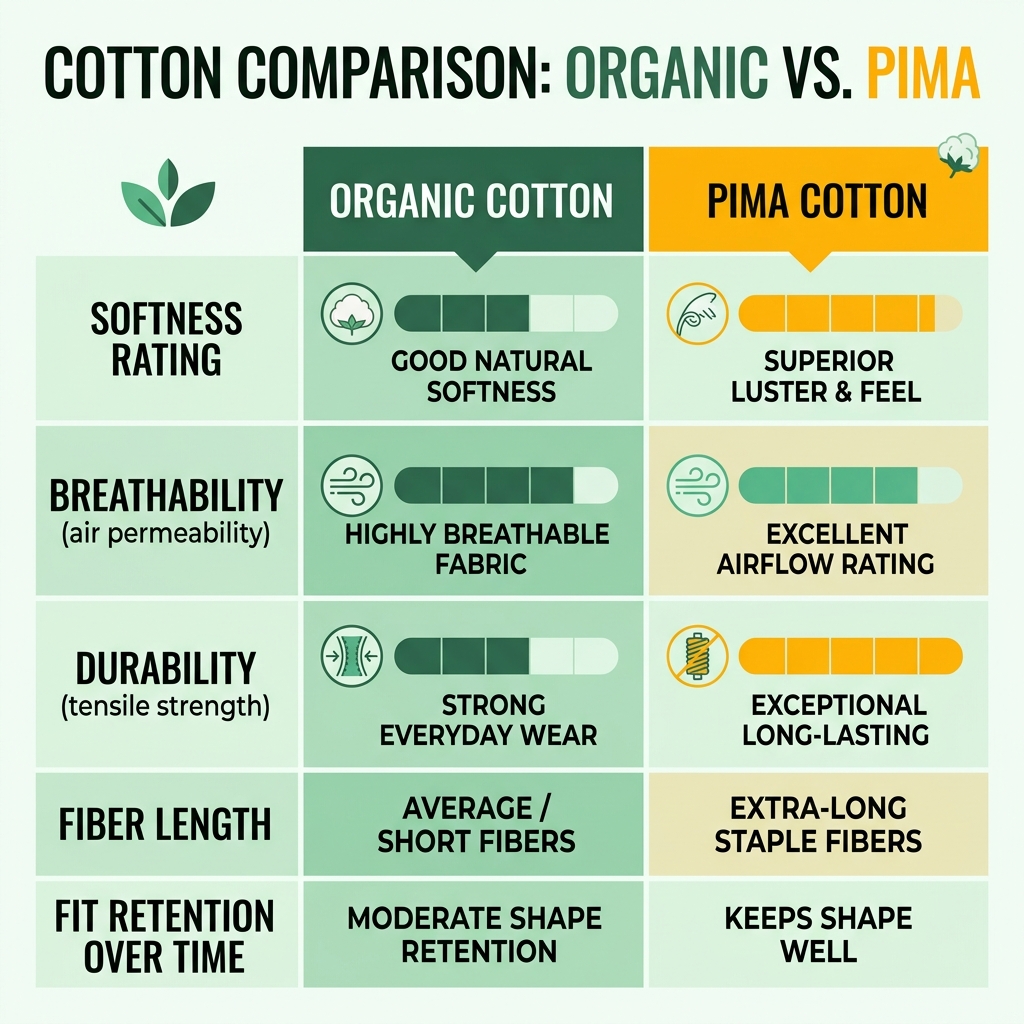
| Attribute | Generic organic cotton | Generic Pima cotton |
|---|---|---|
| Hand-feel | Often nubby, short-staple | Smooth, long-staple |
| Durability | Rougher, less durable | Stronger, more flexible |
| Breathability | Depends on knit | Fine yarn, lighter feel |
| Fit recovery | Bags faster | Holds shape |
| Abrasion resistance | Fuzzes under friction | Withstands repeated wash cycles |
Softness and durability both trace back to staple length
Extra-long staple cottons like pima spin into smoother, stronger, more flexible yarn. Textile researchers at NC State and UC Davis have been blunt on this: organic status doesn't make cotton softer, and organic fiber is often the shorter, nubbier kind. Robert Hutmacher has noted that the way growers harvest organic cotton makes long, continuous yarn harder to produce, so you feel more texture and get less durability.
Pima strands typically run around 1.4 to 2 inches versus roughly 1 inch for upland cotton. That extra half-inch is what lets the yarn twist tighter with fewer loose ends poking out of the surface.
Why fit holds up in pima cotton activewear
Finer fibers pack into a denser, lighter knit. That gives pima its breathable feel over a long hold and helps garments keep their shape and appearance. A short-staple fabric loses that recovery faster.
The tighter twist also means fewer stray fiber ends work loose during movement, so the fabric resists the fuzzing and thinning that shows up at high-friction spots like underarms and waistbands. Longer, smoother fibers keep the fabric soft and strong through repeated wear, so a piece still looks good after dozens of workouts.
Environmental & Health Footprint Comparison
An environmental footprint isn't just water and carbon. It's also who absorbs the cost of that production. When you weigh pima against a generic organic tee, the ecological math matters. So does whether the fiber is grown and finished with care.
Organic farming skips synthetic pesticides and fertilizers, which lowers chemical runoff and protects the workers handling the crop. That's a real health win, both for the soil and for anyone wearing low-residue fabric against sensitive skin. Peruvian Pima earns its own profile through exceptionally long, smooth fibers that feel soft against the skin while staying strong and breathable.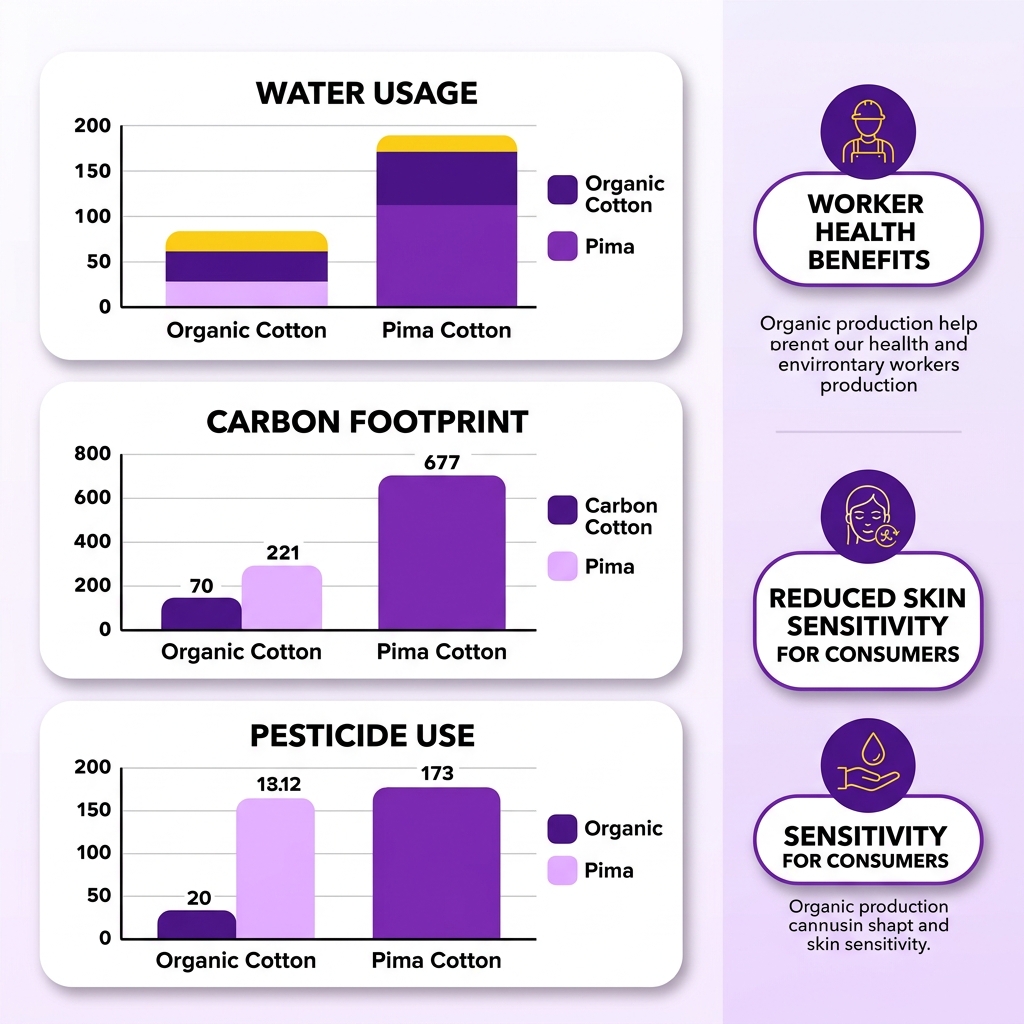
The footprint ledger both fibers are judged on
Here's how the two stack up across the measures shoppers ask about most.
| Factor | Generic organic cotton | Peruvian Pima (Black Pearl) |
|---|---|---|
| Water at finishing | Varies by mill, often unlisted | Rain-fed valley growing regions |
| End-of-life | Biodegradable in months | Biodegradable, fewer synthetic blends |
| Garment lifespan | Wears thin with washing | Long-staple resists thinning and tearing |
| Wearer health | Clean, but hand-feel varies | Durable, breathable everyday comfort |
Notice what the ledger doesn't automatically capture. A low pesticide score says nothing about the woman who picked the cotton.
Where the empowerment loop closes the footprint
A garment can be chemically clean and still leave its growers invisible. Social sustainability certifications, like Fair Trade models, exist to close that blind spot by verifying wages and working conditions, not just soil inputs.
The strongest programs go further than a single audit. They track cooperatives across seasons, guarantee floor prices that hold when markets dip, and reinvest a premium into schools, clinics, and clean water for the growing communities themselves. That continuity is what turns a one-time label into lasting change on the ground.
Skip the pure-organic label if what you actually want is fabric that feels as good as it looks. Organic tells you how the plant grew. It won't tell you how the finished garment wears. For skin comfort and a brand that supports women through community, Peruvian Pima does more of the job.
Cost, Value, and Longevity Analysis
Price tags lie about value. A cheaper organic tee that thins out by month four costs you more than a pima piece you keep for years. So the honest way to compare the two isn't the sticker. It's cost-per-wear.
Here's the math I use. Take the purchase price, divide by the number of times you actually wear the garment before it pills, sags, or loses shape. A fabric that survives more wash cycles keeps dropping that number every time you put it on.
Long-staple Peruvian Pima earns its longer life from fiber structure, not farming method. Those long, smooth strands resist the pilling and seam-fatigue that retire a short-staple organic tee early. That durability is where the money argument turns.
How cost-per-wear changes the value math
Two tops, similar price. One frays and gets demoted to the laundry pile after 20 wears. The other holds its shape past 100. The second one costs a fifth as much per wear, even if it rang up higher at checkout.
Run the numbers on a $60 top and the gap gets concrete. Retire it at 20 wears and each wear ran you $3. Stretch the same $60 across 120 wears and you're down to $0.50 a wear. Over a three-year rotation, that difference stacks up fast, especially once you factor in the replacements you skip.
| Wears reached | $60 top: cost-per-wear | Replacements needed |
|---|---|---|
| 20 | $3.00 | Buy 3-4 per year |
| 60 | $1.00 | Buy 1 per year |
| 120+ | Under $0.50 | Buy once, wear for years |
What the premium actually buys
The premium isn't only about the cloth in your hand today. It's the extra-long, smooth fibers and careful hand harvesting that keep a garment soft, strong, and pill-resistant, so the value keeps working long after the piece leaves the shelf.
Skip the premium if you only need a throwaway piece for one season. Fair enough. But if you want something you'll wear for years, the longer lifespan and the quality of the fiber make the higher price the cheaper choice over time.
Buy fewer, wear longer, and keep a piece that holds its shape and color. That's the loop.
How to shop, care for, and spot real pima at Black Pearl
Two shoppers can hold the same certified garment and walk away with very different outcomes. One reads the label and confirms the fiber. The other trusts the price tag. That habit of checking is what protects both your money and the woman who grew the crop.
So here's the practical part. Verifying a label online or in-store comes down to a short routine.
How to verify a pima cotton activewear label before you buy
Beyond the fiber content itself, look at what the label doesn't hide. Check for a batch or lot number, which signals a brand that tracks production runs rather than blending anonymous stock. Scan for a country-of-origin statement placed near the fiber content, not buried in the fine print. And weigh the garment in your hands if you can. Genuine long-staple pieces feel denser than their thickness suggests, because the fibers pack tighter without added bulk.
If a listing leans entirely on lifestyle photos and buzzwords, treat that as a gap. A seller confident in the material tends to say more about it, not less.
The right way to care for pima cotton
Long-staple cotton rewards gentle handling. Wash cold, skip the hot dryer, and fold rather than hang to hold the shape. High heat is the fastest way to shorten the life of any cotton garment, pima included.
| Care step | Organic cotton | Certified Peruvian Pima |
|---|---|---|
| Wash temp | Cold to warm | Cold |
| Drying | Low heat or air | Air dry preferred |
| Storage | Fold | Fold, avoid hangers |
| Pilling risk | Higher (short-staple) | Lower (long-staple) |
Where I think our line stands out is the pairing of that verified fiber with versatile design. Our tops, bottoms, and jackets are priced for everyday wear, so a piece moves from yoga to errands without a second thought.
Skip us if you want cheap, disposable basics. That's not what we make. If you want fewer garments that last, with softness you can feel and quality you can keep, that's the trade we build around.
References
[1] Is Organic Cotton Really Better? A Shopper's Guide | Wirecutter - https://www.nytimes.com/wirecutter/blog/is-organic-cotton-better-for-the-environment/
[2] Textile Certifications Overview - PERFORMANCE DAYS - https://www.performancedays.com/loop/trends-forum/focus-topic/2025-03-certifications-which-ones-matter/certifications-overview.html
[3] Sustainability Certification Organizations in the Fashion Industry - https://fashionunited.com/i/sustainability-certification-organizations-in-fashion
Frequently Asked Questions
1. Can a single garment be both certified organic and Pima cotton?
In principle, yes. But it's rare because most organic cotton is short-staple, while Pima earns its reputation from long, extra-fine strands. Organic status describes how the plant was grown. Pima describes fiber length. A label pairing traceable Pima with a social standard like Fairtrade tells you more than organic alone about both feel and grower impact.
2. I have sensitive skin. Does organic cotton beat Pima for comfort?
Not automatically. Organic farming skips synthetic pesticides, which lowers chemical residue and helps sensitive skin. But comfort against the body also depends on hand-feel, and short-staple organic cotton often feels rougher and nubbier. Long-staple Peruvian Pima stays smooth, breathable, and durable. For low-residue reassurance plus soft wear, look for chemical-safety proof like OEKO-TEX alongside a long-staple fiber.
3. Is a "Better Cotton" logo worthless if I care about the farmer?
For farmer impact, it does little. A Better Cotton logo signals a brand's sourcing commitment, not that your specific garment physically contains traceable Better Cotton, so the link between finished item and grower breaks. It still reflects broader sourcing intent. If reaching the woman who farmed the crop is your goal, choose Fairtrade paired with a traceability standard instead.
4. What's the difference between seeing "Pima" and seeing "certified Pima" on a tag?
The word "Pima" or "Supima" alone tells you the fiber type, nothing about verification or who benefited. Certified Peruvian Pima, like the fiber in Black Pearl's pieces, confirms the long-staple cotton behind that softness through a documented standard. Treat a bare fiber name as a description, not a guarantee, and look for a named certification plus batch tracking.
5. How can I spot a fake or vague "sustainable cotton" claim while shopping?
A "sustainable cotton" claim with no named standard guarantees almost nothing. Check for a specific certification, a batch or lot number showing the brand tracks production runs, and a country-of-origin statement near the fiber content rather than buried in fine print. Listings that lean only on lifestyle photos and buzzwords signal a gap. Confident sellers say more about the material, not less.
6. My cotton tops keep pilling at the underarms. Is that a farming problem?
No, it traces to fiber length, not farming method. Short-staple cotton has more loose fiber ends that work free during movement, so friction spots like underarms and waistbands fuzz and thin faster. Long-staple Pima twists into tighter yarn with fewer stray ends, resisting pilling through repeated wash cycles. Gentle care helps, but staple length sets the ceiling on durability.
7. Will washing Pima like regular cotton ruin it?
High heat is the fastest way to shorten any cotton garment's life, Pima included. Wash cold, skip the hot dryer in favor of air drying, and fold rather than hang to hold shape. Long-staple cotton rewards gentle handling and already resists pilling better than short-staple organic fabric, so proper care lets that durability advantage actually pay off over years of wear.
8. Is the higher price of Pima activewear ever not worth it?
If you only need a throwaway piece for one season, the premium isn't worth it, and that's an honest carve-out. The value case rests on longevity measured as cost-per-wear. A $60 top retired at 20 wears costs $3 each time; stretched past 120 wears it drops under $0.50. Black Pearl's pieces are priced for everyday wear and are built to last, not to replace yearly.