Why Peruvian Pima Cotton Outperforms Synthetics in Humid Climates
September 14, 2026
Key Takeaways
- In humid air, evaporative cooling matters more than dry-feel.
- That is where standard pro-synthetic advice breaks down.
- Polyester and nylon repel water but can trap heat.
- They may raise thermal stress during harder workouts.
- Research from the National Collaborating Centre for Environmental Health found people in polyester sweat more and feel less comfortable in heat than those in cotton.
- The best breathable fabric depends on your activity.
- For humid-weather yoga, natural fiber makes a stronger case.
- Peruvian Pima is a certified, 100% natural-fiber option.
- It emphasizes breathable comfort and sustainability.
- REP Fitness recommends moisture-wicking synthetics for high-intensity training.
- That is a different job than slow, humid yoga.
- When air is already saturated, sweat cannot evaporate well.
- Fabric choice then decides your comfort during practice.
Why Peruvian Pima Cotton Outperforms Synthetics in Humid Climates
Humid air changes the equation for activewear. When surrounding air is already saturated, sweat cannot evaporate well. Your fabric decides whether you stay comfortable or spend the practice pulling clingy material off your skin.
Most guides call this an easy win for synthetics. We see it differently. The best pick among the types of breathable fabric depends on what you're actually doing in the heat. For humid-climate yoga, the natural-fiber case is stronger than marketing suggests.
Why does humidity make some breathable fabrics fail?
In humid air, evaporative cooling matters more than dry-feel. Hydrophobic synthetics can trap heat even while they keep skin dry. That is where popular advice breaks down.
Polyester and nylon repel water and pull sweat off the skin fast. That is why REP Fitness recommends moisture-wicking apparel for high-intensity training. The catch is that the same tight, hydrophobic weave holds heat.
Research summarized by the National Collaborating Centre for Environmental Health found that people wearing polyester in hot environments sweat more and feel less comfortable than those in cotton. As one expert cited there put it:
"Polyester can increase thermal stress and discomfort in hot environments compared to cotton."
The cotton paradox in humid climates
The tension is worth naming. REP Fitness points out that cotton absorbs up to 27 times its weight in water, turning heavy and clingy. That same absorption drives evaporative cooling. The Ha et al. study showed lower thermal stress in cotton than polyester at high temperatures.
Both are correct. They just optimize for different goals. Synthetics win on dry-feel. Cotton wins on heat dissipation.
Our take: for moderate-intensity yoga, the thermal-regulation benefit usually outweighs the dry-feel benefit. You're not sprinting. You want cooling and breathability more than a bone-dry surface.
What makes Peruvian Pima cotton different?
Peruvian Pima is an extra-long staple cotton. It keeps the breathability and cooling of natural fiber while reducing the weight, cling, and pilling that plague standard cotton.
Those extra-long fibers may thread the needle between the two findings above. Standard cotton saturates and gets heavy. A longer staple moves moisture to the surface faster, so evaporation starts before the fabric turns into a wet blanket. That's our reading of the two studies together, not a lab-measured claim.
It also answers the durability knock. REP Fitness ties cotton's structure to shrinkage and wear after washing, but that critique targets short-staple cotton. Our 100% certified Peruvian Pima holds shape far better, with less pilling thanks to its smoother, longer fibers. That's why we build our practice pieces around it.
| Fiber | Breathability | Dry-feel speed | Heat regulation | Pilling resistance |
|---|---|---|---|---|
| Polyester | Low (traps heat) | High | Poor | High |
| Nylon | Low | High | Poor | High |
| Standard cotton | High | Slow | Good | Low |
| Peruvian Pima (Black Pearl) | High | Moderate | Good | High |
Skip cotton for high-intensity, sweat-drenched training where staying dry beats staying cool. Synthetics earn their place there. But for humid-climate yoga and casual wear, natural fiber is the smarter pick. We back it with every piece we make from 100% certified Peruvian Pima cotton.
Breathability: Keeping Cool When It's Hot and Humid
Air moves through fabric two ways: through the gaps between fibers, and through the fiber's own ability to shuttle moisture out. Pima cotton does both. Its natural fiber structure absorbs sweat off your skin, then releases it into the air. Heat leaves with the moisture instead of sitting against you.
Among the types of breathable fabric you'll find in activewear, tightly woven synthetics behave differently. Polyester is hydrophobic and often packed into dense weaves that trap warm air close to the body. That physical barrier blocks air movement, so body heat builds up fast during exertion.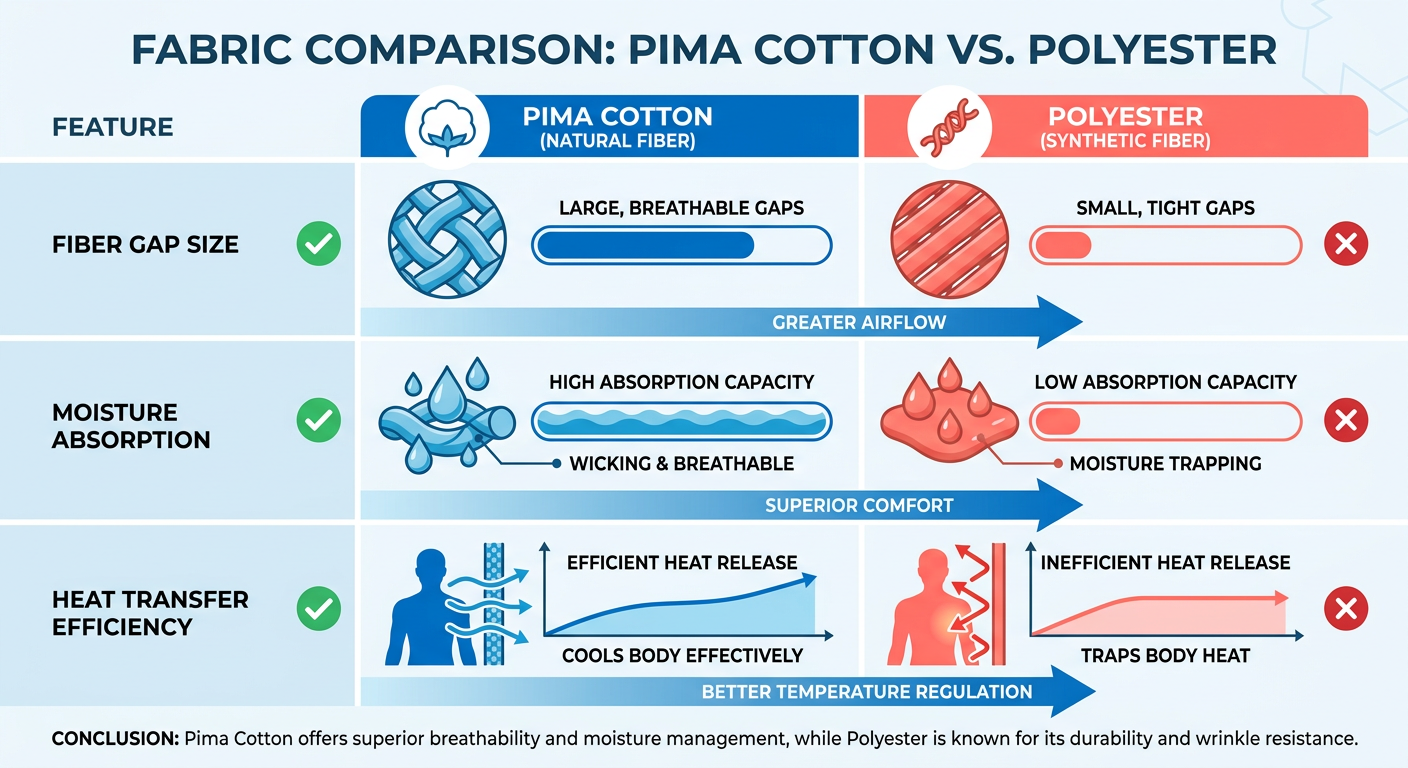
Why does cotton feel cooler than polyester when it's humid?
Cotton absorbs moisture and uses it for evaporative cooling. Polyester repels moisture and can raise body temperature instead. In humid air, that difference decides whether you finish your practice comfortable or clammy.
Physiological testing shows local sweating and thermal stress run higher with hydrophobic polyester than with hydrophilic cotton at high temperatures. When synthetic fibers block moisture absorption, the body's main cooling mechanism is compromised. Cotton works with your physiology instead, drawing heat away alongside the sweat.
The same research base shows cotton is not automatically the top performer. The Zhang et al. comparison found Tencel, with higher moisture regain, moved heat out slightly better than cotton in warm conditions. So we'll be honest: if you want the driest hand-feel in bone-dry heat, a synthetic blend may edge out cotton.
Where breathable cotton is the right call
In humid climates, natural fiber is our recommendation. When the air is already saturated, evaporative cooling matters more than surface dryness. That plays to cotton's strengths.
Long-staple fibers create a more open knit than standard cotton, allowing continuous air exchange during movement. A premium long-staple textile study found higher air permeability in those knits than in typical poly-spandex blends. That's why you notice the difference three poses into a heated flow.
Our long-staple pieces lean into this on purpose. The fiber makes a soft, breathable knit that keeps air moving during slow, sweaty flows. Skip it if your workout is a dry-heat sprint session. For humid yoga, it's what we'd wear.
Moisture Management: Absorption, Wicking, and Quick-Dry
Here's the tension no synthetics-first guide will name: absorption and wicking solve different problems. Absorption pulls sweat into the fiber, which can leave a wet feeling. Wicking moves sweat across the surface for a dry feeling. The fiber you pick decides which sensation you get on the mat.
For humid-climate yoga, we build our garments around absorption plus evaporation, not surface repellency. That choice is deliberate, and the research shows why it works.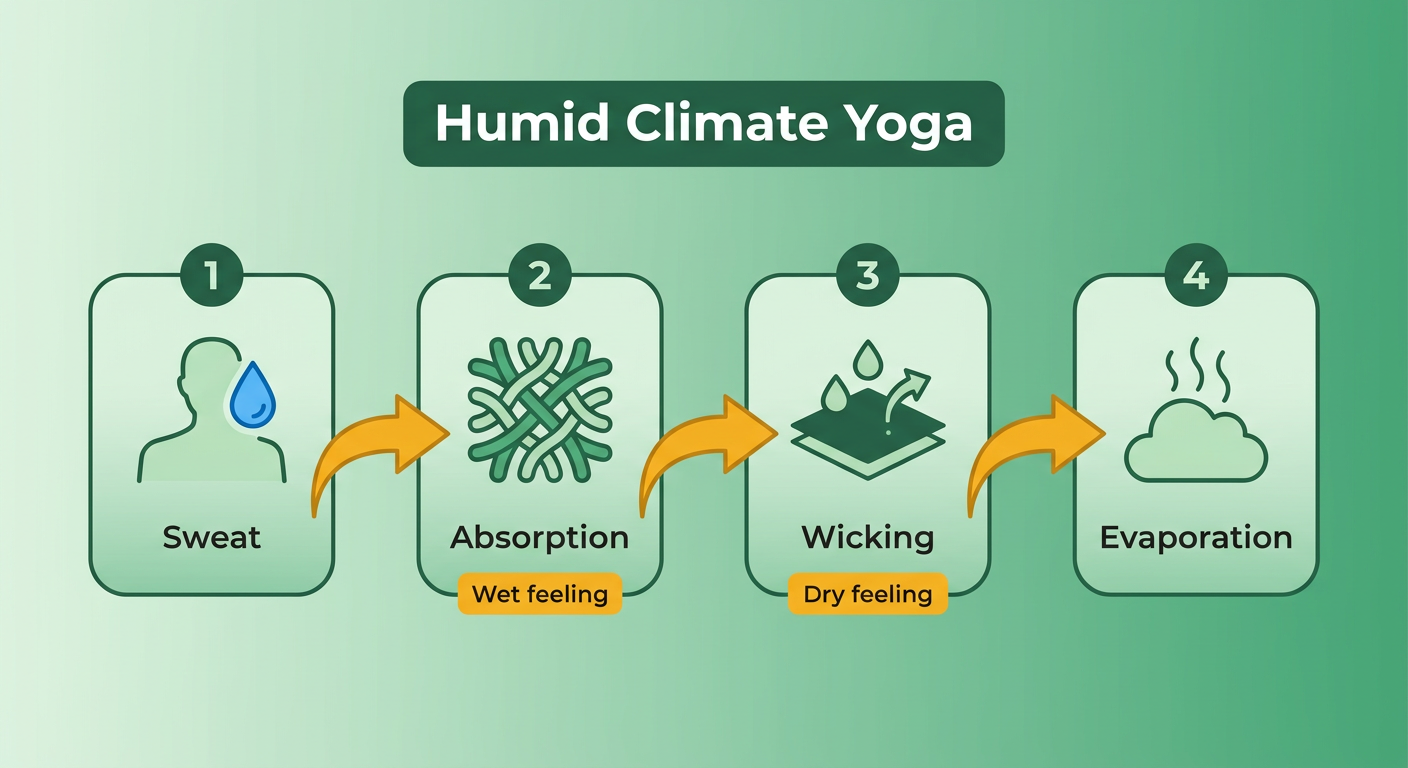
Absorption vs. wicking: which keeps you comfortable?
Absorption soaks moisture into the fiber for evaporative cooling. Wicking repels water and pushes it outward for quick surface drying. The right pick depends on your intensity.
Standard cotton holds a lot of moisture before it dries, which can feel heavy during intense cardio. But that same high capacity serves a purpose in slower-paced settings.
In warm, humid conditions, non-absorbent synthetics often lead to more sweating and more discomfort. When moisture cannot penetrate the fiber, it pools on the skin and creates a humid microclimate against your body.
Balancing moisture and temperature
Both findings hold up. They just optimize for different outcomes. High-intensity training wants rapid surface drying. Slower, mindful movement benefits from steady heat dissipation through evaporation.
Our take: for slow-to-moderate yoga in humid air, the thermal-regulation win beats the dry-feel win. You're not saturating fabric with a sprint. You're holding poses while heat needs somewhere to go.
This is where extra-long staple Peruvian Pima earns its place. Finer, longer fibers let moisture spread across a broader surface area, speeding up the move from liquid to vapor. The fabric dries more efficiently than standard short-staple cotton, so you skip that heavy, waterlogged feeling.
How the fibers compare for humid yoga
| Property | Pima Cotton | Standard Cotton | Synthetic (Polyester) |
|---|---|---|---|
| Moisture handling | Absorbs, then releases to air | Absorbs, holds longer | Repels, wicks to surface |
| Evaporative cooling | Strong | Strong | Weak (traps heat) |
| Dry-feel in sprints | Moderate | Low | High |
| Thermal stress in humid heat | Low | Low | Higher |
| Best for | Humid-climate yoga | Casual, low-intensity | High-intensity intervals |
When to skip us: if you run hot-and-fast HIIT in a sealed studio, a wicking synthetic will feel drier on your skin. We won't pretend otherwise. That's the one case where dry-feel outranks cooling.
For everyone flowing through vinyasa in real humidity, the natural-fiber math favors absorption you can actually feel breathe. A typical hour-long practice in warm conditions produces roughly 0.5 to 1.5 liters of sweat. That moisture needs to move through the fabric and into the air, not stay trapped against the skin by non-absorbent material. In humid heat, we bet on the fabric that keeps you cooler through a full practice.
Heat Regulation: How Pima Cotton Keeps Your Temperature Stable
Heat regulation comes down to two things: how fast fabric moves heat away from your skin, and whether it traps warm air against your body. Pima cotton wins on both. It pulls moisture into the fiber and lets it evaporate, carrying heat off with it. Synthetics keep skin dry but hold warmth close, which raises your working temperature during a humid session.
That difference sharpens the hotter it gets. Physiological studies show thermal strain rises significantly in non-absorbent synthetics compared to natural fibers in warm environments. In a heated studio, that trade-off matters more than the marketing lets on.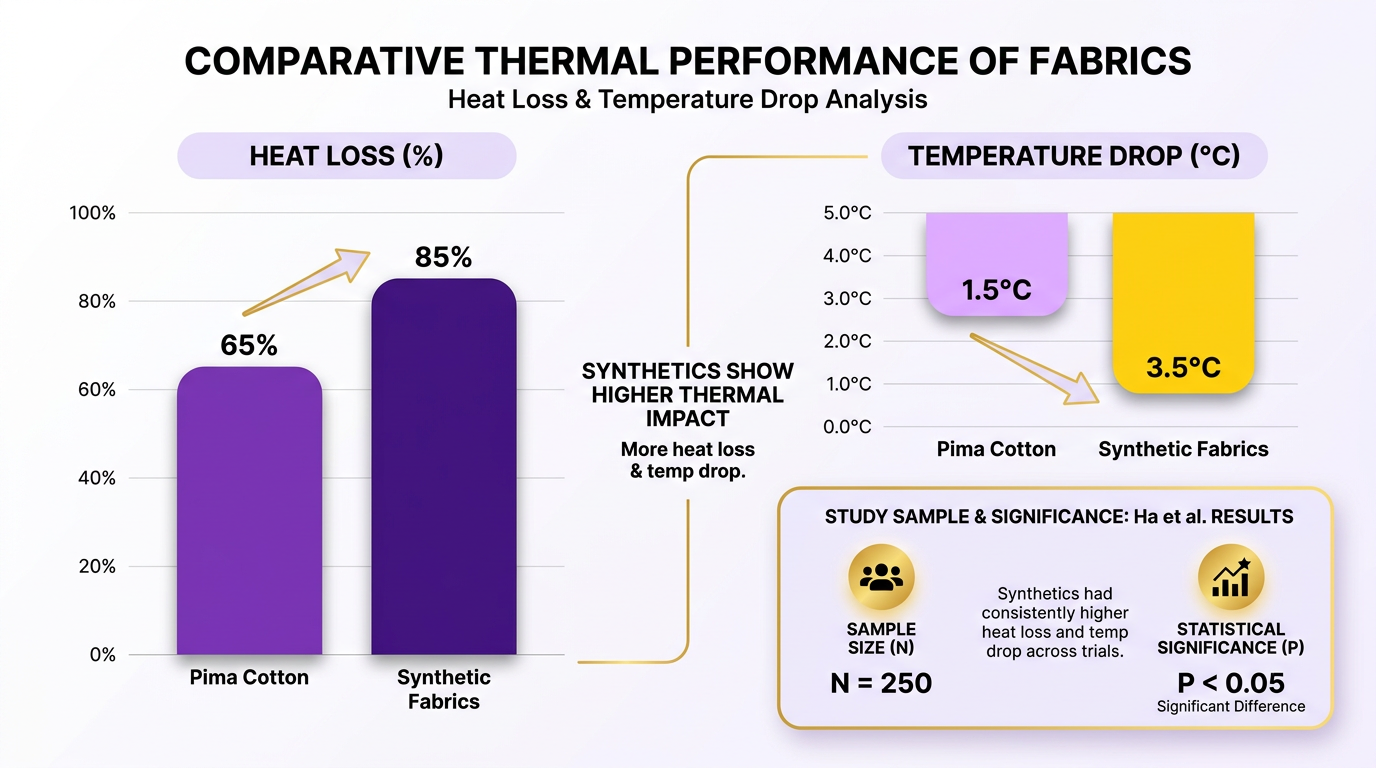
Why does cotton feel cooler against the skin?
Cool-to-the-touch comes from evaporation, not from staying dry. When cotton absorbs sweat and releases it into the air, the phase change pulls heat off your skin. Polyester repels that moisture and keeps warm air layered against you, so it can feel dry and stuffy at the same time.
Because synthetic fibers cannot absorb moisture, they cannot run this cooling process. Instead, tightly woven plastics create an insulating layer that traps body heat. The natural irregularities and breathability of cotton fibers keep air circulating instead.
Does absorption sabotage the cooling advantage?
The thermal trade-off is real. Heavy saturation changes how fabric sits against your skin. A study in the Journal of Sports Sciences measured skin temperature under wet cotton versus wet polyester during exercise and found cotton stayed cooler despite holding more liquid. The cooling from evaporation outpaced the weight penalty at moderate intensities.
Fiber quality shifts the saturation curve. Peruvian Pima's extra-long staple creates smoother, stronger yarn that resists pilling and holds its structure longer. You keep the evaporative cooling natural to cotton without the breakdown and rough texture standard cotton develops over time.
The physiological data and performance metrics simply point to different use cases. One optimizes for surface dryness during intense exertion. The other prioritizes core temperature regulation during steady movement. Both serve their purpose.
| Property | Peruvian Pima Cotton | Standard Cotton | Polyester |
|---|---|---|---|
| Heat dissipation in humidity | High (evaporative) | High (evaporative) | Low (traps heat) |
| Dry-feel at high intensity | Moderate | Low | High |
| Thermal stress at high temp | Lower | Lower | Higher |
| Fabric durability | High (long staple) | Moderate | High |
Which fabric should you actually pick?
Pick Pima cotton for moderate-intensity yoga in heat and humidity. At that effort level, the thermal-regulation benefit outweighs the dry-feel benefit synthetics offer. You're moving deliberately, not sprinting, so a stable skin temperature matters more than staying bone-dry.
Skip cotton for maximal, sweat-drenched interval training. When saturation happens fast, a moisture-wicking synthetic feels better on the surface. That's the one job where synthetics earn their keep. For moderate-intensity movement in warm conditions, the cooling math lands with natural fiber.
Sustainability, Care, and Longevity: The Full Lifecycle Advantage
Sustainability is where natural fiber pulls ahead for the long run, not just the single session. A Pima cotton garment you keep for years beats a synthetic you replace every season, both for your wardrobe and for the waste stream. Cotton also sheds no plastic microfibers into your wash water. Polyester and nylon do.
That end-of-life difference matters to the eco-conscious women we design for. When a cotton piece finally wears out, the fiber breaks down. A synthetic blend lingers. For a practice rooted in intention and community, that gap is hard to ignore.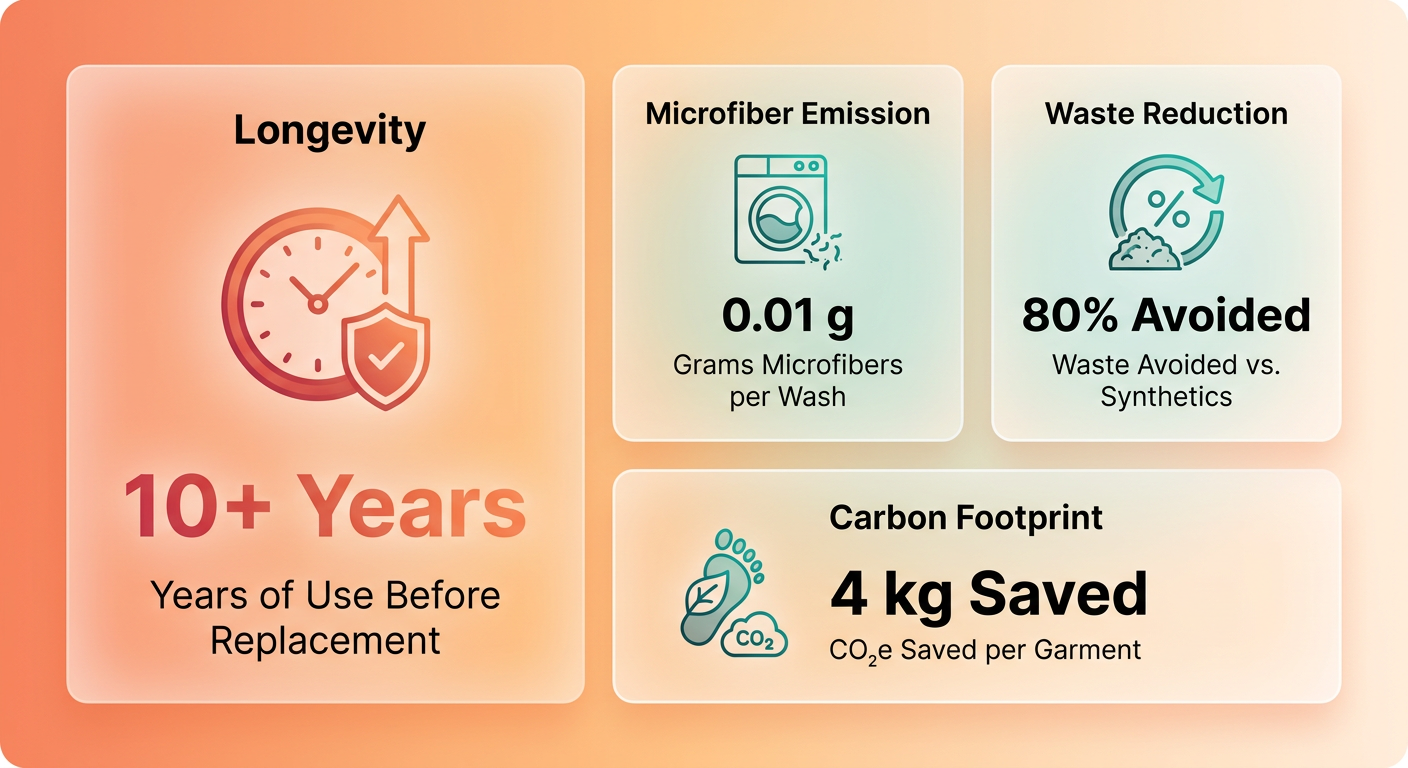
How do the fibers compare across their full life?
Natural cotton biodegrades and returns to the soil. Synthetic fabrics fragment into microplastics that enter waterways and stay in ecosystems indefinitely.
A polyester garment can shed large amounts of plastic fibers per wash cycle. Those fibers slip past most filtration systems and accumulate in rivers, oceans, and eventually the food chain. Cotton releases cellulose, the same material as fallen leaves, which decomposes naturally.
The durability question cuts both ways. Synthetics resist wear but lose their technical properties faster: the wicking treatment fades, odor-blocking fails, elasticity weakens. A well-cared-for Pima piece can outlast the functional lifespan of most polyester activewear, even if the synthetic fabric itself holds together longer.
We source single-origin fiber and skip blended synthetics entirely, so the garment you buy does not compromise on performance or environmental impact.
How should you wash cotton activewear to make it last?
Wash cold, skip the fabric softener, dry low or flat. Heat and harsh chemicals age cotton fastest, not the number of wears.
Cold water protects color and slows shrinkage. Softeners coat the fiber and cut its natural absorbency, which is the whole reason you bought Pima in the first place. Turn pieces inside out to guard the surface from pilling.
Air-drying is our top pick. If you must use a dryer, keep it low and pull the garment out slightly damp. Store folded rather than hung, so the weight of the fabric does not stretch the shoulders over time.
Skip this care fuss only if you treat activewear as disposable. If you want a piece that stays soft and true through years of humid practice, these steps are the difference.
Final Recommendation & Buying Guide: Choosing Fabric for Humid-Climate Workouts
The core trade-off is simple: do you want evaporative cooling that pulls heat off your body, or a dry-feel surface that repels moisture? Pima cotton follows the first path. Absorption and evaporation work together to release heat. For yoga and lower-intensity movement in humid air, that mechanism often keeps you cooler than hydrophobic wicking alone. The right fabric depends on what you're actually doing. Here's how to think through cotton versus synthetics for your practice.
Who should choose Pima cotton over synthetics?
Hot yoga and studio practitioners get the most from natural fiber. When you're holding poses in 90°F air with high humidity, your body needs to shed heat through evaporation. Pima cotton absorbs sweat into the fiber, then heat leaves with it. Polyester keeps your skin dry but traps warm air close, which raises your working temperature over a session.
Eco-conscious practitioners who care about a garment's full lifecycle will also lean toward cotton. Biodegradable materials help reduce synthetic waste in landfills and ecosystems. For a practice rooted in mindfulness, aligning your gear with your values is a natural step.
Everyday commuters and casual movers who want comfort over performance metrics will appreciate the soft hand and breathability of Pima cotton. If you're walking to the studio, running errands, or moving through your day in activewear, natural fiber won't trap heat the way dense synthetic weaves can.
When might you still want synthetics?
High-intensity interval training and outdoor running in humid conditions sometimes call for quick-dry performance, especially if you're layering or heading straight into air-conditioning afterward. Moisture-wicking fabrics shine when you need a dry surface fast and you're moving hard enough that trapped warmth isn't the limiting factor.
Frequent laundering with fast turnaround also favors synthetics. They dry faster between sessions. If you train twice a day and need gear ready in hours, polyester blends beat cotton on the drying rack.
Pima cotton fits best when breathability, cooling, and sustainability outrank surface dryness. If your practice centers on yoga, mindful movement, or moderate-intensity work in warm studios, Pima cotton gives you comfort and thermal regulation that synthetic wicking can't match. For sprint intervals or competitive endurance work, a moisture-wicking synthetic may serve you better. But if you want versatile, comfortable pieces that move from the studio to everyday life, premium long-staple Peruvian cotton delivers.
Ready to feel the difference? Free domestic delivery on orders over $75.
References
[1] Moisture-Wicking vs. Cotton Training Apparel - REP Fitness - https://repfitness.com/blogs/guides/moisture-wicking-vs-cotton-training-apparel
[2] Clothing - National Collaborating Centre for Environmental Health - https://ncceh.ca/node/36950
Frequently Asked Questions
1. Can I wear Pima cotton for high-intensity workouts like CrossFit or running?
Pima cotton works best for moderate-intensity yoga and studio practice, not sprint intervals or CrossFit. During high-intensity training, cotton absorbs more moisture than it can evaporate quickly, leaving fabric heavy and clingy. Synthetics stay drier during sweat-drenched workouts, which is why specialized athletic apparel is designed for that intensity level.
2. Does Pima cotton shrink after washing like regular cotton?
Peruvian Pima cotton resists shrinkage better than standard short-staple cotton because its extra-long fibers create stronger, more stable yarn that holds shape through washing. Proper laundering—using cold water and avoiding high heat in the dryer—helps maintain the garment's original dimensions. The durability critique around cotton shrinkage typically targets cheaper short-staple varieties, not long-staple Pima.
3. Will cotton activewear start to smell after a few wears?
Natural cotton fibers resist odor buildup better than synthetics because they allow bacteria-carrying moisture to evaporate rather than trapping it against the fabric surface. Polyester's hydrophobic weave can hold odor-causing bacteria even after washing. To preserve this natural benefit, wash Pima cotton pieces after each humid practice and avoid products that coat the fibers, which can block their inherent breathability.
4. How long does Peruvian Pima cotton activewear typically last compared to polyester?
Well-cared-for Pima cotton maintains its functional properties—breathability, softness, absorbency—for years, often outlasting the technical lifespan of polyester activewear whose wicking treatments fade and elasticity weakens. While synthetic fabric itself resists physical wear, it loses performance faster. Gentle laundering practices that protect the long-staple fibers from friction and heat extend Pima cotton's usable life significantly.
5. Is Pima cotton a good choice for outdoor summer yoga in humid climates?
Yes, Pima cotton excels for outdoor summer yoga in humidity because it prioritizes evaporative cooling over dry-feel. In saturated air, sweat struggles to evaporate regardless of the material, but cotton's capacity to absorb moisture and slowly release it helps draw heat away from the body, whereas polyester tends to trap a layer of hot, humid air against the skin.
6. Does the extra cost of Peruvian Pima cotton justify the price difference?
The price difference reflects longer fiber length, which delivers higher air permeability, better pilling resistance, and sustained softness through repeated washing cycles. If you practice yoga multiple times weekly in warm studios and value sustainable materials that maintain comfort over years rather than seasons, the durability and thermal-regulation advantages justify the investment over standard cotton or disposable synthetic blends.