Why Peruvian Pima Cotton Beats Synthetics for All-Day Comfort, Not Performance Stats
September 23, 2026

Fiber Structure: Why Peruvian Pima Cotton and Synthetics Feel Different
The gap between Pima cotton and synthetics starts at the fiber itself. Cotton is a natural cellulose fiber that pulls moisture in. Polyester and nylon are polymer filaments engineered to repel water and shuttle it toward the surface. That structural split explains most of what you feel against your skin over a full day. It's also why we build our Peruvian Pima cotton activewear for women around all-day wear instead of gym performance numbers.
Fiber length and surface texture matter too. Long-staple cotton like Peruvian Pima spins into finer, smoother yarn, which the skin reads as softness. Synthetic filaments are smooth by nature, but as REI's fabric guide notes, they still aren't as soft as cotton, and they tend to hold onto odor. Breathability comes down to knit and weight more than the fiber name on the label.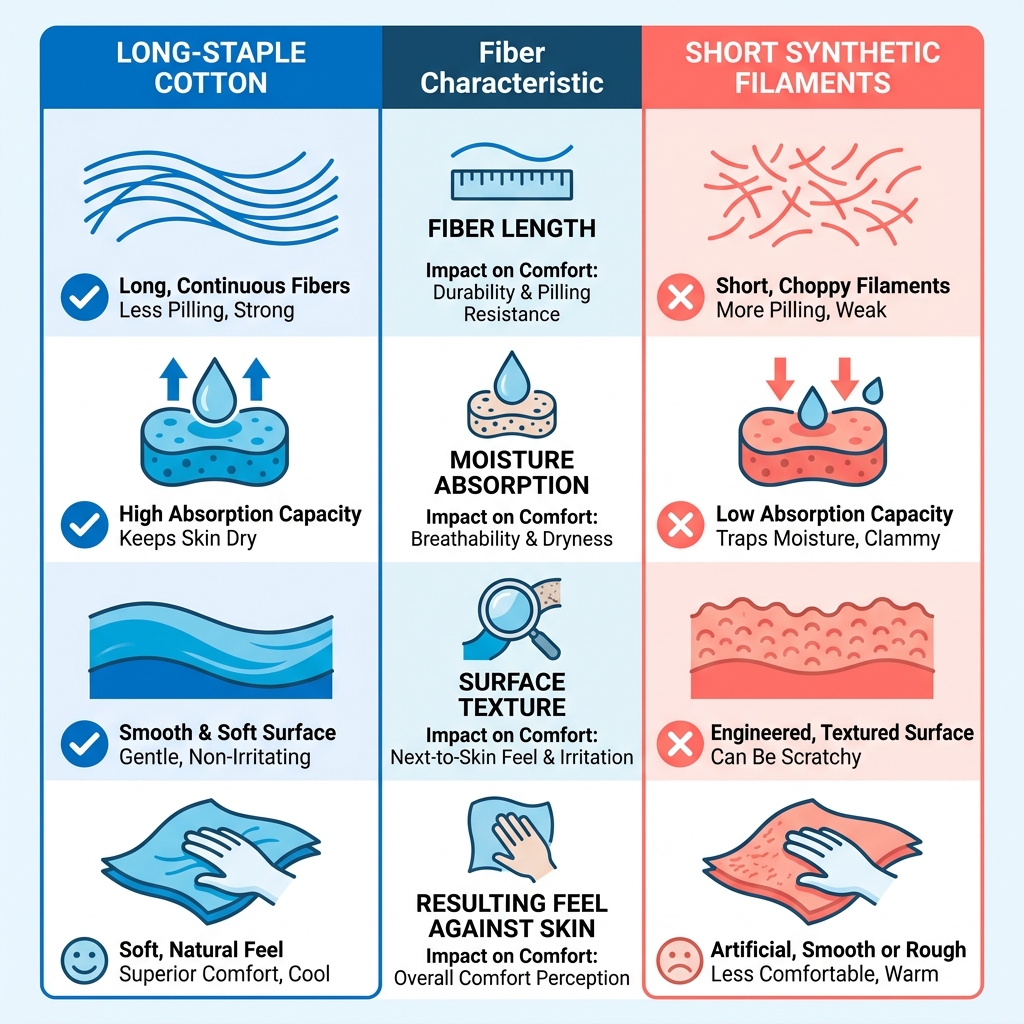
One Fiber Drinks Moisture, the Other Pushes It Away
Cotton's absorbency is the trait everyone argues about. It pulls moisture in rather than wicking it away, which is a genuine drawback when you're working up a real sweat and a soaked shirt turns clammy.
Off the gym floor, that same absorbency reads differently. REI still lists cotton as "soft, durable, breathable, versatile and easy to care for," the qualities that carry a garment through a long, low-key day. For errands, desk hours, and school runs, that softness and breathability are what our 100% certified Peruvian Pima cotton is built around, so comfort holds from morning to evening.
The Spec Sheet Won't Tell You How Hour Ten Feels
Spec sheets and lived comfort don't line up. REI's guide points out that a synthetic's breathability "varies based on yarn size and knit or weave," so the label alone won't tell you how a piece feels once it's on. Softness, weight, and fit shape the experience far more than a wicking rating printed on a tag.
No spec sheet tells you how a garment feels at hour ten. That's why we lead with comfort instead of stats.
| Property | Peruvian Pima cotton | Polyester (PET) | Nylon/elastane blend | Black Pearl Pima activewear |
|---|---|---|---|---|
| Softness | High (long staple) | Moderate | Moderate | High |
| Breathability | Good, weave-dependent | Varies by knit | Varies by knit | Good |
| Moisture behavior | Absorbs, aids evaporation | Wicks, dries fast | Wicks, stretches | Absorbs |
| Odor retention | Low | High | High | Low |
| Care ease | Easy | Easy | Easy | Easy |
Three reasons we reach for Pima for all-day wear:
- Long-staple softness that stays gentle through repeated wear and washing.
- Absorbency that supports evaporative cooling at rest and during light activity.
- Low odor retention, where synthetics tend to trap it.
One caveat, and we won't dodge it: skip cotton for sustained, sweat-drenched training. The absorbency that soothes at your desk turns heavy mid-run. For everyday comfort, though, the fiber earns its place.
Pima vs Synthetics at a Glance
Cotton is a natural cellulose fiber that absorbs moisture. Polyester and nylon are engineered polymer filaments built to repel water and push it outward. Long-staple Peruvian Pima spins into finer, smoother yarn, and the skin reads that as softness synthetic filaments can't match despite their smooth surface.
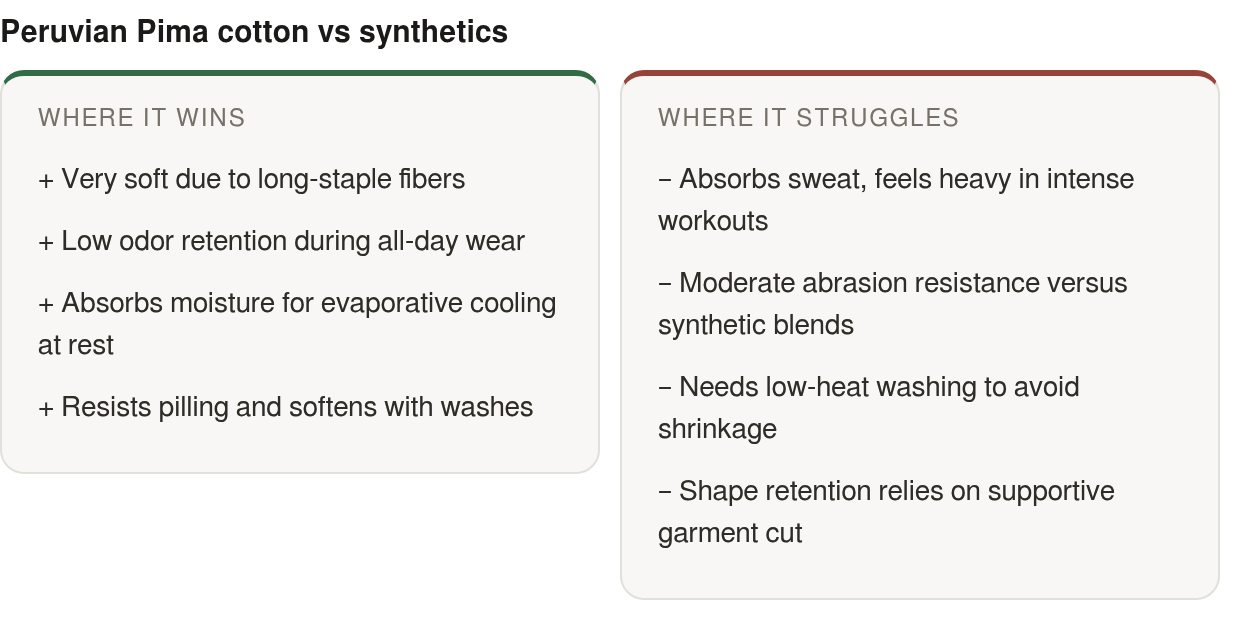
REI's fabric guide labels cotton "a poor choice if you plan to break a sweat," since it absorbs rather than wicks during high-intensity output. Synthetic breathability varies by yarn size, knit, and weave, so a label alone can't predict how a garment feels against skin. On odor, Pima stays low while polyester and nylon blends both trap it.
Comfort Mechanics: What Softness, Breathability, and Moisture Actually Do
Comfort over a full day comes down to three things working together: how a fabric feels, how it breathes, and what it does with your sweat. Get all three right and you forget you're dressed. Get one wrong and you're tugging at a waistband by 2 p.m. That's why we build our Peruvian Pima cotton activewear for women around the lived-in hours, not a treadmill test.
Worth naming the tension up front. Synthetics look great on a spec sheet, yet the numbers don't predict how a garment feels once your body heats up. So the marketing math and the wearing experience often part ways.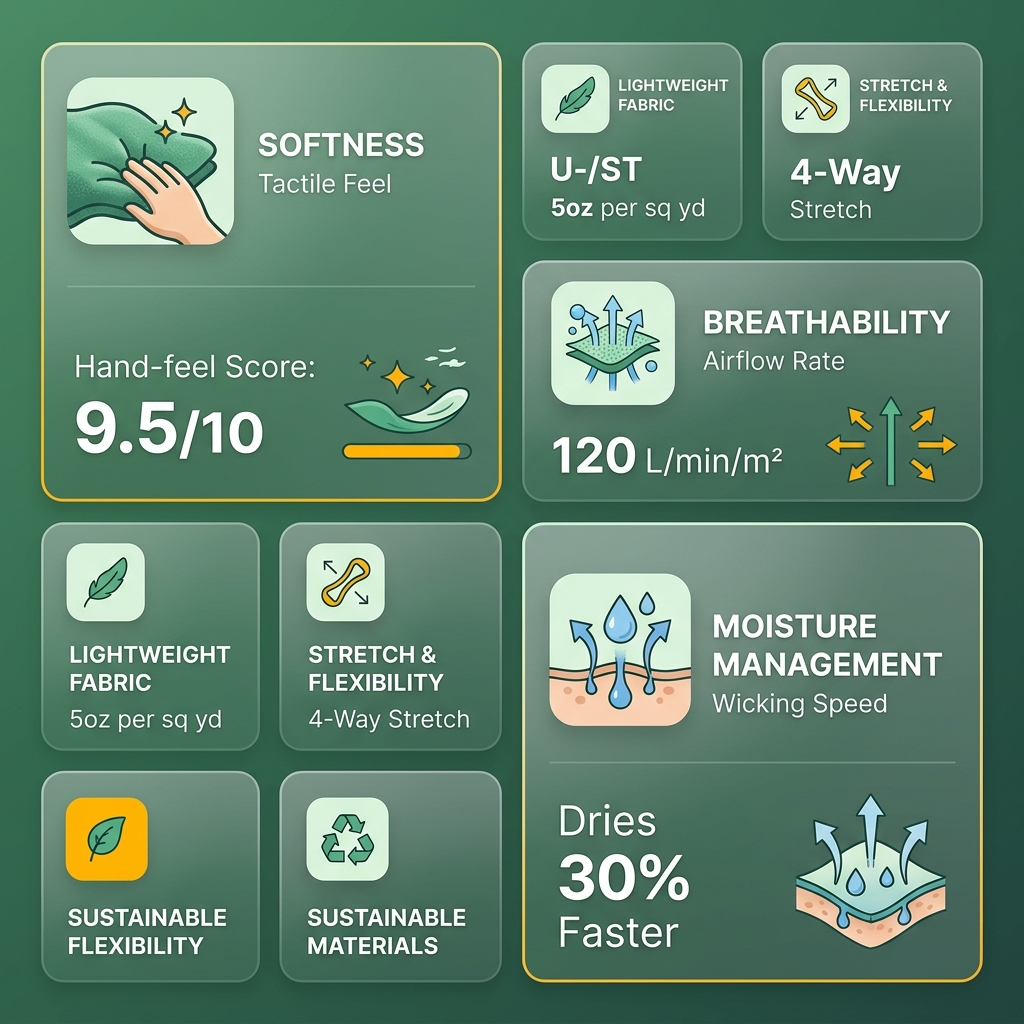
Absorbency: Feature or Flaw Depends on What You're Doing
There's a real disagreement in the research, and we won't pretend otherwise. For sustained high-intensity output, cotton's habit of absorbing instead of wicking leaves a soaked shirt clammy. That's the case against it, and it's fair.
Everyday wear tells a different story. For light activity and daily movement, that absorbency can work in your favor. REI notes that some people even douse cotton in water to boost the evaporative cooling effect. Rather than trapping heat, the fiber lets moisture evaporate and helps cool you.
Outside the gym, absorbency is a feature. For errands, work, travel, and coffee runs, that's the load your clothes actually carry.
Breathability Is a Fit Story, Not Just a Fiber Story
Air movement matters more than most spec sheets admit. Fit and construction shape breathability as much as fiber chemistry. As REI's guide explains, tighter knits and weaves breathe less, looser ones breathe more. Technical synthetic gear is close-fitting by design, and that skin-tight cut fights the airflow that keeps you cool.
A looser natural-fiber piece wins on two fronts at once. The fiber absorbs and releases moisture, and the cut lets air do its job. Breathable cloth paired with a relaxed fit helps your body regulate its own temperature through the day.
| Comfort pillar | Peruvian Pima cotton | Polyester | Merino wool |
|---|---|---|---|
| Hand-feel | Very soft, long-staple | Firmer, can pill | Soft, once scratchy |
| Moisture behavior | Absorbs, cools by evaporation | Wicks, can feel clammy | Wicks, absorbs some |
| All-day breathability | High with open weave | Varies by knit | High |
| Odor retention | Low | High | Low |
Why Numbers Cut Both Ways
The measured numbers mislead in both directions. A fabric can score well on paper and still feel clammy against warm skin, or feel comfortable while showing no thermal edge on the spec sheet at all. That gap runs opposite ways depending on the fabric, so no data sheet predicts your afternoon.
We choose Pima for the women who wear it all day and want that choice to mean something. That's the heart of what we do: helping women feel confident while building a community where we lift one another up.
Longevity and Wear: How Pima and Synthetics Age
The tradeoff, named up front. Synthetics win the spec sheet on raw abrasion resistance. A polyester-nylon blend can survive rough handling that would fray a lesser cotton. That's real. But raw abrasion isn't the kind of durability that matters for clothes you live in.
What matters is how a garment ages against your body, wash after wash. This is where Pima pulls ahead. Long-staple Peruvian Pima resists the fuzzy pilling that turns cheap synthetic leggings scratchy by month three. Longer fibers mean fewer loose ends working their way to the surface, so the hand stays smooth instead of going rough.
Why does Pima cotton get more comfortable over time?
Most fabrics degrade with wear. Well-made Pima softens. The fibers relax with each wash while the long staple holds the yarn together, so you gain suppleness without losing structure. That's the opposite of a synthetic blend, which usually starts at peak feel and drifts downhill as it pills and picks up odor.
Shape retention is the real caveat. Pure cotton can stretch out and take a set at the knees or seat if a garment is cut without support. Construction closes that gap: a tighter knit density, a touch of recovery in the yarn, and reinforced seams at stress points all help the fabric spring back instead of sagging. Skip loose, low-density cotton for anything you'll sweat hard in. That's where the material genuinely underperforms, and we won't pretend otherwise.
| Wear factor | Peruvian Pima cotton | Poly/nylon blends |
|---|---|---|
| Pilling over time | Resists, stays smooth | Prone to fuzzing |
| Hand feel after washes | Softens | Degrades |
| Abrasion resistance | Moderate | High |
| Shape retention | Needs supportive cut | Holds by default |
| Odor buildup | Low | High |
Which one should you actually buy?
For all-day wear, errands, travel, and gentle movement, Pima ages better and stays pleasant against skin. For high-friction, high-sweat training, a supported synthetic still earns its place. We know which side we're built for, and we're comfortable saying so.
Care Routine: How Washing Decides How Long Comfort Lasts
How you wash a garment decides how long it stays comfortable. Most care guides skip this part, and it's where natural fibers and synthetics split hard. With Pima, gentle care keeps the softness we build in from day one. With synthetics, care is mostly damage control.
The core rule for long-staple cotton is low heat and low drama. Hot water and high dryer settings shrink cotton and roughen the fibers that give it that lived-in hand. Wash cold or warm, tumble dry low or hang, and skip the fabric softener. Softener leaves a waxy film that coats the fiber and dulls the breathability you paid for.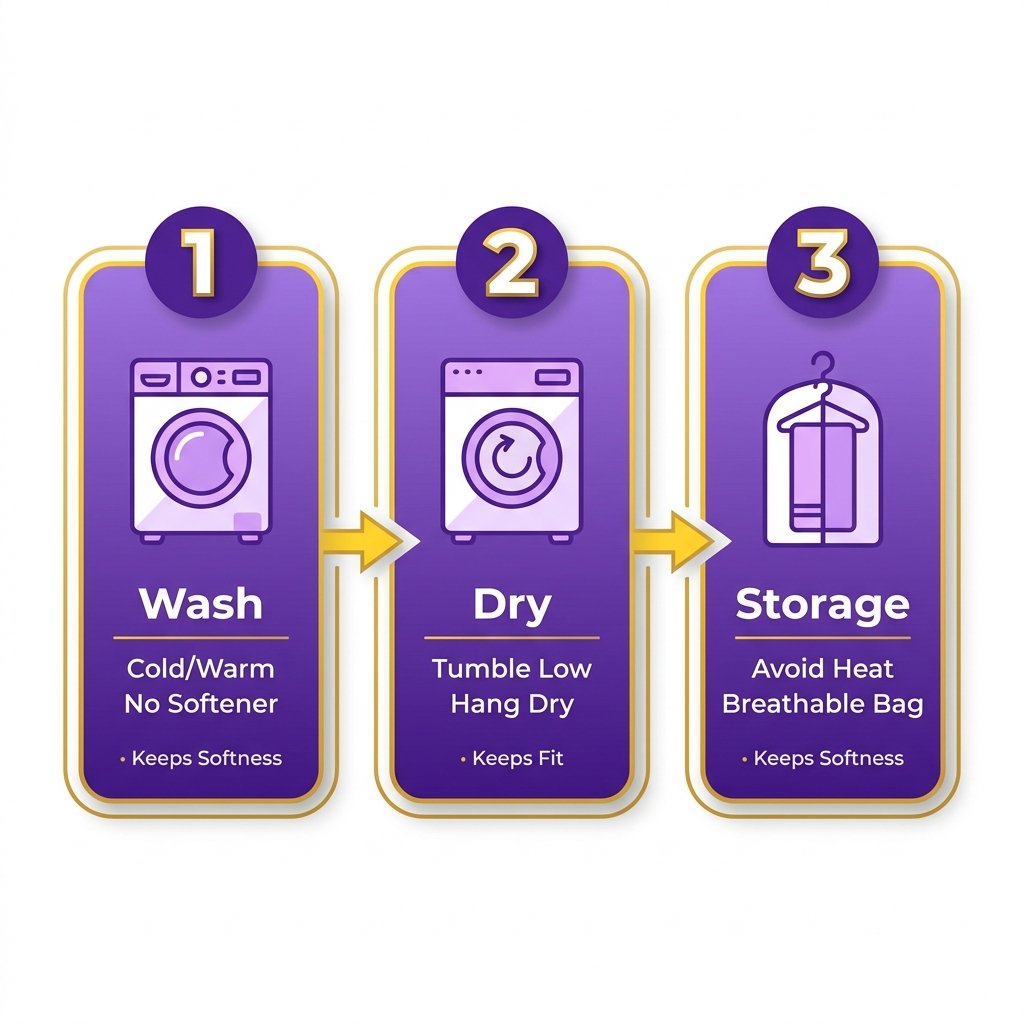
Synthetics need the opposite kind of attention. They don't shrink much, but they trap odor and hold onto detergent residue. Fabric softener is a problem here too. It clogs the tiny spaces that let polyester move sweat, which is the one thing synthetics are supposed to do well.
Fabric Softener Ruins Both, For Different Reasons
Skip softener on everything. On cotton it kills the natural feel. On synthetics it kills the moisture wicking. A splash of white vinegar in the rinse does the softening job without the buildup, and it pairs cleanly with plant-based detergents that won't strip either fiber.
| Care Step | Peruvian Pima Cotton | Performance Synthetics |
|---|---|---|
| Wash temp | Cold to warm | Cold only |
| Drying | Low tumble or hang | Low heat, never hot |
| Fabric softener | Skip it | Skip it |
| Odor control | Rarely needed | Frequent, traps smell |
| Storage | Folded, breathes fine | Keep dry, avoid damp |
The Payoff: Comfort That Lasts
The tradeoff: cotton asks for a little more care upfront, and rewards you with a garment that gets softer, not scratchier. Synthetics are lower-maintenance on paper but tend to feel worn out faster once residue and odor set in.
We think that's a fair trade for pieces you actually live in. Fold them, let them breathe, keep the heat down, and they'll stay comfortable well past the point where cheaper fabrics give up.
Sustainable and Ethical Production: The Part of Comfort You Can't Feel
The part of comfort you can't feel on your skin is knowing where the fiber came from. That's the piece synthetics rarely tell you, and it's central to how we think about the whole story, not just the fabric hand.
Start with what touches you. Synthetic athleisure sheds tiny plastic fibers every time you move and every time you wash it. Those microfibers wash out into water systems, and the finishing chemicals used on many synthetics can leave residue against sensitive skin. Long-staple Peruvian Pima needs less aggressive chemical processing to feel soft, because the fiber is already smooth on its own.
Why does ethical sourcing change how a garment feels?
Comfort and conscience are more linked than they sound. When cotton is grown and picked with care, the supply chain has room for quality at every step. That care shows up as cleaner fiber, gentler processing, and fewer harsh treatments sitting against your body all day.
Peru's Pima tradition is smallholder work, hand-harvested to protect the long fibers. Most of it grows in the northern coastal valleys, where river irrigation and steady sun let farmers skip a lot of the inputs industrial cotton leans on. That means fewer synthetic pesticides in the soil and a shorter, more accountable path from field to finished piece. Wearing something that starts with a fiber this good is its own kind of ease.
One honest note on scope. If you want a garment purely for heavy sweat and abrasion, a technical synthetic may suit that one workout better. We're not the pick for high-intensity performance gear.
| Consideration | Peruvian Pima Cotton | Typical Synthetic Athleisure |
|---|---|---|
| Microplastic shedding | None; natural cellulose fiber | Sheds during wear and wash |
| Chemical finishing | Minimal; fiber is soft on its own | Often needs softening treatments |
| End of life | Biodegradable | Persists for decades |
| Labor story | Hand-harvested, traceable | Frequently opaque |
The synthetic supply chain hides its footprint in carbon-heavy petroleum processing and garments that never break down. Natural cotton returns to the soil.
We think that matters to how a piece feels once it's yours. It's the same thinking behind our mission to support women through comfort, connection, and pieces built to last.
Black Pearl Yoga Wear: The Brand's Edge in All-Day Comfort
Our design starts with how a garment behaves across a full day, not how it performs in a single workout window. We shape each cut around movement, drape, and the kind of softness that holds up through a morning practice, errands, and an evening out. The result reads as put-together whether you're stretching on the mat or grabbing lunch with friends.
The community side isn't decoration. Our mission is to help women feel confident and connected, and that thread runs through the clothes themselves. The pieces are meant to be worn together, shared, and lived in, which is why we lean into versatile cuts over single-use gym gear.
How does our line compare to synthetic-focused brands?
Here's where we sit against the synthetic benchmark most performance brands chase. We're honest about the tradeoff: synthetics still win raw abrasion numbers. On the comfort metrics that decide whether you keep a garment for years, natural long-staple cotton is our clear pick.
| Feature | Our line | Typical synthetic athleisure |
|---|---|---|
| Temperature feel | Stays cool against skin | Can hold heat during rest |
| Odor over a day | Resists buildup naturally | Often needs frequent washing |
| Drape and fit | Relaxed, flattering lines | Compression-focused |
| Community mission | Central (#weallcanwin) | Rarely a factor |
| Best use window | All day, any setting | Active sessions |
That mix favors anyone who spends more hours out of the gym than in it. A single set can carry you from a sunrise flow through a workday and into dinner without a change, which is the point.
Who This Line Is Actually For
Choose us if you want clothes that move from yoga to casual outings without a wardrobe change, and you care where your fiber comes from. Skip us if your priority is high-intensity performance gear built purely for sweat-heavy training. That's not what we make, and we'd rather say so.
For women who value comfort, chic design, and a community that lifts each other up, this is the line built for you.
References
[2] Clothing - National Collaborating Centre for Environmental Health - https://ncceh.ca/node/36950
[3] Synthetic Fabrics vs. Natural Fibers for Preventing Heat Stress - LHSFNA - https://lhsfna.org/synthetic-fabrics-vs-natural-fibers-for-preventing-heat-stress/
Common Questions
Is Peruvian Pima cotton a good choice for sensitive skin?
Long-staple Peruvian Pima needs less aggressive chemical processing because the fiber is already smooth on its own, which means fewer harsh finishing treatments sitting against your body. Many synthetics rely on softening treatments and finishing chemicals that can leave residue on skin, so cotton is often the gentler option for reactive skin.
How does Pima cotton compare to merino wool for all-day wear?
Both retain odor at low levels and breathe well over a full day. Pima stays consistently very soft thanks to its long staple, while merino can feel scratchy for some wearers despite softening over time. Merino wicks and absorbs some moisture; Pima absorbs and cools through evaporation.
How do I keep cotton leggings from stretching out at the knees or seat?
Shape retention comes down to construction, not just the fiber. A tighter knit density, a touch of recovery in the yarn, and reinforced seams at stress points all help cotton spring back instead of sagging. Avoid loose, low-density cotton for anything you plan to sweat hard in.
If cotton absorbs moisture, why doesn't it always feel clammy?
It depends entirely on what you're doing. During sustained high-intensity sweat, absorbed moisture stays against skin and feels clammy. At rest or light activity, that same absorbency lets moisture evaporate and cools you. Some people even douse cotton in water to boost the evaporative cooling effect rather than trapping heat.
What can I use instead of fabric softener on Pima cotton?
A splash of white vinegar in the rinse softens without leaving buildup. Fabric softener coats cotton fibers with a waxy film that dulls breathability, and it clogs the spaces synthetics use to move sweat. Vinegar pairs cleanly with plant-based detergents that won't strip either fiber.