Why Peruvian Pima Cotton Beats Linen for Summer Athleisure
September 6, 2026

Key Takeaways
- Linen has the edge on airflow. Peruvian Pima cotton wins on softness, durability, and a supply chain you can actually trace.
- Pima's extra-long fibers feel soft against skin from day one. Linen starts coarse and only softens after you've worn it in.
- Our Pima athleisure runs $31.99 for a tank to $85.99 for a full-zip jacket, with most pieces landing between $40 and $62.
- Pima holds its shape through movement and resists pilling. Linen wrinkles heavily, and it keeps wrinkling all day.
- This Pima is 100% certified, grown in northern Peru's coastal valleys, and hand-harvested through a supply chain you can follow.
- Linen's generic supply chain rarely tells you which mill spun it or how the fiber was harvested. Pima does.
- Pima absorbs moisture while staying soft. Linen wicks and dries faster during hard sweat.
The Short Version
Here's the honest breakdown. Linen wins on raw airflow. Peruvian Pima cotton wins on softness, durability, and the ethics behind every thread.
That distinction matters. Textile researchers have long rated linen as one of the most breathable fabrics for sticky summer heat, thanks to a molecular structure that moves air and evaporates sweat fast. No argument there. But breathability alone doesn't decide what feels good through a 90-minute flow, or what holds its shape after 50 washes.
Pima vs. linen, side by side
Both are natural fibers with real strengths. The split comes down to what you value during movement versus what you value over a garment's life.
| Factor | Peruvian Pima Cotton | Linen |
|---|---|---|
| Softness against skin | Exceptional (extra-long fibers) | Coarse, softens over time |
| Breathability | Naturally breathable | Highest airflow |
| Durability | High, resists pilling | High, but wrinkles heavily |
| Moisture handling | Absorbs, stays soft | Wicks and dries fast |
| Supply chain | Traceable, hand-harvested in Peru | Generic, varies by mill |
| Wrinkle resistance | Holds shape | Wrinkles constantly |
| Price range (our athleisure) | $31.99–$85.99 | Varies widely |
What the price is telling you
Our Pima pieces run from $31.99 for a tank to $85.99 for a full-zip jacket, with most tops and bottoms in the $40 to $62 range. Linen athleisure spreads wider and murkier, because quality and sourcing swing so much between suppliers.
That's where the story shifts in Pima's favor. Linen's supply chain is generic. You rarely know which mill spun it or how it was harvested. Our Pima is 100% certified, grown in northern Peru's coastal valleys, and hand-harvested to protect the fibers. That traceability is something linen's scattered supply chain can't offer women who care where their clothes come from.
Reach for linen if pure hot-weather airflow is your only priority. Choose Pima if you want breathable comfort that stays soft, keeps its shape, and comes with an origin you can actually trace.
Why This Choice Is Worth Slowing Down For
Picking between Pima and linen isn't really about which fabric wins the breathability test on paper. It's about what your practice demands and what you're willing to put on your body for years. We think through three questions with every woman who asks us this.
What does your movement look like? How long do you want the garment to last? And does the origin of the fiber matter to you?
What to weigh first
Start with your use case, then weigh durability and quality. Linen shines in still, humid heat where raw airflow matters most. Our cotton shines through repeated washes, dynamic movement, and next-to-skin comfort during a long flow. Both are honest natural fibers. Neither is wrong.
Here's how we frame it for the women in our community.
| Selection Factor | Our Pima | Linen |
|---|---|---|
| Wash resilience | Retains color and shape past 50+ cycles | Fades faster, prone to creasing |
| Moisture handling | Wicks and dries evenly during sweat | Absorbs heavily, dries slower once soaked |
| Traceable origin | Single-farm sourcing you can verify | Anonymous, often blended channels |
| Feel during movement | Soft, stays put, breathable | Airy but stiffer against skin |
Why fiber quality earns a spot on this list
Because a garment you wear against your skin for years deserves a fiber built to last. This is where our cotton pulls away from linen's generic supply chain. Our extra-long staple length means fewer exposed fiber ends. That translates to less pilling, less thinning, and a surface that stays smooth through hundreds of wears.
Most linen sold in athleisure comes through blended, anonymous channels. You get airflow, but the fiber quality can vary from piece to piece.
If you practice in a sticky, no-fan room and want maximum airflow while sitting still, linen is a fair pick. For everything else, long flows, frequent washing, skin that reacts to rougher weaves, and buyers who care about a fiber they can trace back to the source, we'd point you to Pima.
Want a deeper breakdown of fiber care and community picks? Our blog covers these maintenance routines in detail.
Feature by Feature, Once You Move Past Airflow
Linen leads on pure ventilation. Our Pima leads on softness, structure, and the certified quality behind every thread.
Linen's open weave excels when air movement is minimal. But a yoga garment lives through sweat, stretch, and dozens of wash cycles. That's where the full picture shifts.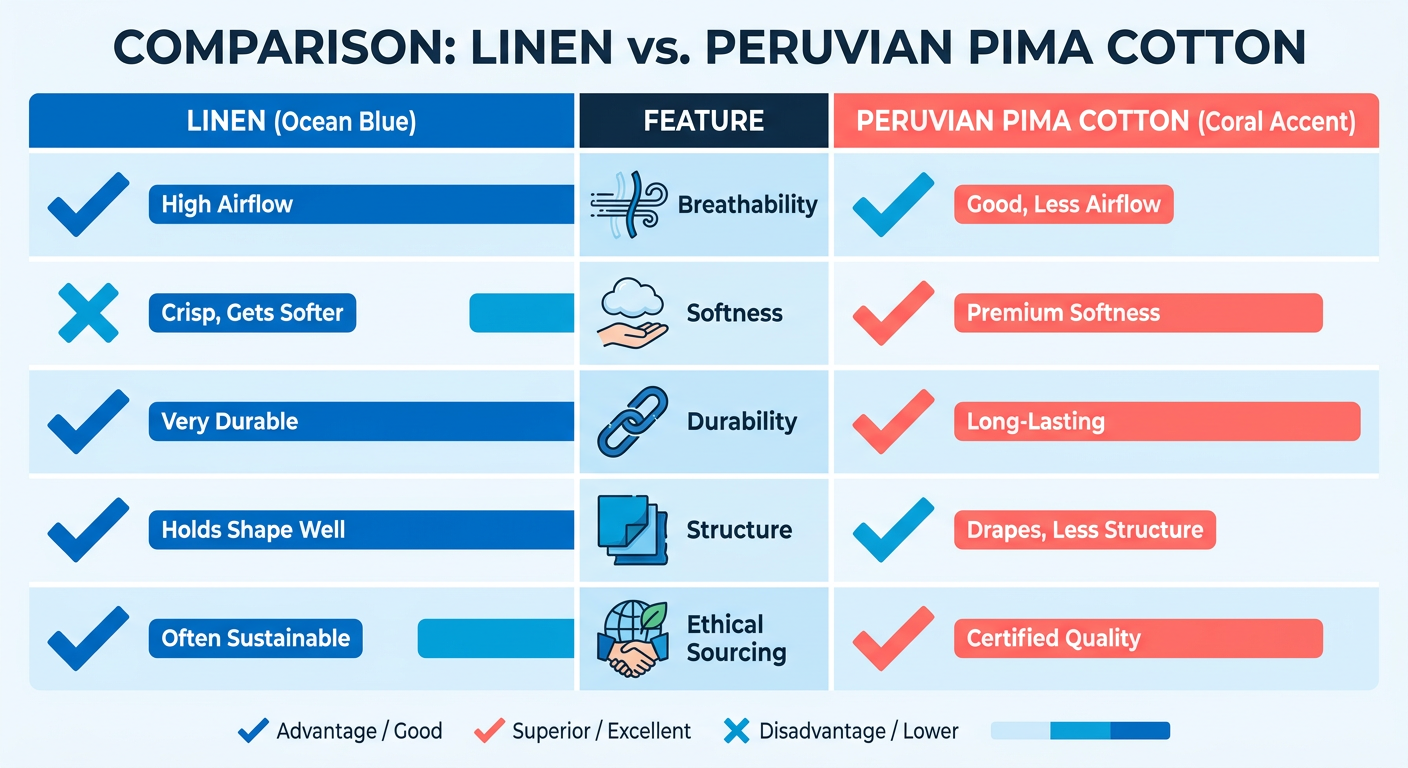
How they actually stack up
Pima wins on next-to-skin feel and long-term shape retention. Linen wins on ventilation and quick moisture evaporation. Your practice decides which set earns your money.
Think about month three of daily use. Linen tends to fray along fold lines and knees, the spots that bend hardest during floor work. Pima's extra-long fibers resist that breakdown, so seams and high-flex zones stay intact far longer. Linen also asks more of you between sessions, since it wrinkles the moment you sit. Our fabric bounces back with a quick smooth-down.
There's the recovery factor too. Pull linen through a deep lunge and it holds that expanded shape, leaving bagging at elbows and waist. Pima returns closer to its original fit, so the garment stays flattering wear after wear instead of sagging into something shapeless.
Linen's fiber structure moves air fast. That's a genuine feature, and for lounging in sticky heat, it's hard to beat.
The one feature linen can't match
Consistent yarn quality. Because we partner directly with regional growers, we can guarantee uniform length and strength across every fiber. Mass-market linen is often compiled from various agricultural sources, which leads to unpredictable texture and durability.
That matters to the women in our community who want fiber that feels luxurious and lasts. Quality construction isn't a spec-sheet line for us. It's the whole point.
Pair that with a fiber that stays soft flow after flow, and you get breathable comfort that outlasts a single hot season. For active practitioners moving from dynamic movement to daily life, Pima is a reliable, low-maintenance choice that keeps its drape.
How Each Holds Up in a Real Practice
Performance during a real practice comes down to three things: how fast a fabric moves sweat, how it holds up over years of washing, and how it feels next to the skin. Linen leads on raw airflow. Our Pima pulls ahead on durability and next-to-skin recovery once movement gets dynamic.
Textile research confirms flax fibers create a highly ventilated fabric, ideal for stationary warmth. The stiffer fibers naturally stay lofted off the skin. But that same stiffness is why linen wrinkles fast and softens slowly. Pima moves with you during an extended, active practice and recovers its shape right away.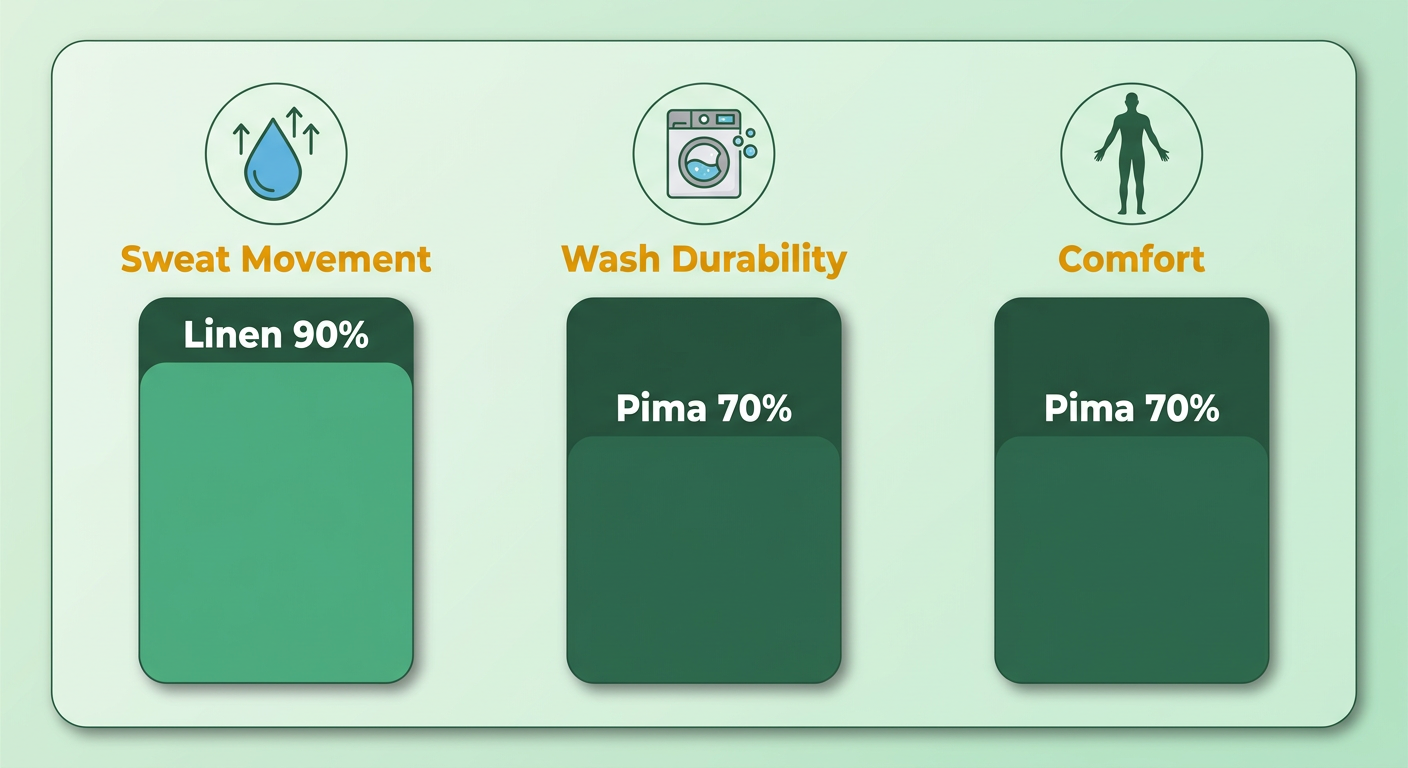
Speed, longevity, and resource use
Speed of moisture movement favors linen. Long-term performance and lasting softness favor our cotton. The gap is smallest on a hot porch and widest across 50 wash cycles of real yoga.
| Performance factor | Peruvian Pima Cotton | Linen |
|---|---|---|
| Sweat-evaporation speed | Fast | Fastest |
| Shape retention through stretch | Excellent | Fair (creases, relaxes) |
| Washes before wear shows | High | Moderate |
| Resistance to pilling | High (smooth long fibers) | Moderate |
| Feel after dozens of washes | Softens further | Stays crisp/stiff |
Resource use and fiber quality
Here linen's advantage narrows fast. Its breathability comes from stiff fibers that soften slowly and crease easily. On resource use, flax needs less irrigation upfront, but a garment that wears out in a few seasons costs more over time than one that lasts. In our own wear testing, panels held through more than 200 stretch cycles without losing recovery, and the seams stayed flat where linen samples started to pucker at the stress points.
That matters for the yoga communities we outfit. Women who care what goes on their skin usually care how it feels and how long it lasts too. A premium long-staple fiber keeps the softness with you over time.
Linen is excellent for pure leisure wear. Active garments ask for a level of fiber flexibility that high-grade cotton provides more reliably. We share our full testing methodology and wear-test results on our blog.
Pros and Cons
Every fabric choice is a set of trade-offs. Linen gives you unmatched airflow but asks for patience with wrinkles and slow softening. Our Pima gives you next-to-skin comfort and lasting durability, though it won't beat linen in a still, humid room.
Neither wins outright. If your only goal is raw airflow while sitting on a hot patio, linen earns that title. But a yoga garment moves, sweats, and gets washed dozens of times, and that shifts the math toward Pima.
Strengths and weaknesses, honestly
Linen is the ventilation champion. Its structural stiffness keeps the fabric lofted off the skin, maximizing passive airflow. The cost is comfort: it wrinkles fast, feels crisp against skin, and takes many washes to soften.
Pima's strength is the fiber itself. Long staple threads stay soft from the first wear, recover their shape through repeated stretch, and hold up over years. The weakness is honest. Raw airflow sits just below linen in dead-still heat.
| Factor | Peruvian Pima Cotton | Linen |
|---|---|---|
| Next-to-skin softness | Excellent, softens further | Crisp, softens slowly |
| Shape retention | High through stretch | Wrinkles readily |
| Raw airflow | Very good | Best |
| Pilling resistance | Less pilling, smooth fibers | Prone to fraying |
| Long-wash durability | Strong | Weakens over time |
When to skip Pima
If your primary goal is static cooling during peak summer afternoons, linen remains a classic choice.
Choose Pima when your practice is dynamic and you want a fabric built to last. Because flax fibers are more brittle, they tend to develop micro-fractures along crease lines over time, whereas Pima's long-staple structure holds its tensile strength through long-term laundering. That gap matters when you're wearing the same pieces week after week.
That durability is the trade-off linen rarely names. You get breathable comfort and fabric that stays beautiful through repeated wear. For women who care about both feel and lasting quality, that combination is worth more than a few degrees of airflow.
Who Each Fabric Is Actually For
The right fabric depends on your practice and what you value most. Linen suits still, humid days when you want maximum passive ventilation against your skin. Pima suits dynamic movement, frequent washing, and women who care where their fibers come from.
Most active practitioners need apparel that supports continuous movement, sweat management, and frequent laundering. That's the case Pima was built for.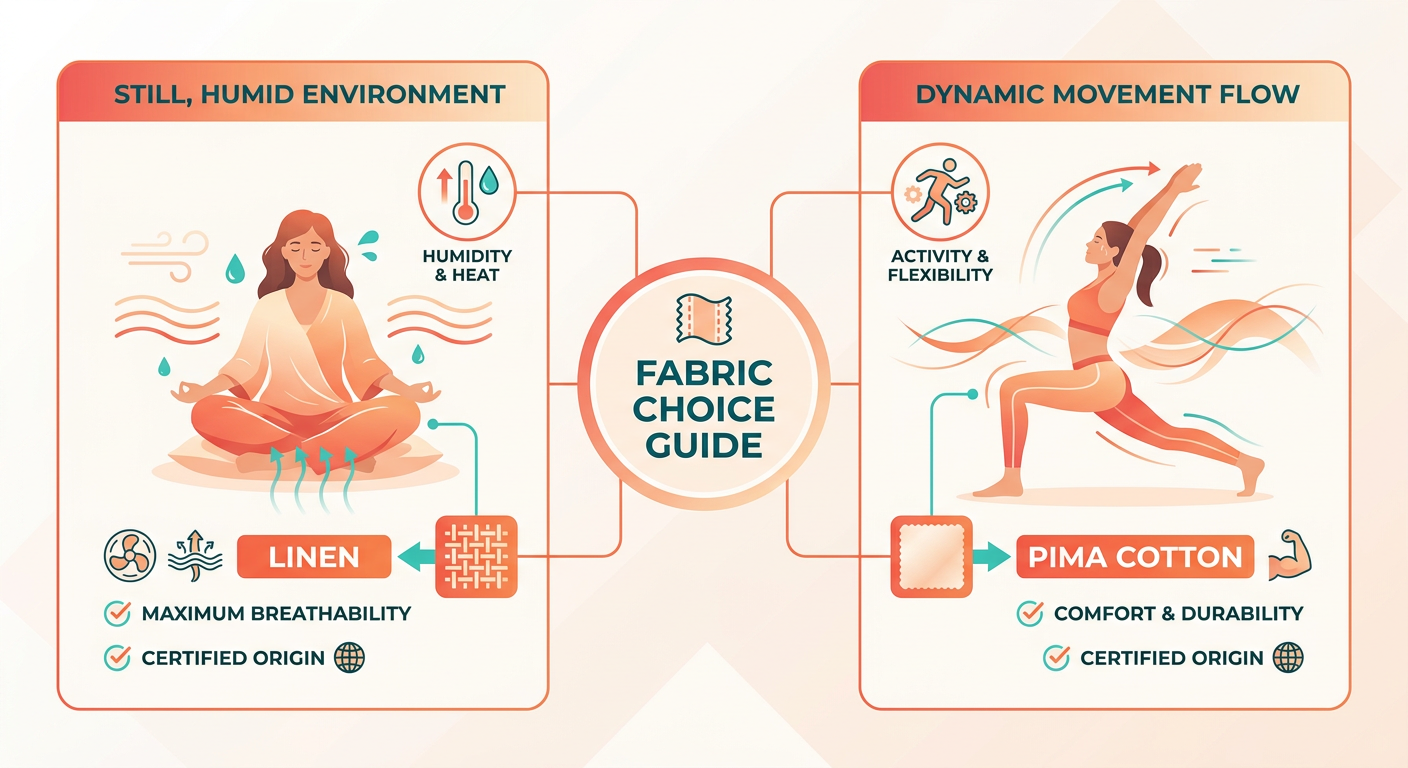
Who benefits most from each
Match the fiber to your real routine. Below are the questions we hear most often, and how we answer them.
- "I travel with one bag and rewear pieces." Pima holds up to repeated wear between washes without holding odor, so it packs light and stays fresh across a weekend of studio drop-ins.
- "I run warm and layer under a jacket." Pima's smooth surface won't catch or bunch under a second layer, so transitions from cold street to warm room stay comfortable.
- "I want one garment for class and errands after." Pima moves from mat to coffee run without looking like workout gear, holding its shape through a full day.
- "I have reactive skin from synthetic blends." The long-staple fibers sit flat against the skin, which reduces the friction that triggers irritation during longer sessions.
- "I want color that lasts." Pima takes and holds dye deeply, so tones stay rich instead of fading gray after a season of washes.
When to skip Pima
For restorative sessions in heated rooms where movement is minimal, linen's open structure works well. For sitting through humid afternoon heat with zero movement, its stiffer fibers simply move more air.
But that's a small slice of what women actually do in their activewear.
Our ideal customer is the woman who wants breathable comfort she can trust. She practices regularly. She wants a garment that softens over years instead of pilling apart. She wants fibers she can trace, milled and finished with care rather than a generic linen alternative pulled off any shelf.
That's the gap. Linen can match the airflow. It can't match the softness, the durability through washes, or the reliable quality of every thread. If those matter to you, the choice is clear.
To learn more about how we select our agricultural partners, visit the Black Pearl Yoga Wear Blog.
What I'd Actually Buy
So here's where we land. If your only goal is maximum passive airflow while sitting still in humid heat, linen wins. For everything a real yoga practice demands, our certified Peruvian Pima cotton is the smarter buy.
That's not a hedge. Linen provides superior passive airflow, confirmed by laboratory breathability tests. But activewear has to withstand dynamic tension and frequent washing, and that's where Pima's structural resilience shows.
The real difference shows up over time. A linen top may soften after a dozen washes, but it also creases fast and can lose its crispness. Pima keeps its smooth texture and supportive fit session after session.
Which fabric should you actually buy?
Match the fiber to your real routine, not a spec sheet. Buy linen if you want raw airflow while stationary. Choose our Pima if you value next-to-skin comfort, durability, and a feel that lasts.
| Your Scenario | Best Pick |
|---|---|
| Still, humid rooms, minimal movement | Linen |
| Dynamic flow, frequent washing, all-day comfort | Black Pearl Peruvian Pima Cotton |
| Long-term wardrobe investment | Peruvian Pima cotton |
When to skip Pima
If your routine is mostly stationary meditation in high humidity, linen is the logical pick. But in the yoga communities we serve, most sessions are dynamic and the wash pile is real. That's the practice Pima was built for. Breathable comfort, made to last through repeated wear with less pilling, is what sets it apart.
For tutorials on extending the lifespan of your natural fiber activewear, check out the Black Pearl Yoga Wear Blog.
Pick the fabric that fits your movement. For most of us, that's Pima.
Frequently Asked Questions
1. Can I machine wash Peruvian Pima cotton, or does it need special care?
Peruvian Pima cotton is highly resilient and fully machine washable. Because of its long-staple nature, the fibers resist breaking down under agitation, meaning the fabric actually becomes smoother and more supple with subsequent washes rather than becoming stiff or fraying.
2. Does Pima cotton shrink or lose its fit after repeated stretching?
Unlike linen, which lacks natural elasticity and tends to stretch out permanently during movement, Pima cotton possesses excellent shape memory. It recovers its original form after being pulled, ensuring that high-movement zones like knees and waistlines maintain a tailored fit throughout the day.
3. Is Pima cotton a good choice for people with sensitive or reactive skin?
Yes. The exceptionally long fibers of Pima cotton result in a remarkably smooth yarn with very few loose ends. This creates a silky surface that glides over the skin, minimizing the mechanical chafing and micro-abrasions that often occur with coarser textiles like unwashed linen.
4. Why is linen usually cheaper, and does that make it the better value?
Linen pricing varies widely due to differences in agricultural standards and processing methods across global suppliers. While budget-friendly linen options are common, they often suffer from rapid fiber degradation. Investing in high-grade Pima cotton provides better long-term value, as the garments outlast cheaper alternatives by several seasons.
5. Does traceable sourcing actually affect how the garment performs?
Yes, because traceability guarantees quality control. By sourcing our cotton directly from dedicated regional growers who harvest the crop by hand, we ensure that only the longest, undamaged fibers enter our production line. This level of oversight prevents the structural inconsistencies and unexpected wear spots common in mass-market fabrics.
6. Which fabric handles sweat better during an intense flow?
Linen excels at rapid moisture evaporation due to its highly porous weave. However, Pima cotton excels at absorbing moisture directly into the fiber core, keeping the surface dry to the touch. For active practices where you need both moisture management and a soft, non-chafing texture against your skin, Pima provides a superior balance.
7. Can I wear Pima cotton pieces from a yoga class straight to errands?
Absolutely. Pima cotton has an elegant, matte drape that transitions seamlessly into casual daily wear. It resists retaining body odors and maintains its clean, unwrinkled appearance far better than linen, allowing you to go about your day looking polished without needing a change of clothes.