Pima Cotton vs. Polyester Mesh: Which Fabric Actually Keeps You Cooler Past the Gym
September 13, 2026
Key Takeaways
- Polyester mesh wicks sweat faster during hard workouts. Pima cotton becomes stronger once your exertion drops.
- Wicking fabrics speed evaporation, but that does not automatically cool your body, per physicist Po-Chun Hsu's research on extreme heat.
- Polyester traps heat close to the skin while wicking, which weakens its cooling reputation.
- When you stop sweating hard and leave the gym, airflow matters more than wicking.
- Cotton feels miserable when soaked, which is why polyester dominates peak activity.
- Peruvian Pima cotton is prized for softness, breathability, and durability, making it stronger for post-workout wear.
- Most fabric guides grade workout performance and ignore how a piece feels afterward.
The Short Version
Polyester mesh wins during your workout. Pima cotton wins the moment you walk out of the gym. That flip happens because your sweat rate drops, and the cooling job changes from wicking sweat away to letting air move freely against your skin.
Most fabric guides stop at the workout. We care about what happens after, when you're grabbing coffee or meeting friends and still want to feel cool and put-together. That's where the most breathable fabric for summer earns its keep, and it isn't always the technical synthetic you'd assume.
Which fabric actually keeps you cooler?
It depends on your sweat rate. During peak effort, polyester moves moisture faster. During the post-gym cool-down, cotton's breathability takes over. Polyester keeps evaporating sweat during exercise, while cotton can turn uncomfortable when wet, per physicist Po-Chun Hsu.
Here's the part buried in the research. Polyester traps heat close to the body even while it wicks. And wicking boosts evaporation without necessarily cooling you. So once you stop sweating hard, polyester's edge fades and cotton's airflow becomes the star.
At a glance
| Metric | Pima Cotton | Polyester Mesh |
|---|---|---|
| Weight target | Lightweight jersey ⭐⭐⭐⭐ | Ultra-light mesh ⭐⭐⭐⭐⭐ |
| Moisture-wick rate | Absorbs, slower to dry ⭐⭐⭐ | Channels sweat via capillary action ⭐⭐⭐⭐⭐ |
| Breathability (airflow) | Air flows freely, regulates temp ⭐⭐⭐⭐⭐ | Less breathable, traps heat ⭐⭐⭐ |
| Softness / hand feel | Long-fiber, luxe against skin ⭐⭐⭐⭐⭐ | Technical, less soft ⭐⭐⭐ |
| Durability | Strong long-staple yarns ⭐⭐⭐⭐ | Strong, resists shrink/wrinkle ⭐⭐⭐⭐⭐ |
| Odor control | Natural, resists smell ⭐⭐⭐⭐⭐ | Holds odor ⭐⭐ |
| Best for | Post-gym errands, brunch, casual settings | Peak sweat, high-intensity sessions |
What to look for on the label
Check the fabric weight and construction, not just the fiber content. A lightweight Pima jersey closes most of the breathability gap with mesh in low-to-moderate activity, while keeping the softness and odor resistance synthetics lack. Fiber type alone won't tell you how cool a garment feels. How it's knit and finished matters just as much.
The "best fabric" debate is really an activity-phase question. During sprint intervals, reach for moisture-wicking polyester. For the transition into your day, a light Pima cotton piece keeps you cooler and looks far better across a table than a sweat-mapped mesh tank.
One exception: if you're doing back-to-back high-intensity sessions with no cool-down, stay in synthetic mesh the whole time. Cotton gets heavy and slow to dry once saturated, and there's no cool-down window for it to shine. For everyone else moving from workout to real life, cotton's the smarter pick.
Why Fabric Choice Matters After You Leave the Gym
Every woman knows the moment: you walk out of the gym, sweat rate dropping, heart rate falling, and suddenly the fabric that felt like performance engineering during class feels like a liability. That's where the real question about the most breathable fabric for summer activewear actually lives. Not during the workout. After it.
Why the cool-down changes the whole equation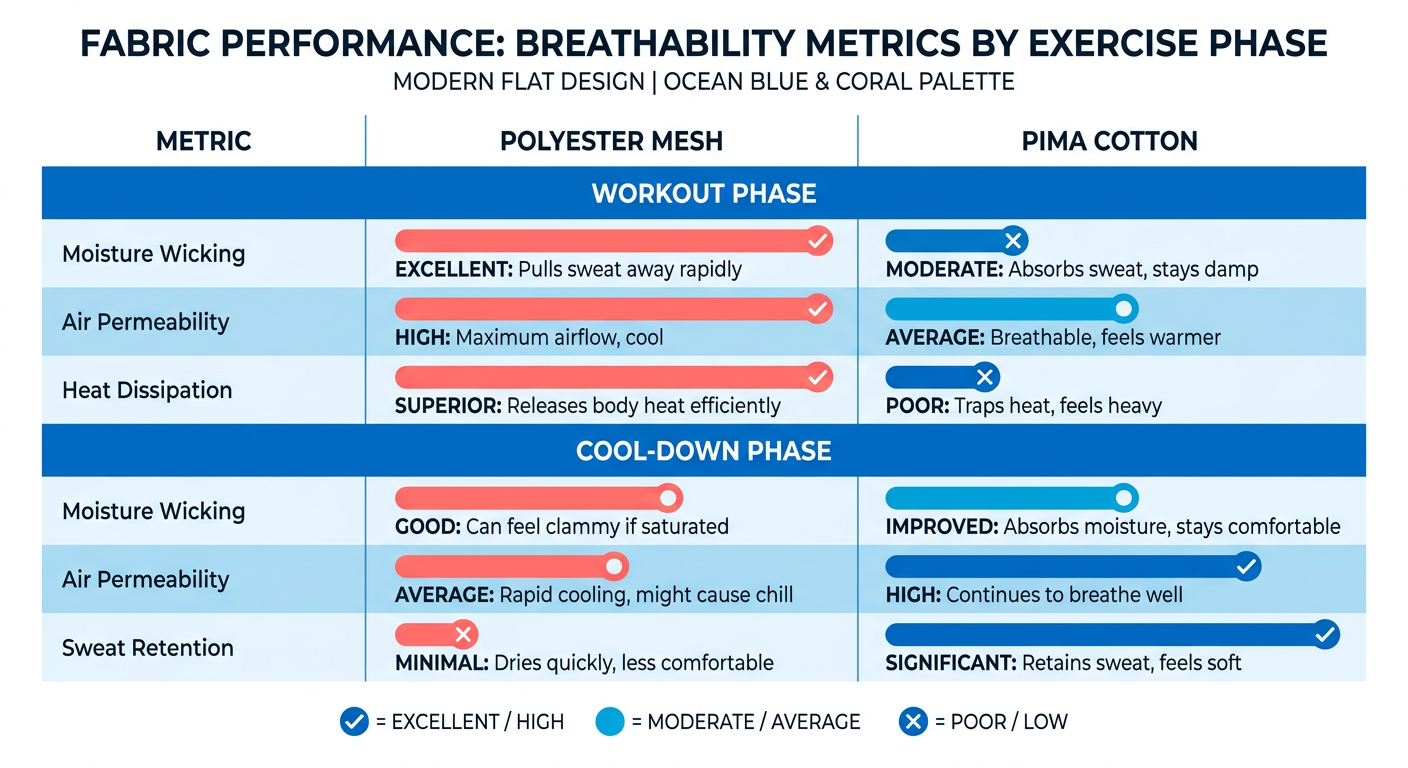
Most fabric comparisons treat breathability as one fixed quality. It isn't. Research from Szonei Fabrics breaks it into separate mechanisms, including air permeability and moisture handling. Those don't all peak in the same fabric at the same time.
During a workout, liquid moisture handling wins. Polyester's capillary-action wicking pulls sweat off skin fast enough to matter. But once effort drops and sweat rate falls, passive airflow and moisture release take over. That's where cotton's open fiber structure shines.
Controlled comparisons back this up. As REI's fabric guide notes, cotton is breathable and lets air flow freely to help regulate body temperature, while synthetics wick moisture but can trap heat against the skin. At moderate sweat levels, cotton's absorption didn't bog people down; it reduced thermal insulation and let the body shed heat more efficiently. So polyester's wicking advantage is real at peak exertion, but it shifts the moment activity drops, because the tight engineered structure that moves liquid also restricts passive airflow.
The saturation argument people get wrong
Here's the contradiction worth naming. Baleaf's comparison of Pima cotton and polyester found athletes preferred polyester for wicking, while casual users favored Pima cotton's comfort.
Cotton's critics always reach for the same argument: cotton gets heavy when wet. True, at peak exertion. But in a post-gym transition, where you've toweled off, changed pace, and your sweat rate is already declining, Pima's long-staple fibers stay comfortable rather than saturated. The soaked-shirt problem is a peak-exertion problem. It doesn't apply in the transition phase.
The variable thermal data misses entirely is odor. Polyester's weave is tight enough to wick efficiently, which also means it traps odor compounds once sweat rate drops. REI's guide notes that nylon and polyester "can retain odor" as a direct consequence of their fiber structure. Manageable in a gym. A social liability over coffee. Pima cotton's more open structure releases both moisture vapor and odor as conditions cool, which is exactly the kind of detail that never shows up on a sweat-rate chart but matters the second you're sitting across from someone in an air-conditioned café.
What this means before you buy
| Factor | Polyester Mesh | 100% Pima Cotton |
|---|---|---|
| Peak-exertion moisture handling | Strong. Capillary wicking clears sweat fast | Moderate. Absorbs rather than transports |
| Post-gym breathability | Lower. Engineered structure traps residual heat | Higher. Open fiber allows passive airflow |
| Odor in social settings | Prone to retention as sweat rate drops | Releases odor compounds more readily |
| Feel when sweat rate is declining | Can feel clingy or warm | Soft, lightens as moisture releases |
| Best phase | During class | Walking out the door |
One honest caveat: if you're heading straight from a hard session into an outdoor activity in full sun, the math tips back toward polyester's wicking. The post-gym social transition, whether that's an air-conditioned café, a restaurant, or a casual errand, is where Pima wins clearly. That's the scenario Black Pearl Yoga Wear designs for with 100% certified Peruvian Pima cotton, and it's the one most fabric guides simply skip.
Construction and Weight
Fabric weight, not just fiber type, decides how cool you feel after a workout. Peruvian Pima cotton and polyester mesh are built on completely different logic, and that structural difference is exactly why one keeps its cool when you leave the gym and the other starts working against you.
The short version: Pima's long fibers make an open, air-moving cloth. Polyester mesh punches holes into a synthetic knit to force airflow. Both aim for airflow, but they get there in opposite ways, and that matters once your sweat rate drops.
What makes Peruvian Pima cotton good for summer wear?
Peruvian Pima cotton is an extra-long staple cotton, meaning its individual fibers run longer than standard cotton. Those long fibers spin into smoother, stronger yarns that need less twist, which leaves the finished cloth softer and more open. That openness is what lets air pass freely against your skin.
Breathability tracks weave and weight closely. As Szonei Fabrics notes, the physical spacing between yarns dictates how easily heat escapes. A lighter, more open construction runs noticeably cooler than a dense, heavy one made from the same fiber. That's why premium Peruvian Pima cotton is knit to allow maximum air circulation during movement and everyday wear.
Cotton also absorbs moisture and stabilizes body temperature, as Alsco notes, rather than sitting wet against the skin. In a post-gym scenario where sweat is already declining, that means you feel dry and cool, not soggy.
How polyester mesh is engineered differently
Polyester mesh is a knitted synthetic with deliberate holes that force air through the fabric while the fibers themselves wick liquid sweat to the surface. It's built for peak exertion, when your sweat rate outruns any absorbent cloth. During a workout, that design is hard to beat, as Runners Need points out for high-output activity.
Lighter isn't automatically cooler, though. A member on Backpacking Light warned that some lightweight synthetics feel "like breathing through a plastic bag." Synthetic fibers also lack the natural thermal regulation of organic materials, which can leave you in a stifling microclimate once you step outside. Great during the burn. Less great in the coffee line.
| Property | Peruvian Pima Cotton (Black Pearl) | Polyester Mesh |
|---|---|---|
| Structure | Long-staple, open woven/knit | Knitted synthetic with holes |
| Fiber quality | Extra-long, smooth fibers | Synthetic filament |
| Moisture handling | Absorbs moisture, breathable | Wicks liquid to surface, dries fast |
| Peak-workout cooling | Good | Excellent |
| Post-gym cooling | Excellent | Fades as sweat drops |
| Odor release | Breathes odor out | Tends to trap odor |
Why weight decides the post-gym moment
Once you leave the gym, the cooling job flips from moving sweat to passive breathability. This is where Pima's open, lightweight build takes over. For a woman transitioning to errands or a casual meeting, a soft, breathable Pima piece avoids the heavy, heat-trapping feel of denser knits.
There's a social wrinkle too. Polyester is highly durable, but Alsco's research highlights how synthetic fibers tend to retain sweat residue, whereas cotton releases moisture vapor and stays fresh. Fabric weight is measured in GSM (grams per square meter), and a shirt in the 120–150 GSM range moves air more easily than a dense 220 GSM knit. That lighter build is what carries you comfortably from the last rep to the first sip.
Moisture Management and Wicking
Here's the mechanism most fabric guides skip: fast moisture transport does not automatically equal physical cooling. Technical synthetics excel at moving liquid sweat during high-intensity exercise, but the AP report on heat and fabric points out that the cooling effect depends heavily on the environment and the wearer's actual level of exertion.
This is where the search for the most breathable summer activewear stops being a single answer. During peak effort, your sweat rate outpaces what cotton can absorb, so polyester's surface-transport wins. Walk out the door and the job becomes passive breathability, not frantic wicking.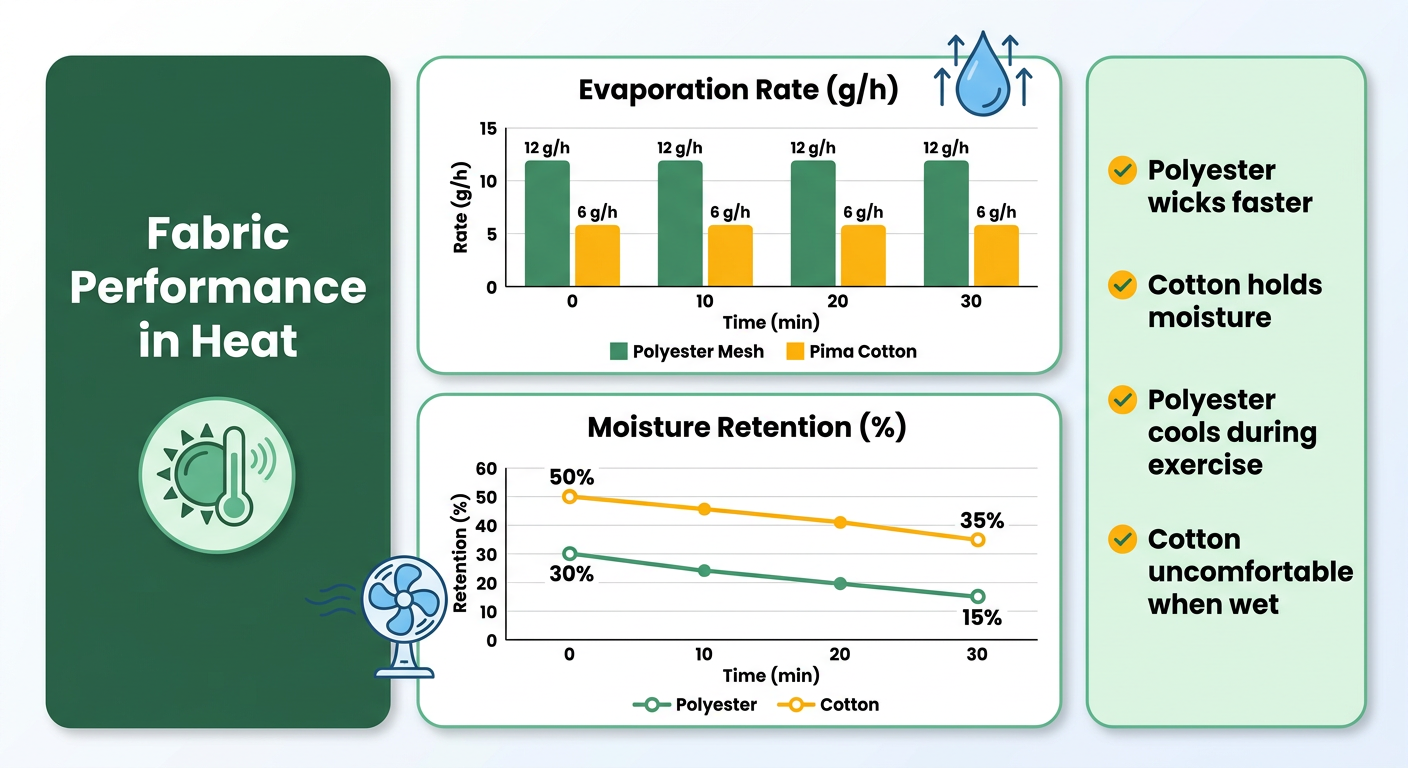
How fast does each fabric actually feel dry?
Polyester dries faster; Pima cotton feels drier at low sweat volumes. Those sound contradictory, but they measure different things. Polyester wicks moisture to its surface for quick evaporation, per Runners Need's guide. Pima cotton absorbs sweat into the fiber, so at a light post-yoga glow it never feels clammy against your skin.
The saturation point is what decides it. Cotton can absorb moisture before it feels wet. During a HIIT class you blow past that threshold and cotton turns heavy, as Baleaf's breakdown notes. But your post-workout recovery sweat rarely reaches that threshold, which keeps Pima comfortably inside its absorption window. That's exactly why it feels dry and light when polyester would start to cling.
| Moisture factor | Pima cotton | Polyester mesh |
|---|---|---|
| Moisture handling | Absorbs into fiber | Wicks to surface via capillary action |
| Peak-sweat drying | Slow, can saturate | Fast, quick-dry |
| Low-sweat feel | Stays dry, soft | Can feel damp-cool then odorous |
| Odor after wear | Releases odor compounds | Traps odors in tight weave |
Why polyester loses the social round
Odor is polyester's hidden veto. As discussed in Alsco's fabric comparison and REI's guide, synthetic fibers have a chemical affinity for oils, so they hold onto sweat-associated bacteria far longer than natural fibers. You might not notice on an outdoor trail. You will notice sitting close to other people.
Some guides credit polyester's wicking with better cooling, but controlled research shows wicking doesn't always translate to an actual temperature drop in low-exertion settings. In a relaxed, air-conditioned room, cotton's natural breathability and vapor release are what keep you feeling fresh.
One caveat, plainly: for the sweaty middle of a spin class, skip cotton. Polyester still owns peak exertion. But look at the timeline of a single garment. The odor buildup that makes synthetics unwearable happens fast. Bacteria feeding on trapped sweat can produce a noticeable smell within a short time, which is why a shirt that felt fine mid-workout turns sour on the drive home. Natural fibers don't hold those compounds the same way, so they stay socially wearable long after the exertion ends. That's the exact window where surface wicking stops mattering and vapor release takes over.
Fit, Comfort, and How It Feels on the Cool-Down
The moment you leave the gym, the sensory experience of your clothes changes completely. During a workout, you barely register fabric. You're moving, you're warm, everything is secondary to performance. Step into a café or run a post-gym errand, though, and you feel every texture, every clingy seam, every bit of residual dampness. That shift is where summer activewear has to prove itself on different terms.
Polyester mesh passes the workout test. It struggles with what comes next.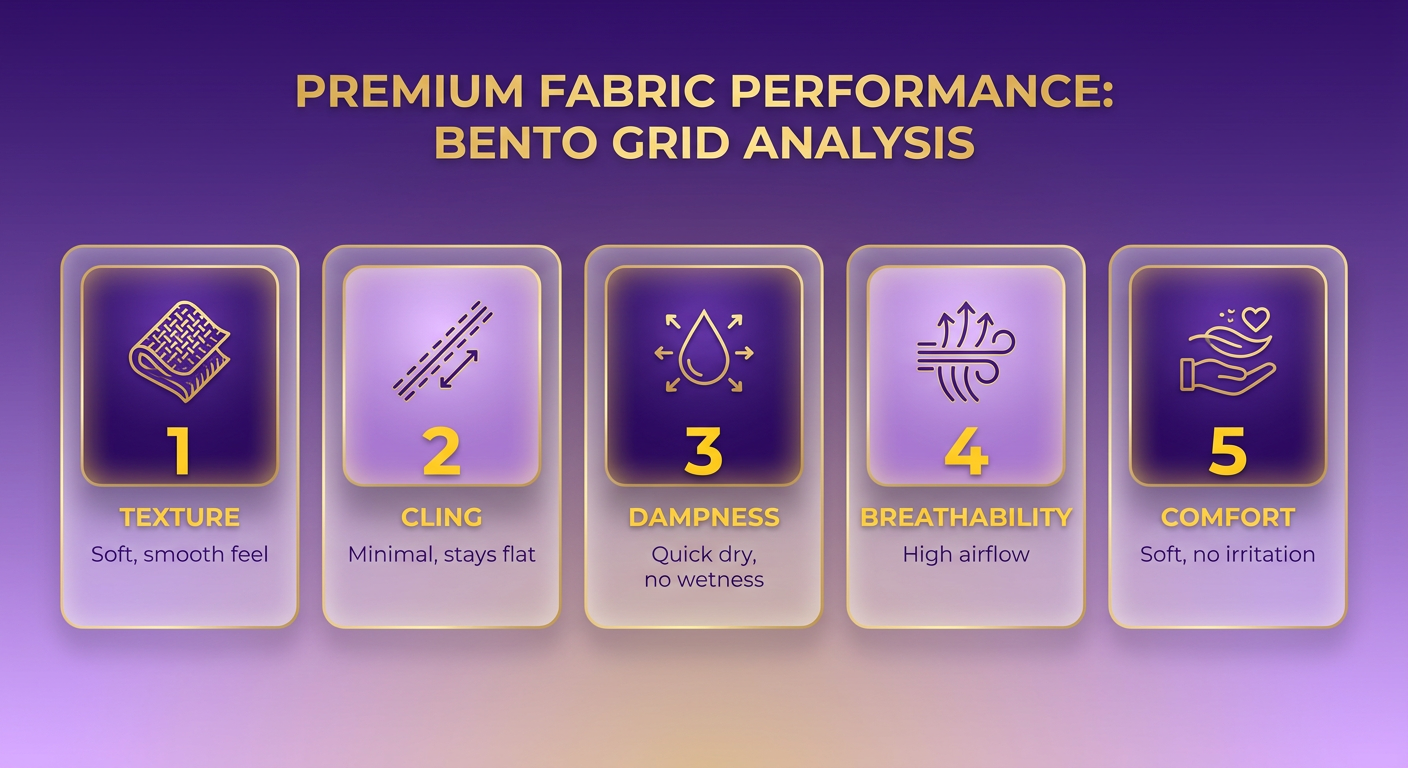
Why Pima cotton feels different on cool-down skin
Pima cotton wins the post-gym tactile test for a specific mechanical reason: it softens as it absorbs. Purecare's hot-weather fabric breakdown credits Pima's long-fiber construction for its softness, and that structure matters most when your skin is still warm and sensitized from exercise. The fibers lie smoothly against skin rather than scratching across it. Polyester, by contrast, is a hydrophobic fiber with a slick surface during exercise. But once sweat slows and the fabric stops actively wicking, many women notice it sits stiffly rather than draping.
Fit plays into this too. Meredith McQuerry's work, cited by the AP, makes the point that looser fits suit casual settings while tighter fits suit exercise. Pima's natural drape supports that shift. A well-cut Pima piece moves with you at rest, whereas performance mesh is engineered to compress and support movement, which can feel restrictive when you're trying to wind down.
How drape affects heat escape
Drape isn't just an aesthetic quality. It determines how much of the fabric stays in contact with your skin as you settle into a chair, lean against a counter, or sit through a meal.
A fabric that clings holds your body heat against you. A fabric that falls away creates a small air gap. And that gap is where passive cooling happens once you stop generating heat. This is what makes post-workout wear different from workout wear: you no longer need a fabric that pulls sweat off your skin at speed. You need one that holds its shape away from your body and lets air circulate through the weave.
The knit's physical structure decides how quickly that air gap forms. Szonei Fabrics' breathability analysis shows how yarn spacing and fabric density dictate heat transfer. A lighter, more open cotton knit re-establishes the air gap faster than a dense one, because there's less mass pressing against warm skin and more room for convection to carry heat off. That's why the same fiber can feel airy in one garment and clammy in another. The weave matters as much as the material.
The irritation and odor factor nobody talks about
Skin sensitivity spikes during cool-down. Blood flow redistributes, the skin is flushed, and small friction points that felt invisible at peak effort suddenly register.
Research on fabric and thermal comfort consistently shows synthetic fabrics can increase localized moisture and friction in high-contact zones during the shift to rest. Pima's smooth, long-staple surface reduces that friction directly, which is one reason it stays a preferred choice for wear that bridges activity and everyday life.
There's a sensory dimension thermal data alone misses, too. Backpacking Light's community testing on hot-climate fabric reinforces it: synthetic garments often need specialized antimicrobial treatments to stay wearable over a full day. Pima cotton's natural fibers don't harbor those microbes, so the fabric stays fresh without chemical finishes. Its open weave vents heat and moisture on its own, which keeps you feeling fresh the moment you walk into a social setting.
| Sensory Factor | Polyester Mesh | Peruvian Pima Cotton |
|---|---|---|
| Hand feel post-sweat | Stiff, synthetic texture | Soft, smooth against skin |
| Drape at rest | Structured, form-fitting | Falls away, reduces skin contact |
| Odor release | Traps odor compounds | Open weave releases vapor |
| Skin irritation risk | Higher at cool-down | Lower due to long-fiber smoothness |
| Versatility: studio to street | Performance-focused | Designed for both |
One honest caveat: if you're still moving briskly, power-walking between errands or cycling home, polyester's wicking advantage lasts a little longer. The cotton case strengthens the more fully you've settled into rest. For the seated coffee-shop scenario, Pima wins clearly. For the active commute home, it's closer.
The takeaway for cool-down is that the fabric doing the most work is the one you stop thinking about. A fiber that softens as it warms, drapes away as you settle, and vents odor as you slow down is what carries a garment past the moment your heart rate drops. That's the window where performance-first materials quietly give up ground, and where a long-staple, breathable knit earns the second half of the day.
Durability, Care, and Longevity
Cotton's durability behaves differently than most fabric guides suggest, and it matters directly for women choosing summer wear with a longer lifespan in mind.
Does breathability survive repeated washing?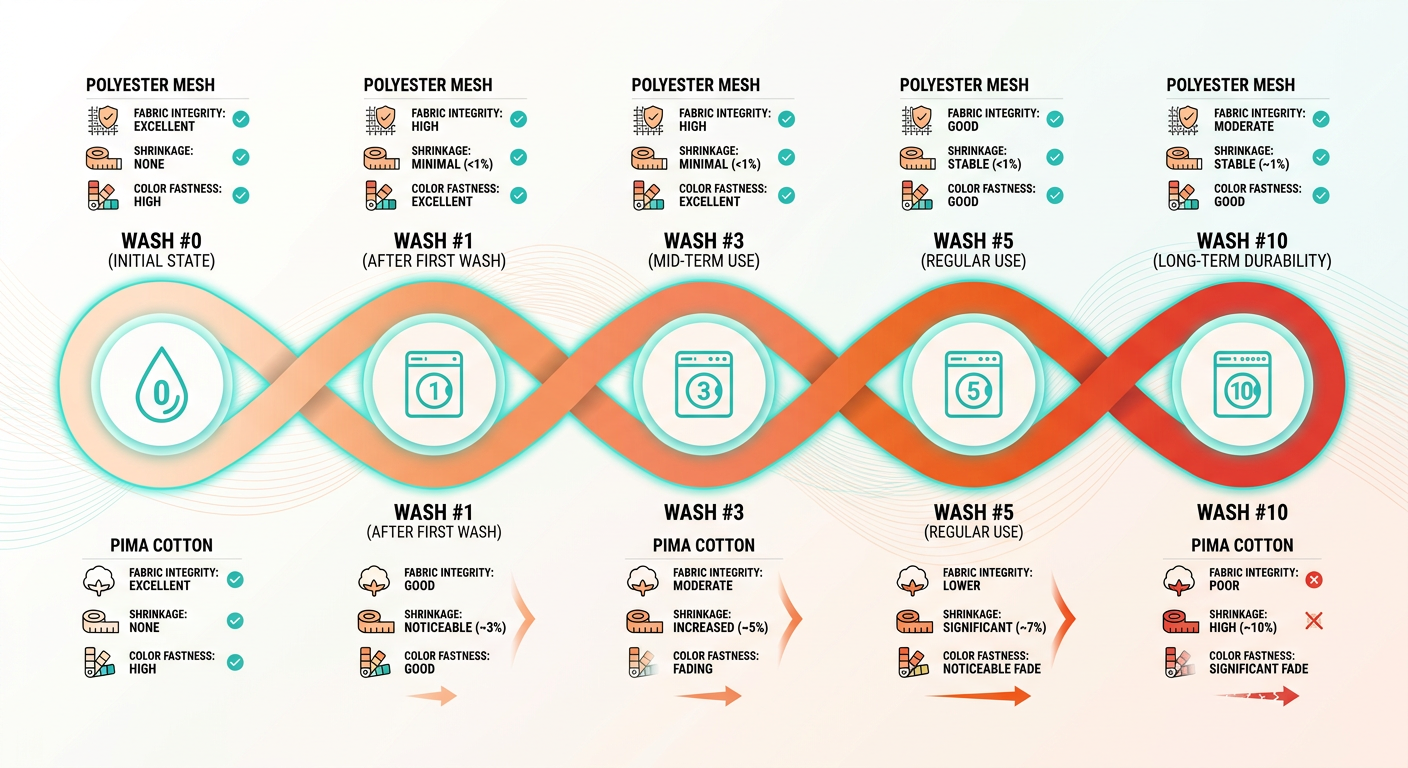
The answer differs sharply between the two fabrics, and not in the direction most people expect.
Alsco's comparison of polyester and cotton durability surfaces a detail that rarely makes it into activewear marketing: cotton fibers increase tensile strength when wet. That's the opposite of most synthetics, which weaken when repeatedly soaked and wrung. For a garment washed after every gym session, that fiber-level resilience compounds over time. A Pima piece washed 200 times has been through repeated wet-strengthening cycles. The fabric structure stays open and air-permeable rather than compressing under repeated agitation.
Polyester has a different durability story. It resists shrinking and fading well, and Alsco's analysis confirms it holds shape better than cotton across general use. But synthetic fibers are prone to "permastink," where organic compounds build up in the hydrophobic channels over time, gradually degrading the garment's usability even when the physical structure holds.
That creates a durability metric standard lab wear-testing misses. A polyester mesh top can pass physical abrasion tests with flying colors and still become unwearable from persistent odor. Pima cotton's natural resistance to buildup means its functional lifespan in social settings runs significantly longer.
How each fabric ages in a sweat-heavy wardrobe
| Factor | Pima Cotton | Polyester Mesh |
|---|---|---|
| Fiber strength when wet | Increases | Neutral or slight decrease |
| Shrinkage risk | Low-moderate (cold wash, air dry) | Very low |
| Odor retention over time | Low, open structure releases compounds | Higher, tight weave traps odors |
| Shape retention | Very good with proper care | Excellent |
| Air permeability after 100+ washes | Maintained if not tumble-dried at high heat | Can compress slightly with heat |
| Post-gym social wearability at month 12 | High | Moderate and declining |
When to skip the cotton argument
If your wardrobe is purely performance-focused, competitions, long trail runs, high-sweat HIIT, running-specific guidance from Runners Need is clear that polyester's quick-dry and moisture-transport properties make it the right call during the workout itself. Don't choose Pima for those contexts and expect it to outperform a technical mesh.
The longevity argument for Pima holds specifically for athleisure worn across the full day, the workout plus the errands, the coffee, the lunch. The care routine that protects that longevity is short: cold wash, hang dry, and skip fabric softeners, which coat the fibers and gradually reduce the very air permeability you paid for. Skipping the dryer alone prevents the high-heat compression that shortens the useful life of most knit garments, so a Pima piece keeps its hand feel and structure for years rather than seasons.
The value case follows from the durability picture. A polyester mesh top that gradually embeds odor and loses its social appeal by month eight isn't the better buy, even at a lower sticker price. Measured on cost-per-wear rather than purchase price, a well-cared-for Pima piece keeps earning its place in the rotation and stays genuinely wearable past the gym every time.
Final Verdict and Best-For Recommendations
Here's what a full season of testing settled: mesh owns the sweat-soaked hour, Pima owns the transition into everything that follows. If your day ends at the locker room, mesh is fine. If your gym clothes have to carry you into a café, a school pickup, or brunch, Pima keeps up.
The reason isn't marketing. It's the phase shift traced across this whole comparison. During peak effort, the physics of sweat evaporation favor synthetics while your sweat rate outpaces cotton. The moment you stop, that math flips.
Which fabric is most breathable for summer, scenario by scenario?
Match the fabric to the moment, not to a blanket rule. Here's how we map it for our own customers.
| Scenario | Best fabric | Why |
|---|---|---|
| High-intensity cardio, running | Polyester mesh | Wicks sweat away fast and dries quickly at high sweat rates |
| Yoga cool-down + post-gym errands | Peruvian Pima cotton | Passive breathability and comfort take over as sweat rate drops |
| All-day wear, gym-to-social | Peruvian Pima cotton | Breathable, air-regulating, no trapped odor in close company |
| Ultra-light travel / packability | Polyester mesh | Lightweight, quick-dry, packs small for on-the-go layering |
Notice cotton doesn't win everything. That's the honest read.
Why Pima cotton wins the post-gym cool-down
Three reasons, and they compound. First, breathability. Cotton allows excellent air permeability to help regulate body temperature, whereas polyester can create a warm microclimate against your skin even as it wicks.
Second, odor. Polyester's synthetic fibers are prone to retaining organic residues once you're not actively sweating. This is the hidden social veto on mesh: nobody wants a lingering gym smell during a post-workout meetup. Pima cotton naturally resists that retention, releasing organic compounds easily in a standard wash.
Third, feel and longevity. Because Pima cotton has high structural integrity, it keeps its luxurious hand feel and open knit through hundreds of laundry cycles without thinning or pilling.
When polyester mesh still makes sense
Synthetics remain the logical choice for continuous, high-output training. Athletes in endurance sports rely on polyester's rapid drying to prevent chafing during long efforts. If your routine is pure training with no social transition, technical mesh remains the standard.
And while moisture-wicking gets marketed as a cooling technology, evaporative cooling behaves differently in static environments. Once your sweat rate drops, a fabric that allows passive airflow keeps you far more comfortable than one designed only to pump liquid.
Quick buying tips
- Look for certified extra-long staple Pima. The long fibers are what create the open, air-moving cloth.
- Check the weight before you buy. A mid-weight jersey around 150–180 gsm hits the balance between drape and airflow for transition wear; anything heavier starts to hold heat.
- Reserve mesh for your hardest sessions, then change or layer for the social hours after.
- Wash cold and skip fabric softener, which coats fibers and dulls the breathability you paid for.
Match the fabric to where your day actually goes, and you'll spend less on pieces that only work for one hour of it. Our Peruvian Pima cotton line is cut for that stretch after the workout, and the full range is waiting in our shop.
References
[1] Casual and Cool: Polyester or Cotton/Merino? - Backpacking Light - https://backpackinglight.com/forums/topic/104920/
[2] News - Is Polyester Cooler than Cotton? - https://www.fuzhoutextile.com/news/is-polyester-cooler-than-cotton/
[3] Polyester vs Cotton: Differences and Which is Better? | Alsco - https://alsco.com/resources/polyester-cotton
[4] Cotton vs Polyester - which keeps you cooler? - MF Safety & Workwear - https://mfsafety.co.uk/cotton-vs-polyester-which-keeps-you-cooler/
[6] Stay Cool with the Best Fabrics for Hot Weather - Purecare - https://www.purecare.com/blogs/pure-wellness-journal/best-fabrics-for-hot-weather?srsltid=AfmBOoooXcJ4Y0rScXDqeJ3wNRnBej0Dmt7mX_M8ypCqHdo_oTkRCD68
[7] 11 Breezy Summer Fabrics to keep you cool in the heat - YouTube - https://www.youtube.com/watch?v=Ib2PWRU352M
[8] The Best Fabrics for Running Clothes - Runners Need - https://www.runnersneed.com/expert-advice/gear-guides/best-fabrics.html
[9] The Best Fabric for Hot Weather Workouts: How to Stay Cool During ... - https://freecountry.com/blogs/outsideisours/the-best-fabric-for-hot-weather-workouts-how-to-stay-cool-during-summer-training?srsltid=AfmBOor7kWAfzalASrR8V8E5tRu1c8-BwqG62OvfvxLC8zIR8NbY6lk_
[10] How To Stay Cool: The Best Fabrics for Hot and Humid Weather - Baleaf - https://www.baleaf.com/blogs/all-blogs/how-to-stay-cool-the-best-fabrics-for-hot-and-humid-weather?srsltid=AfmBOopvYyWCmel5VEA-qi4b7s7g2LCdbPLdQuQuuDcfPMZfUDWqIQPM
[11] Cotton vs Polyester Breathability: Best Fabric for Hot Climates - https://szoneierfabrics.com/cotton-or-polyester-which-fabric-has-better-breathability-for-hot-climates/
[12] The best fabric for extreme heat? It's more complicated than you think - https://www.ap.org/news-highlights/spotlights/2026/the-best-fabric-for-extreme-heat-its-more-complicated-than-you-think/
[13] Clothing - National Collaborating Centre for Environmental Health - https://ncceh.ca/node/36950
[14] Thermo-Physiological Comfort Properties of Sportswear ... - PMC - https://pmc.ncbi.nlm.nih.gov/articles/PMC8624076/
Frequently Asked Questions
1. Can I wear Pima cotton for hot yoga or high-intensity classes?
It is best to avoid cotton for high-intensity, high-sweat environments. When physical exertion is continuous, cotton absorbs moisture rather than transporting it, causing the fabric to become heavy and clingy. Technical synthetics are specifically engineered to move liquid away from the skin rapidly during peak sweat production.
2. Why does polyester smell worse than cotton after a workout?
Synthetic fibers are chemically lipophilic, meaning they naturally attract and bind to the oils found in sweat. This creates an ideal environment for odor-producing bacteria to thrive. Natural cotton fibers do not share this chemical attraction, allowing sweat residues to wash out completely and preventing long-term odor buildup.
3. Does a lighter fabric always keep me cooler?
Not necessarily. Fabric weight is only one part of the equation; the weave construction is equally important. A tightly woven lightweight synthetic can restrict airflow, whereas a slightly heavier but highly porous knit allows heat to escape easily. Look for open-stitch constructions that facilitate natural ventilation.
4. If I'm cycling or power-walking home, should I stay in polyester?
Yes, keeping your synthetic gear on is beneficial if you are maintaining an active pace. The moisture-transport properties of polyester continue to assist with sweat evaporation while you are in motion. Once you transition to a stationary state and your body temperature begins to normalize, switching to a breathable natural fiber will feel much more comfortable.
5. What should I check on a garment label besides fiber type?
Look closely at the weave description and the fabric weight. A fine, long-staple knit like Pima jersey offers excellent air permeability for daily wear, combining natural comfort with structural durability that synthetic alternatives cannot match.
6. Why does drape matter for staying cool after exercise?
Drape dictates how a garment hangs on your body when you are stationary. If a fabric clings tightly to damp skin, it traps a layer of warm, humid air next to your body. A fabric with excellent drape naturally falls away from the skin, creating a ventilation pathway that allows body heat to dissipate naturally.
7. Does skin sensitivity change after a workout?
Yes, post-exercise vasodilation increases blood flow to the skin's surface, making it far more sensitive to tactile irritation. Coarse or stiff synthetic fibers can cause micro-abrasions and discomfort during this phase. The exceptionally smooth, long-staple fibers of Pima cotton minimize surface friction, providing a soothing feel when your skin is flushed.