How to Swap Synthetic Activewear for Pima Cotton Without Losing Softness
September 22, 2026
Why the Switch to Pima Cotton Is Worth a Look
Our community asks us the same thing almost weekly: can a natural fiber keep up during a sweaty flow, or does switching mean giving up performance? Built right, pima cotton activewear for women holds up beautifully. The reasons go beyond comfort. They also affect skin health and wash water.
If you practice often, start with your next-to-skin layer. Choose engineered pima knit with a moisture finish, not a plain woven tee. That single change gets you most of the benefit with less risk. Check the finish chemistry instead of assuming “natural” means untreated.
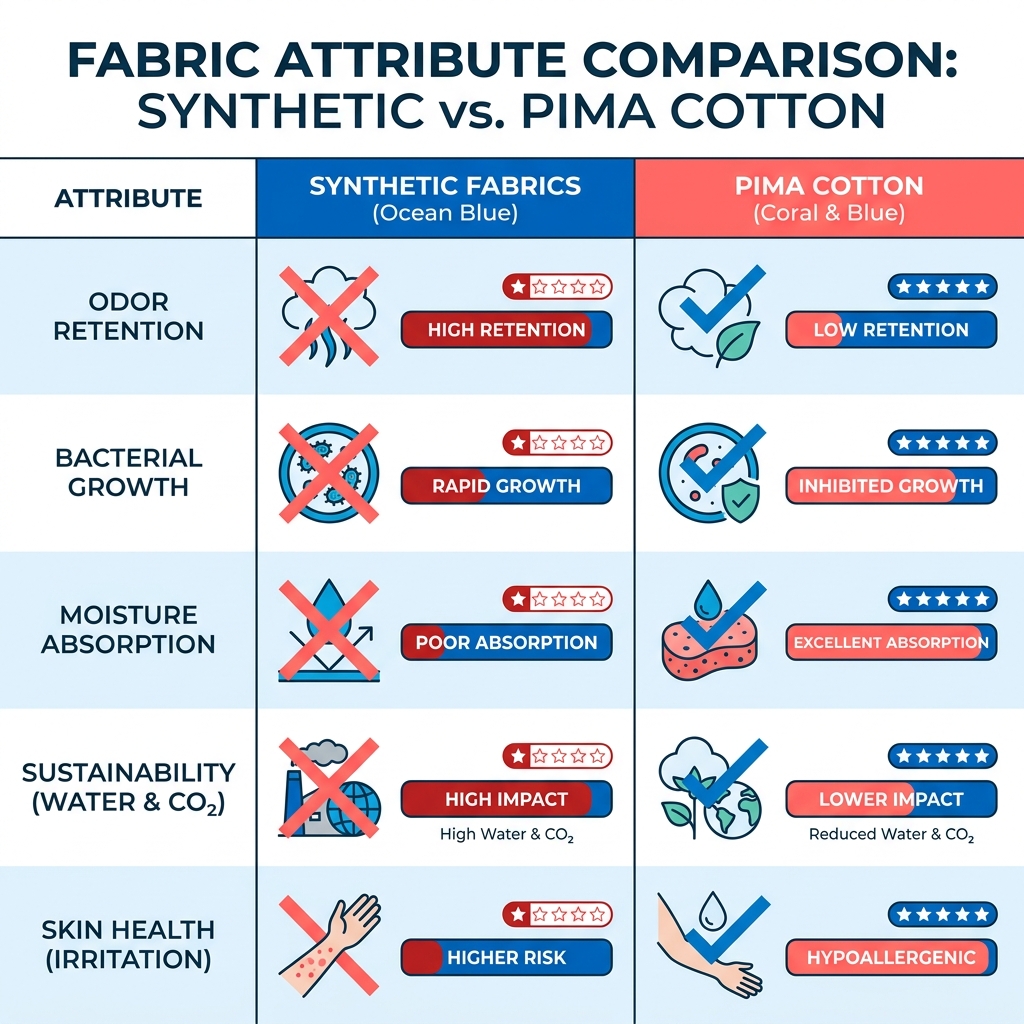
Here's what pushed us toward the material. Synthetic fabrics hold odor and feed bacteria. That growth keeps going even after washing, according to Cotton Incorporated's research. That's why your favorite polyester leggings smell an hour into class, even after careful laundering. Certified Peruvian pima is selected to sidestep more of that odor cycle at the fiber level.
Are Synthetic Fabrics Actually a Health Concern?
For a growing number of women, yes. Some moisture-wicking synthetics are treated with PFAS, the “forever chemicals” linked by some public health researchers to thyroid issues, fertility problems, and other endocrine effects. A Strategist writer who tested non-synthetic activewear admitted she first wrote off the synthetics-free movement as hysteria, then discovered a thyroid issue of her own and pledged to buy only cotton, wool, and earth-derived fabrics.
We're not here to diagnose anyone. But if you do hot yoga in the same garment several times a week, against your skin, for years, the material touching you matters. Pima can give you breathability and freshness at the fiber level. That does not mean a moisture-finished pima garment is automatically free of chemical inputs, so look for a clear PFAS-free statement from the brand when a finish is used.
Does Cotton Really Perform, or Is That Wishful Thinking?
This is where scope matters. Plain woven cotton is genuinely bad for hard workouts. Seamwork's fabric guide calls it hydrophilic, capable of holding up to 25 times its weight in water, and painfully slow to dry. If you're shopping for a 100 percent cotton tee to sweat in, skip it. That advice is correct.
The picture flips with modern construction. TransDRY and STORM COTTON are performance finishes, not natural cotton properties. Cotton Incorporated's research describes TransDRY-treated cotton as drying up to twice as fast as regular cotton, and STORM COTTON is marketed as repelling liquid while keeping the fiber's natural softness. Add a small stretch percentage and the fit problem disappears too.
Two independent fixes stack here, and that's the whole case for a smart swap. A performance finish solves the drying complaint Seamwork raises. A touch of stretch solves fit and support. Neither one alone answers the objection. Together they close it. The Strategist tester found an 84 percent organic cotton bra performed like a classic Nike sports bra.
One caveat: the finish names tell you the function, not the chemistry. TransDRY and STORM COTTON are finishes, and whether a given finish is PFAS-free depends on the processor and the specific formulation. A cotton garment can be natural at the fiber level and still carry a synthetic performance finish, so verify that separately.
What This Comes Down to for Us
We build for women who want to feel good in what they wear and good about what it's made from. Choosing certified pima is a decision about softness, about skin, and about not shedding microplastics into the wash water with every rinse. Comfort and conscience don't have to compete. Chosen carefully, the fabric lets them reinforce each other. But “chosen carefully” also means weighing fiber source, water footprint, and finish chemistry together.
The Short Version
- Synthetic fabrics harbor odor-causing bacteria that keeps multiplying even after washing, which is why polyester leggings smell an hour into class.
- Some moisture-wicking synthetics carry PFAS “forever chemicals” linked to thyroid dysfunction, fertility problems, and other endocrine effects.
- Plain woven cotton absorbs up to 25 times its weight in water and dries painfully slowly, making it genuinely poor for hard workouts.
- TransDRY-treated cotton is described as drying up to twice as fast as regular cotton, while STORM COTTON repels liquid without sacrificing natural softness—both are finishes, not natural cotton behavior.
- The Strategist tester found an 84 percent organic cotton bra performed like a classic Nike sports bra.
Performance Comparison: Softness, Moisture Management, and Breathability
Here's the tension we work through with anyone shopping for pima cotton activewear for women: two credible sources say almost opposite things about cotton on a sweaty body. One sewing guide calls it a terrible activewear fabric because it holds up to 25 times its weight in water and takes forever to dry. A fabric-science team argues that performance-finished cotton dries fast and stays cool.
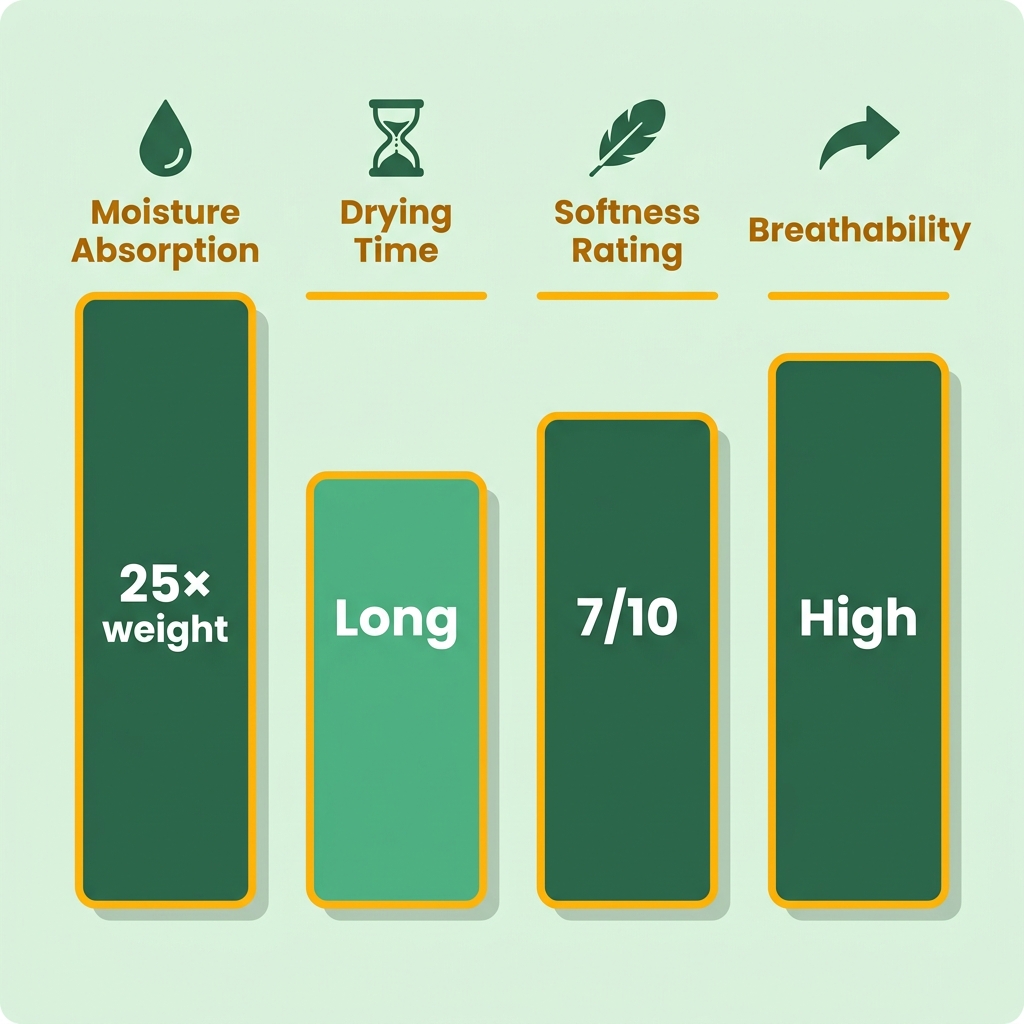
Both are right. They're describing different fabrics. The first is a plain woven tee. The second is engineered pima knit with a moisture finish and a touch of stretch. That gap is the whole game when you make the swap, so let's take performance apart along the three things our community actually asks about.
How does softness really compare?
Pima wins outright, and nobody disputes it. Long-staple pima feels smoother against skin than polyester-spandex or nylon-elastane, which is why women who've been “babied by the slickness of nylon,” as one Strategist writer put it, still find the switch comfortable.
Softness is the one metric where you don't trade down. A synthetic blend can feel technical and cool, but it rarely feels plush.
Can cotton keep up on moisture and breathability?
This is the part people fear. Untreated cotton soaks and clings, and some synthetic wicking fabrics dry much faster than plain cotton. Buy a basic cotton tee for hot yoga and you'll regret it.
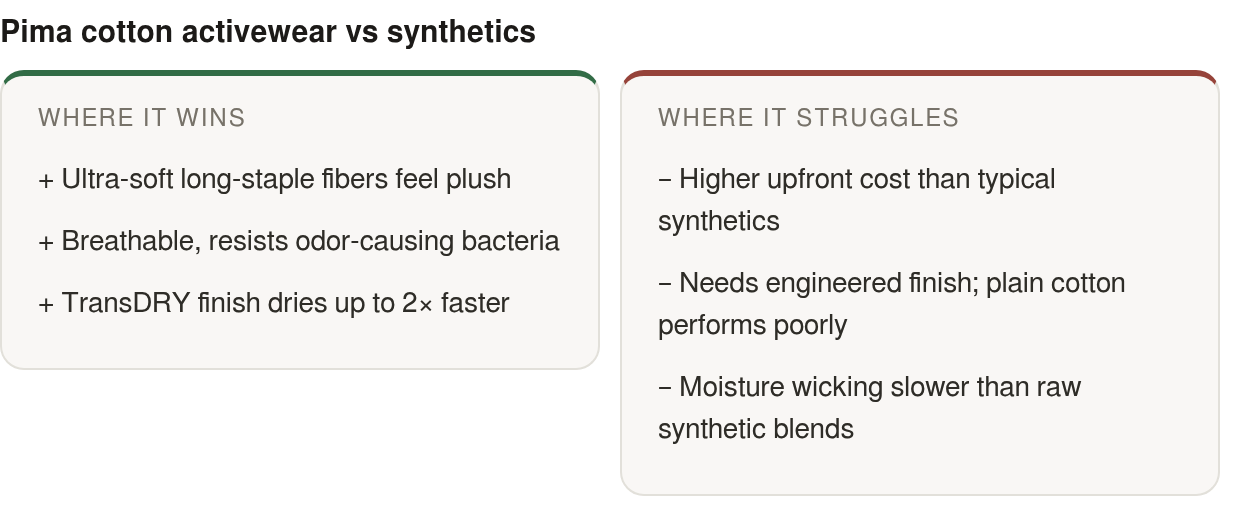
But finished pima closes most of that gap. TransDRY-treated cotton dries up to twice as fast as regular cotton, and STORM COTTON repels liquid without killing the fiber's natural breathability. Cotton also breathes better at rest, since it doesn't trap odor-causing bacteria the way synthetics do.
The physics help explain why. Cotton's natural moisture regain is higher than polyester's, so cotton can pull vapor off skin before you feel soaked, while polyester tends to push sweat back onto you. That absorb-then-release behavior is what makes a low-to-moderate sweat session feel cooler in finished pima, and it's why the fiber content on the tag matters as much as the finish name.
Across Seamwork's guide and the Strategist test, the clearest use case is low-to-moderate work: studio classes, walking, barre, and flows. High-output or hot sessions are still where raw synthetic wicking holds the strongest advantage.
The side-by-side matrix
| Metric | Finished Pima Cotton | Polyester/Nylon Blend |
|---|---|---|
| Softness | Highest, smooth long-staple hand | Slick but flat |
| Moisture wicking | Good with finish, up to 2x faster than plain cotton | Fastest raw wicking |
| Breathability | High, resists odor | Moderate, traps bacteria |
| Durability | Strong, holds shape with a touch of stretch | Very strong |
| Care effort | Air-dry, gentle wash | Wash-and-go |
| Cost | Mid to premium | Budget to mid |
One thing worth checking before you buy: run your hands over the fabric and do Seamwork's 10cm-to-15cm stretch check. Mark 10 cm of fabric, stretch it to 15 cm, and note whether it recovers or sags. Then confirm the piece is engineered pima knit rather than a plain woven tee. That's the difference between fabric that moves with a flow class and fabric that fights you.
Practical Wardrobe Transition: Styling, Fit, and Versatility Tips
You don't have to overhaul your closet in one weekend. The smartest way we've seen women move into pima is to treat a few soft, well-cut pieces as anchors, then build outward from what you already own.
Start with the top. A fitted pima tee or a relaxed cotton tank pairs cleanly with the synthetic leggings still in your drawer, so you get next-to-skin softness up top while your bottoms keep doing their job. That single swap is the easiest entry point, and it costs you nothing in style.
Fit Language Changes How Everything Layers
Fit terms aren't just marketing. Relaxed, fitted, and high-rise each behave differently once you start stacking pieces, and knowing the difference saves you a lot of dressing-room frustration.
A high-rise cotton bottom sits at the natural waist, which means a slightly cropped or boxy top layers over it without bunching. Go relaxed on top, fitted on the bottom, or flip it. One loose layer against one close layer reads as intentional. Two loose layers read as pajamas.
For cooler mornings, add a long cotton layer you can knot at the waist or leave open over a fitted tank. That keeps the breathable base doing its work during a warm flow while giving you coverage on the walk in.
The Capsule Is Built on Color, Not Volume
You want fewer pieces that mix, not more pieces that clash. We steer women toward a tight color story: two neutrals and one accent. Soft cotton takes dye beautifully and holds its tone longer when you wash it cold and skip the harsh detergents, which is the same care rhythm this whole switch depends on.
Keep accessories quiet so the fabric stays the star. A canvas or leather tote, clean low-profile sneakers, and small everyday jewelry carry a studio look straight to a coffee meeting without a wardrobe change.
Photograph your favorite combinations and tag them when you post. Seeing how other women style the same anchor top is the fastest way to find pairings you'd never have tried on your own.
What Pima Actually Costs You Over Time
Let's talk money, because that's where most women hesitate before switching. A rack of synthetic leggings can run cheaper up front, and pima usually costs more per piece. That premium is real, and it deserves an honest defense.
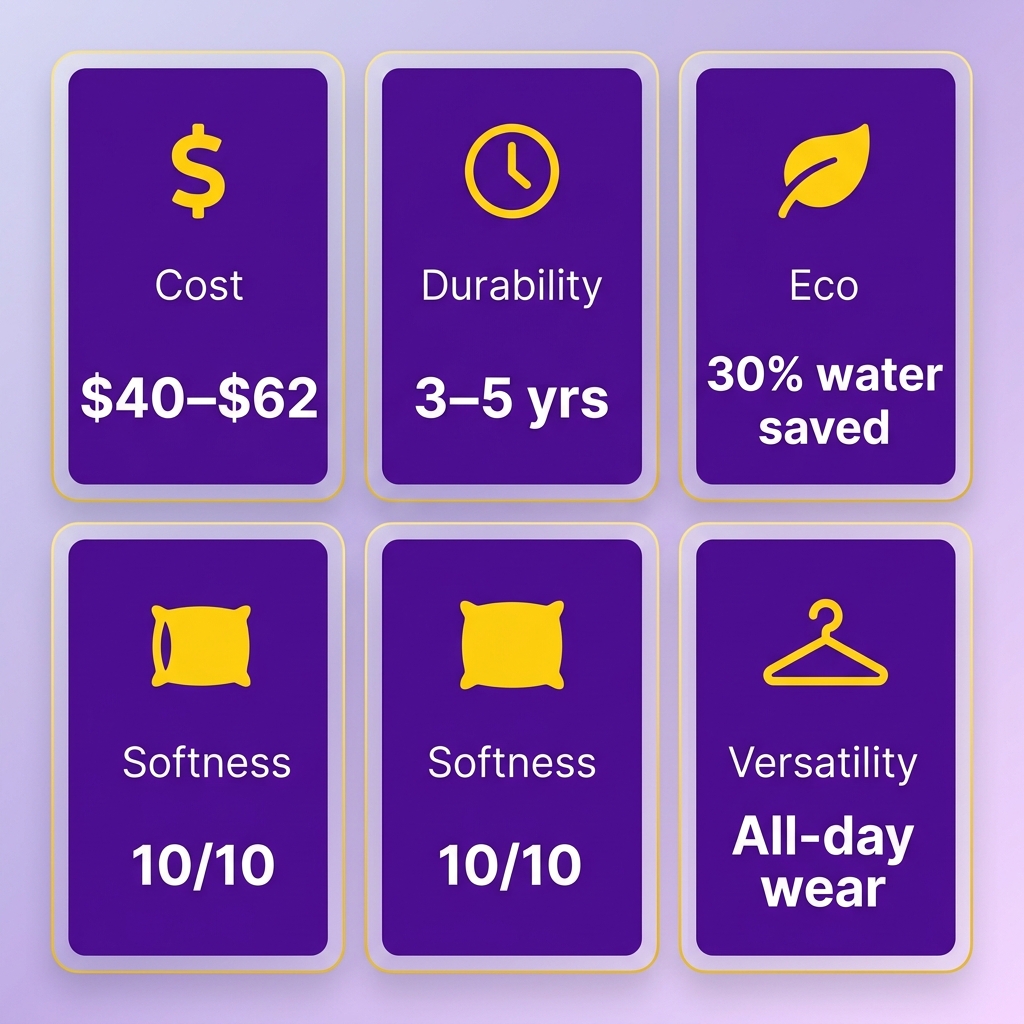
Here's the math we walk women through. Cheap synthetic pieces wear out. They pill, thin, and start holding odor no matter how you launder them, so you replace them on a rotating basis. A well-made pima garment can resist that breakdown because the extra-long fibers mean fewer exposed ends, less pilling, and a surface that stays smooth through hundreds of wears. You may buy once instead of three times.
The Replacement Cycle Is the Hidden Cost
Price per wear tells the truth that the shelf tag hides. A cheap synthetic top you toss after a season can cost more over time than a pima piece you keep for years. The longevity closes the gap, then flips it.
Our pima also holds its shape and color past dozens of wash cycles. That matters when you're deciding whether a garment stays flattering or sags into something you stop reaching for.
Traceability You Can Actually Follow
The sustainability story here isn't a vague green label. This cotton is 100% certified, grown in the warm coastal valleys of northern Peru, and hand-harvested to protect the fibers from damage. That careful picking preserves softness and keeps color rich, and it comes from a supply chain you can trace back to the source.
Compare that to the anonymous channels behind a lot of fast athleisure, where you rarely know which mill spun the yarn or how it was grown. If origin doesn't matter to you and you just want the cheapest legging for occasional wear, skip the premium. It's honestly not worth it for a piece you'll wear twice a month.
But origin alone is not the full sustainability case. Cotton's water footprint can vary widely depending on irrigation practice and growing region, and a performance finish is a chemical input. A certified source, a lower-impact water story, and a PFAS-free finish have to be considered together. Ask the brand about water and finish chemistry just like you ask about fiber origin.
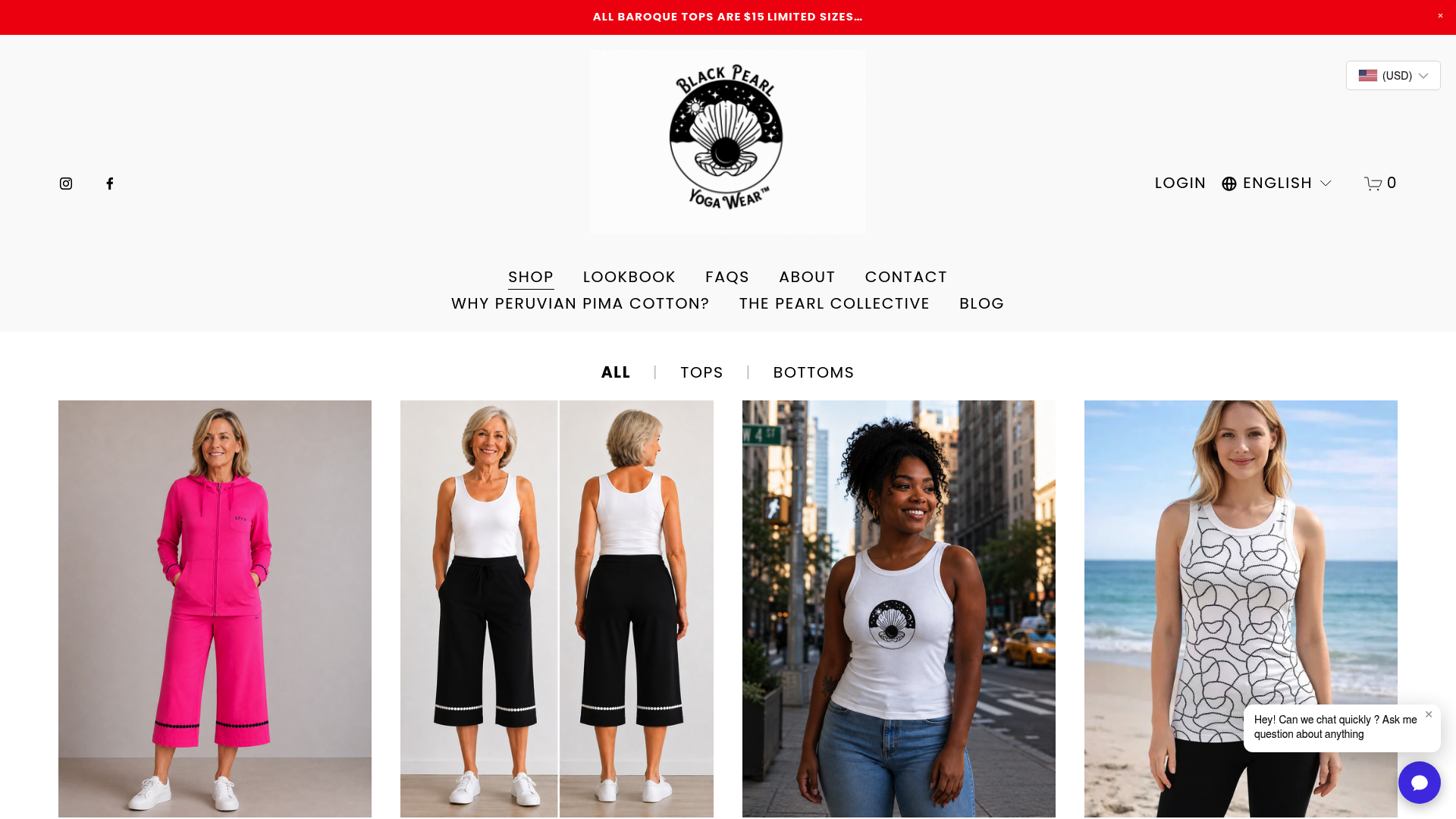
If you practice often, wash often, and want your clothes to last, the value math favors cotton. You can see the full range on the shop page.
References
[1] How Cotton Activewear Works Harder for You - https://cottontoday.cottoninc.com/how-cotton-activewear-works-harder-for-you/
[2] A guide to activewear fabrics - Seamwork - https://www.seamwork.com/fabric-guides/a-guide-to-activewear-fabrics?srsltid=AU7gw4UMEISL-vrXUwvXZM6IqT_bDhVUJ0PAAR8B_ok0MlzeiV2GrgkZ
[3] I Tried All the Non-Synthetic Activewear I Could Find - https://nymag.com/strategist/article/i-tried-all-the-non-synthetic-activewear-i-could-find.html
Still Wondering?
1. Is finished pima cotton good enough for high-intensity or hot yoga sessions?
Finished pima is the stronger call for low-to-moderate sweat sessions, where cotton's natural moisture regain can pull vapor off skin before you feel soaked. For heavy-sweat hot yoga, raw synthetic wicking still tends to dry fastest, though TransDRY-treated pima may close much of that gap depending on the finish and garment construction.
2. How can I tell engineered pima knit from a plain cotton tee before buying?
Run your hands over the fabric and do Seamwork's 10cm-to-15cm stretch check. Mark 10 cm of fabric, stretch it to 15 cm, and note whether it recovers or sags. Engineered pima knit should have visible give from a touch of stretch and a smooth long-staple hand, while a plain woven tee feels flat with no stretch. That single difference decides workout performance.
3. Does pima cotton activewear contain PFAS or other chemical treatments against the skin?
Not automatically. Pima is a fiber, not a finish. Many plain pima pieces have no added finish, but if a garment is marketed as TransDRY, STORM COTTON, or moisture-wicking cotton, that is a performance finish. Whether a finish is PFAS-free depends on the chemistry the processor uses, so ask the brand for documentation. Natural fiber alone does not guarantee that nothing chemical sits next to your skin.
4. How should I wash pima cotton to keep it soft and colorfast?
Wash cold, skip harsh detergents, and air-dry. This gentle rhythm preserves the dye tone and keeps the long-staple fibers smooth, so the garment holds its shape and color past dozens of wash cycles instead of pilling and fading.
5. Is pima cotton activewear worth the higher price if I only work out occasionally?
For twice-a-month wear, the premium honestly isn't worth it, and a cheap synthetic legging serves fine. The value math favors pima when you practice and wash often, since fewer exposed fiber ends resist pilling and one durable piece can replace several worn-out synthetics.