8-Minute Yoga Flow to Improve Posture
September 29, 2026
Before we get into it, the short version:
- The 8-minute flow comes from Taylor Lorenz, a certified teacher with more than 800 hours of training across vinyasa, hatha, and yin styles.
- Seven phases carry you from Thunderbolt to a closing Mountain and Side Bend. You need nothing but a mat and a little floor space.
- Muscle adaptation takes weeks. The earliest reliable sign you're making progress is that standing tall feels easier, not anything you can see in the mirror.
- Two phases, Low Lunge with Side Bend and the Wide-Legged Revolved Fold, land at moderate difficulty. The other five stay easy.
- Slouching at a non-ergonomic desk tightens the chest, rotates the shoulders inward, and weakens the back muscles meant to hold you upright.
- The flow leans on backbends, twists, and lunges instead of forward folds. Some coaches warn that folds can round the spine further.
- Every pose stays low to the ground or steady on two feet. No inversions, no deep binds, no balance tricks for beginners.
Related Video
Watch: 8 Minute Pilates for Posture Workout | Good Moves | Well+Good by Well+Good
Quick Summary
You know that end-of-day ache. Shoulders creeping toward your ears, low back tight, chin drifting forward after hours at the laptop. This 8-minute flow is our answer, and it's built to move with soft, breathable athleisure rather than fight it.
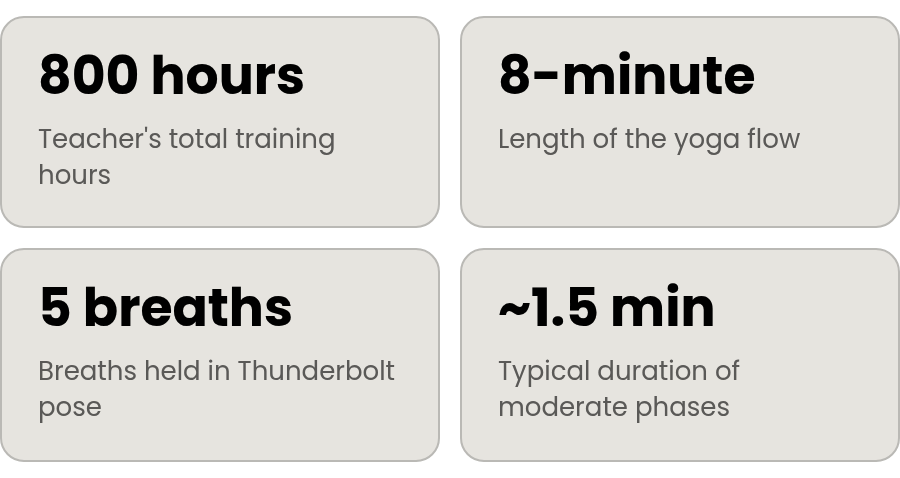
Here it is in seconds. The sequence comes from Taylor Lorenz, a certified teacher with training in vinyasa, hatha, and yin. It needs no props, takes eight minutes, and is designed to undo the slouch that sitting builds in. Forgiving Peruvian Pima cotton leggings let your hips open and your spine round without a waistband digging in. That matters when the goal is a daily habit.
What does the full flow look like at a glance?
Difficulty: beginner-friendly. Every pose stays low to the ground or steady on two feet, with clear breath cues you can follow on a first try. No inversions, no deep binds, no balance tricks.
| Phase | Time | Target Area | Difficulty | Props | Suggested Wear |
|---|---|---|---|---|---|
| Thunderbolt (5 breaths) | ~1 min | Spine, posture reset | Easy | None | Stretch cotton leggings |
| Kneeling Cow & Cat (3 rounds) | ~1 min | Full spine mobility | Easy | None | Fitted breathable top |
| Eagle & Cactus Arms | ~1.5 min | Shoulders, upper back | Easy | None | Roomy-shoulder tank |
| Low Lunge + Side Bend | ~1.5 min | Hip flexors, obliques | Moderate | None | Breathable Pima cotton leggings |
| Wide-Legged & Revolved Fold | ~1.5 min | Hamstrings, spine twist | Moderate | None | Versatile Pima cotton set |
| Down Dog + Standing Fold | ~1 min | Full-body lengthen | Easy | None | Breathable Pima cotton set |
| Mountain + Side Bend + Close | ~0.5 min | Postural awareness | Easy | None | Anything you feel tall in |
Why does an 8-minute flow beat a longer session?
Repetition matters more than intensity here. Muscle adaptation takes weeks, and the first honest sign of progress is simply that standing tall feels easier. A short flow you do every day quietly outperforms a long one you do now and then. That's our read after pulling together the Yoga Journal practice and posture-specific coaching like Man Flow Yoga's posture fix.
One honest note. Some coaches warn that flows built only on forward folds can round the spine, the opposite of what sitting-tired bodies need. This sequence keeps a fold or two for release but leans on backbends, twists, and lunges to reverse the slump. That balance is the point.
The take-aways in three lines
- Posture reset without gear. Eight minutes, no props, no equipment needed beyond a mat and a little space.
- Core, breath, and alignment together. As Lorenz puts it, "practicing any type of yoga can go a long way toward improving your posture."
- Comfort does the quiet work. Soft, stretchy Pima cotton keeps fabric off your skin so nothing pulls as you fold, twist, and reach a little taller.

Why Eight Minutes Beats an Hour You'll Skip
You feel it around 3 p.m. The shoulders round. The chin drifts toward the screen. The low back starts to grumble. Hours at a laptop do that, and most of us aren't built to sit still that long.
The fix isn't a longer workout. It's a focused reset, plus clothes that stretch with you instead of pinching at the waistband. When your leggings move as your hips open and your spine rounds, you stop bracing against the fabric and start feeling your alignment. Soft, breathable Peruvian Pima cotton is what makes those daily minutes something you'll come back to.
Slouching Is the Desk Worker’s Default Setting
Modern life quietly rewires your posture. Non-ergonomic desk setups, endless scrolling, and long stretches of sitting set the stage for hunching, as Welltech explains. Slouching tightens the chest, rotates the shoulders inward, and weakens the back muscles meant to hold you upright.
Good posture isn't rigidity, either. Holding any one shape too long is the real trouble, and even proper alignment is something you're meant to move through rather than lock into. A brief daily flow interrupts that stuck pattern before it hardens into pain.
Short and Repeated, Not Long and Occasional
The posture game is quieter than most people expect. You're not chasing a dramatic before-and-after after one session. You're teaching the body to find a better default. Center for Yoga LA notes that the early win is felt before it's seen, which reframes the goal around consistency rather than intensity.
That's the honest reason short wins for women working from home. You'll do a few focused minutes between meetings. You won't carve out an hour most days. And the practice that gets done is the one that changes anything.
Start at the Pelvis, Not the Shoulders
Most posture routines rush to open the chest. We'd flip the order. The rounded shoulders and forward head you see in the mirror often trace back to a tucked pelvis. When the pelvis tucks under, it can pull the whole spine out of its natural line, so releasing there first tends to unwind more than the shoulders alone ever will.
Sequencing from the ground up, hips and pelvis first, tends to undo the slump more completely than jumping straight to backbends. This is also where forgiving fabric earns its keep. Leggings that let your hips settle into a low lunge without gripping mean you can find true pelvic alignment instead of fighting a seam.
There's real physiology behind the payoff, too. Yoga can strengthen deep back muscles and improve spinal stability. Those are the deep muscles that keep you upright long after the mat is rolled away.
Warm-Up & Preparation (Including Apparel Tips)
Before you flow, you warm up. A short one is enough. The goal isn't to sweat. It's to wake up the parts of you that have been folded into a chair all day, so your spine remembers what long feels like.
Start from the ground up. A short warm-up, plus athleisure built to move and breathe, sets the tone for the whole practice. When your waistband isn't cutting into a fold, you actually feel your hips open. That's the whole point of soft, stretch-friendly cotton against the skin.
Wake the Spine From the Pelvis Up
Begin on all fours and move through slow rounds of Cat-Cow, letting your breath set the pace. This gentle flexion and extension is the reset Center for Yoga recommends first, and it wakes the muscles that stabilize the spine before you ask them to hold you tall.
Then roll the shoulders. Up, back, and down, slow. Add a few small hip circles in a kneeling or standing position. That's your warm-up. Nothing fancy, just mobility before load.
Fabric That Moves So You Don't Fight It
Stiff clothing quietly limits your range. If a seam pulls when you reach overhead in a side bend, you shorten the reach without noticing. Versatile, comfortable pieces are meant to move with you instead.
Breathable fabric matters for a warmer reason too. As you move, your skin heats up. Certified Peruvian Pima cotton is long-staple and naturally soft, designed to let heat escape and keep that sticky, overheated feeling at bay during a short flow. Comfort isn't a luxury here. It's what keeps you coming back tomorrow.

We favor a comfortable, stay-put fit for posture work. Athleisure designed to move with you holds its place through Downward-Facing Dog and forward folds, so you're not tugging fabric back into place mid-breath. One less distraction, one more moment of actual alignment.
Props Are Optional, Consistency Isn't
The beauty of this flow is how little it needs. As Taylor Lorenz notes in her posture practice, no props are required. Just you, a mat, and a commitment to standing a little taller.
If you want support, keep it simple:
- One block if your hands don't reach the floor in a forward bend
Skip the strap and the bolster for this one. They add setup time, and the whole appeal of a short flow is that you'll actually do it.
Think of the warm-up as a doorway, not a separate workout. Set the mat, give your joints a little room, and keep the setup easy enough that you never talk yourself out of starting.
The 8-Minute Flow Breakdown
Eight minutes moves fast, so we split the flow into three short blocks. Each one has a job. The first wakes your core, the second frees your upper back, and the third stitches the whole body together. You can find the full sequence on Yoga Journal's posture practice, led by teacher Taylor Lorenz. Here's how we'd map it against clothes that actually move with you.
The gear matters more than people admit. A short flow, plus athleisure that gives at the hip and shoulder, is what lets you sink into each shape instead of bracing against a seam. When your leggings stretch as you hinge and your top follows your arms overhead, you feel your alignment rather than your waistband.
How Do You Wake the Core First?
Start kneeling in Thunderbolt, sitting back on your heels, spine stacked tall. Hold for five slow breath cycles and picture your vertebrae dropping straight into the floor.
Then flow into kneeling Cow and Cat. Inhale to arch and draw the shoulders back. Exhale to round and tuck the chin. Three rounds at the pace of your breath.
This is where sequencing from the pelvis up pays off. The Welltech posture guide explains the desk-body pattern, while Yoga Journal's strength piece connects shoulder position to what's happening lower in the spine. Wake the base first and the upper body has something honest to stack on.
What Frees a Stiff Upper Back?
Sit tall, sweep the arms up, then wrap left under right into Eagle arms and draw three small elbow circles before switching direction. That reach is the moment you notice whether a top pinches. A soft raglan sleeve lets the arm swing wide with no drag.
Come high onto your knees, cactus the arms, and take a gentle backbend. Feel the stretch across the collarbones.
This block is less about forcing a big arch and more about giving the upper back a direction it rarely gets during laptop hours. Open across the front body, breathe into the ribs, and let the shoulder blades slide rather than squeeze. Extension should feel spacious, not aggressive.
How Does the Flow Come Together?
Step into Low Lunge, arms up, then add a side bend for the obliques. Move through Wide-Legged Forward Bend and its revolved twist. Pause in Downward-Facing Dog for three breaths. This is where a forgiving waistband lets your hips hinge without folding fabric into your belly.
Finish standing. Roll up slowly into Mountain Pose, notice your new height, then take a Standing Side Bend each way.
The payoff isn't drama. It's the moment after the last breath when your head feels easier to carry and your ribs stack more naturally over your hips. Repeat the same pattern often enough and that ease becomes more available during the rest of the day.
Cool-Down & Recovery
The flow ends, but your body isn't done yet. This last stretch is where the work actually settles. Two quiet minutes let your heart rate soften, your shoulders drop, and your spine keep the length you just built.
A calm finish works better when your clothes stay out of the way. When you fold into a resting shape, the last thing you want is a seam pressing into your belly or a waistband fighting your breath. Soft, breathable cotton is designed to disappear against the skin, so you can sink instead of shift.
Let Restorative Shapes Undo the Hunch
Two poses do most of the work here. Sink back into Child's Pose, knees wide, forehead low, arms long. The Center for Yoga LA guide closes its own beginner sequence this way, and for good reason. It lengthens the back body that sitting keeps short.
Then roll onto your back for a Supine Twist. Drop both knees to one side, open the opposite arm, and let gravity wring out the mid-back tension a desk chair builds in. Hold each side for a few slow breaths.
These aren't showpiece poses. They're the ones that reverse the forward hunch quietly, which matters more than intensity for anyone at a laptop all day.
Breath Is the Mindfulness Cue
You don't need a script. You need attention. Rest a hand on your lower ribs and breathe so it rises and falls. That single point of focus is the whole meditation.
This is where the posture work becomes awareness instead of just movement. Yoga teaches you where your head and pelvis sit in space, so you can catch the chin creeping forward or the ribs flaring while you type. That awareness follows you off the mat.
Close the way many teachers do: hands to your heart, a small bow of the head, a quiet thank-you to yourself for the practice.
The Transition Back to Your Day
The minutes right after you finish are when stiffness creeps back if you rush. Stand slowly. Roll your shoulders once more.
And you don't have to change out of what you practiced in. We love versatile cotton for a work-from-home flow because it moves straight from mat to desk to school pickup, designed for ease of movement without pinching. Meant to breathe through a stretch and still look pulled-together on a call, it lets the calm you just built carry into the rest of your day.
Daily Practice & Habit Building
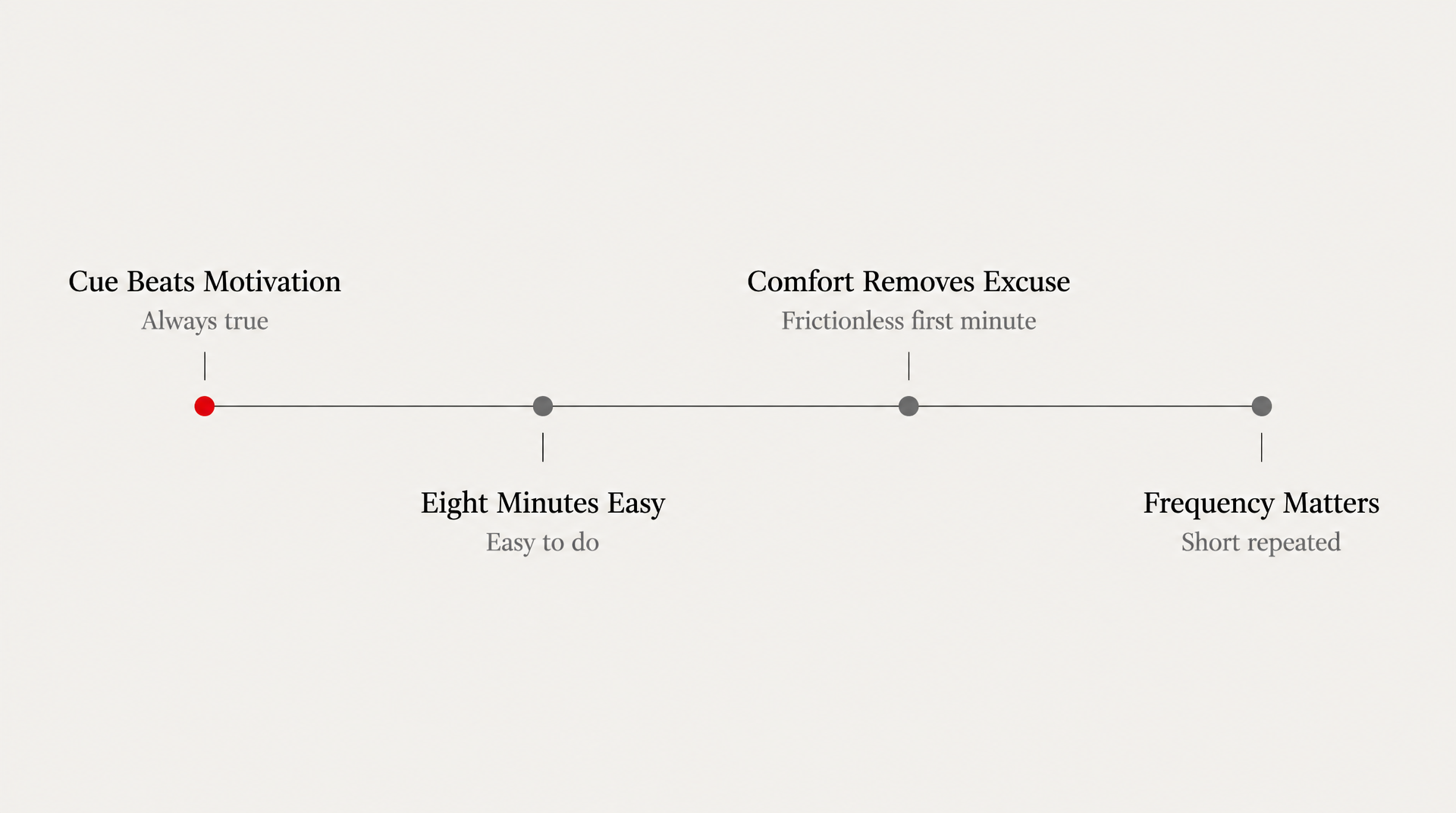
You already know the workout that gets skipped isn't the hard one. It's the one with no trigger, no anchor, nothing tying it to your day. Eight minutes is easy to do and just as easy to forget. So the trick isn't willpower. It's building the flow into a moment that already happens.
Comfort quietly does some of that heavy lifting. A habit sticks when starting it costs you nothing, and clothes that are already soft against your skin remove one more excuse to stall. When your leggings move with you the second you step onto the mat, there's no changing, no adjusting, no bracing against a waistband. The first minute is the whole battle, and soft cotton is meant to make it frictionless.
The Cue Beats the Motivation Every Time
Motivation fades by Wednesday. A cue doesn't. Habit science leans on a simple loop: a trigger, the routine, then a small reward. Attach the flow to something you already do without thinking.
Roll out the mat next to the coffee maker. Flow while it brews. Or tie it to the laptop shutting at day's end, so the practice becomes the line between work-you and home-you. The reward is real and immediate. You stand taller, and the desk ache loosens its grip.
Yoga Journal frames this gently in its posture practice guide: practicing any kind of yoga is a welcome reminder of how good you could feel in your body. That reminder is the reward. Chase it daily.
One Short Round, Then Steal a Little More
The principle is simple: make the routine small enough that it survives real life. A Man Flow Yoga program treats good posture as something you return to throughout the day, not a single workout you finish and forget.
That's the lesson to borrow. One reliable short round, repeated often, does more than an ambitious class that never makes it onto the calendar.
So split the difference. Do the full sequence in the morning, then steal one backbend or twist mid-afternoon when the slouch creeps back. Small, frequent, sustainable.
Track It, Then Let the Community Carry You
Progress you can see keeps you going. Snap a side-profile photo on day one, then again three weeks later. The shift in your shoulder line tells you more than any streak counter. A short note in your phone works too. Jot how your neck feels after each session.
Motivation also travels better in company. Our mission is built on women uplifting one another, because connection and support are what carry you through the flat weeks. You keep showing up when you feel part of something bigger than a solo streak. A short practice, soft clothes, a cue you can't miss, and a community in your corner. That's the whole recipe.
Common Mistakes, Props & Modifications
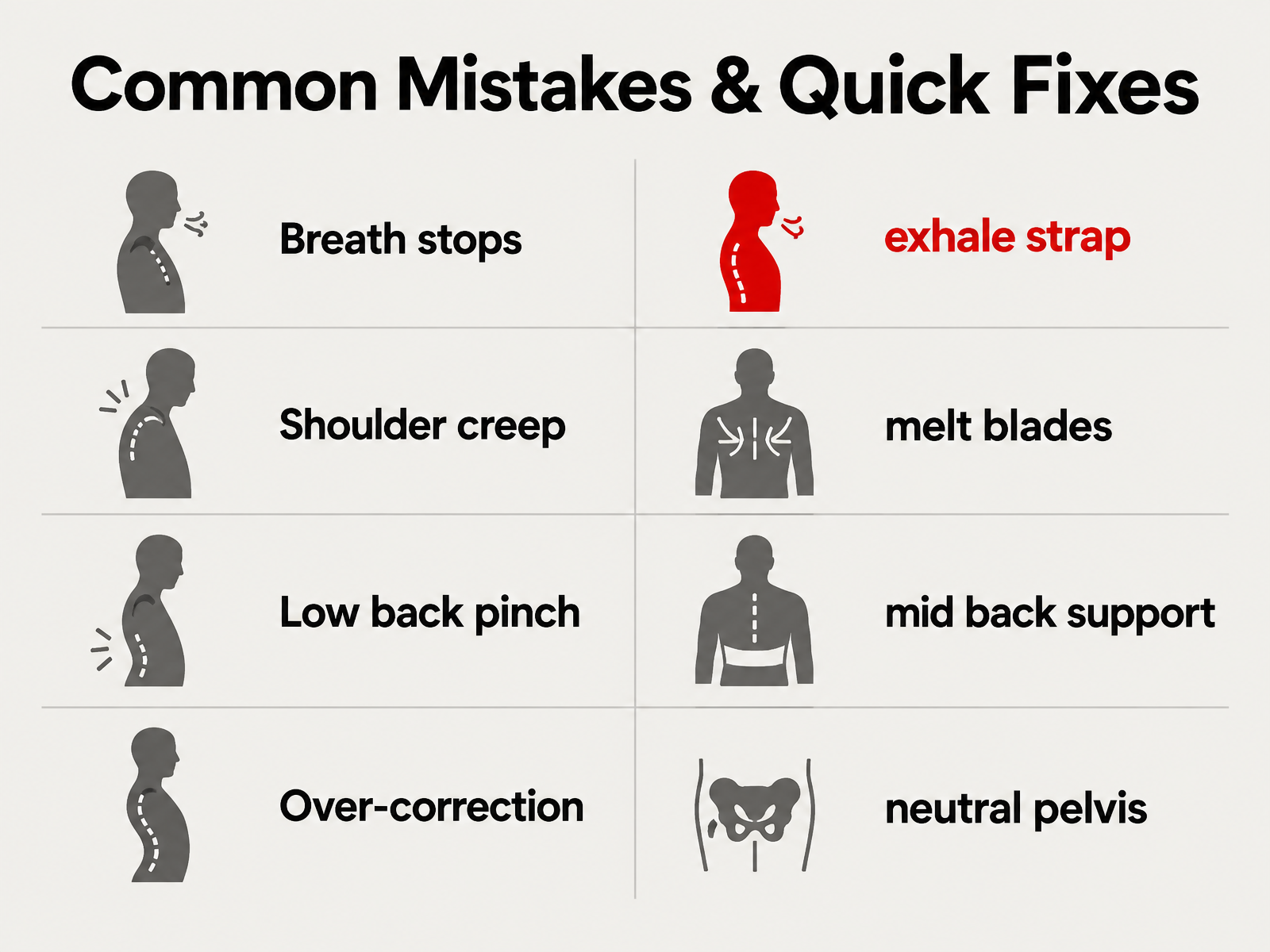
The most common mistake we see isn't a wobbly pose. It's the breath that quietly stops. People sink into a stretch, chase the shape, and forget to exhale. When the breath goes, the shoulders creep back up toward the ears and the whole point of the flow slips away.
Good clothing makes the fix easier than you'd think. A little breath awareness, plus athleisure that moves with your ribs instead of gripping them, is what lets you keep the exhale going through a deep fold. When your waistband isn't compressing your belly, your diaphragm has room to work. That's part of why we love soft, stretch-friendly Peruvian Pima cotton, a naturally breathable fabric grown for its long, smooth fibers.
What Alignment Errors Do Beginners Repeat?
Collapsing shoulders top the list. In the Cactus Arms backbend or the standing side bend, it's tempting to jam the shoulders up and crunch the neck. The cue we like is soft and non-critical: melt the shoulder blades down your back, then lift through the crown.
Watch the low back, too. The Center for Yoga LA guide makes a point worth stealing for our backbends: feel support along your mid back rather than a pinch in your low back. A gentle backbend should spread into a long arc, not fold into one sore spot.
Then there's the over-correction. Yoga teacher Anji Gopal warns that swaying the back to fix a slump can compress spinal discs and nerves over time. Start from a neutral pelvis rather than tucking or arching, then let the chest open. Chasing a bigger backbend rarely helps.
When Should You Reach for Props?
The flow needs no props, and that's the whole appeal of a daily habit. But props buy you precision when a shape feels out of reach.
Slide a block under each hand in your Wide-Legged Forward Bend if the floor feels miles away. It brings the ground up to you so your spine stays long instead of hunching to reach. A rolled-up towel or a strap looped between the hands opens the Eagle Arms stretch when your shoulders won't cross easily. In Child's-style resting shapes, a folded blanket under the hips or forehead takes the strain off.
There's a real debate here. One camp says a daily sequence needs no props at all. Another leans on precise block-and-wall alignment for stubborn misalignment. We land in the middle. Prop-free is your daily default because it's frictionless. Reach for a block on the days your body asks for it.
How Do You Modify for Limited Mobility?
Not every body kneels comfortably, and that's fine. Take Thunderbolt and the lunges to a sturdy chair. Sit tall, plant your feet, and run the same cat-and-cow spinal waves seated.
If your upper back feels locked, the arms-overhead reach will tell you fast. When that reach feels stiff or stuck, it's a clear sign your upper back needs a little more room to open. Move gently, use a strap, and let the stretch-friendly cut of your leggings give at the hip so a seated fold never fights you.
References
[1] Slouched and Slumped? This 8-Minute Yoga Flow Helps Improve ... - https://www.facebook.com/yogajournal/posts/slouched-and-slumped-this-8-minute-yoga-flow-helps-improve-your-posture-try-this/1619044409584238/
[2] 8-Minute Yoga Practice for Better Posture - https://www.yogajournal.com/practice/yoga-for-posture-practice/
[3] Yoga For Posture Alignment: 9 Poses to Save Your Spine - Welltech - https://welltech.com/content/yoga-for-posture-alignment-9-poses-to-save-your-spine/
[4] 15 minute MOBILITY Yoga for Posture, Upper Back Pain & Fix ... - https://www.youtube.com/watch?v=6YgehNFlYH0
[5] The Posture Fix - Man Flow Yoga - https://manflowyoga.com/training/the-posture-fix/
[6] Back Posture Yoga: Poses, Sequences, and Safe Alignment - https://centerforyogala.com/back-posture-yoga/
[7] Improve Your Posture: Yoga Poses for Correcting Poor Posture - https://yogaselection.com/improve-your-posture-yoga-poses-for-correcting-poor-posture/
[8] Want Better Posture? These 8 Strengthening Exercises Will Help. - https://www.yogajournal.com/practice/yoga-for-posture/
Frequently Asked Questions
I'm brand new to yoga and not very flexible. Can I still follow this flow?
Yes. Follow the table at the top for the basic order, move slowly, and keep the shapes small at first. If the floor feels too far away, bring it closer with a block or use a chair for support. Flexibility is not the entry requirement; attention is.
Can I do the flow more than once a day for faster results?
You can, but you don't need to turn it into a marathon. Use the full flow when you have the space, then borrow one useful piece later in the day, such as Cactus Arms after a long call or a Supine Twist before bed. The goal is to keep posture awareness alive without making the habit feel heavy.
Why does this flow use so few forward folds when most yoga sequences rely on them?
Because this practice is built for people who already spend much of the day rounded forward. Folds still have a place for release, especially when you keep the spine long, but this sequence balances them with opening, rotating, and lengthening work so the body gets more than the same desk shape in a different setting.
I already have low back discomfort. How do I avoid making it worse during the backbends?
Make every backbend smaller than you think it needs to be. Keep the pelvis neutral, lift through the chest, and stop if the sensation concentrates sharply in the low back. Aim for a broad, supported arc through the mid back, and use your breath as the check: if you can't breathe smoothly, ease out.