5 Fabric Checks That Separate Real Breathability From Trapped Heat
September 10, 2026
Key Takeaways
- There's no industry standard for "breathable." No agreed benchmark, no accountability, and marketing claims stretch to fill the gap.
- Breathability gets measured in grams of moisture per square meter per day. Almost no product tag will show you that number.
- Heavier, thicker knits resist water vapor more, so they trap heat and moisture instead of letting your body regulate.
- Fabric structure showed no meaningful link to drying rate. Breathability and quick-drying are two separate checks.
- Wet clothing either pulls heat away or holds it in, so you end up clammy in a studio and chilled on a run.
- Trapped heat blocks sweat from evaporating, which shuts down your body's main cooling channel and makes every rep and mile cost more.
Why "Breathable" Often Means Nothing
Trapped heat isn't just mild discomfort. When moisture sits against your skin, it throws off your body's thermoregulation and pushes your cardiovascular system to work harder just to shed heat. Pick the wrong fabric and it quietly drains your energy mid-workout, even if the garment felt feather-light on the hanger.
The problem is made worse by how little activewear retail tells you. Outdoor expert Andrew Skurka, in his breakdown of breathability mechanisms and their limits, points out that claims inflate easily because no universal benchmark holds brands to account. Labs can quantify moisture vapor transmission rates all day. You just won't find those numbers on a retail label.
Why trapped heat drags down performance
When moisture builds up, the fabric clings and starts working against your movement. Water conducts temperature efficiently, so a saturated garment can chill your muscles during rest periods or hold in stifling heat during hard efforts. Either way, your core temperature swings.
The construction of the textile is the main driver here. Research on fabric structure and drying rate shows that thickness directly raises resistance to vapor passage. Dense knits act as physical barriers to heat leaving your body.
The same study turned up something less obvious: a fabric's structural design doesn't dictate how fast it sheds liquid water. An open, highly breathable weave won't necessarily dry quickly once it's soaked. You have to judge these two properties separately.
Is cotton breathable or not?
Both, depending on how hard you're working. This is the contradiction shoppers get burned by, and it's real. One camp says cotton retains moisture and gets uncomfortable when you sweat. The other shows cotton outperforms polyester for warm-weather comfort.
The deciding factor is how hard you're pushing. Cotton's natural affinity for water lets it absorb and diffuse vapor efficiently during low-to-moderate activity, which keeps you cool. Push into high-intensity training, where sweat outpaces evaporation, and standard cotton gets overwhelmed and heavy.
The fix isn't ditching cotton. It's choosing the right cotton. Studies on cotton varieties show the fiber variety itself shifts moisture vapor transport, independent of yarn or construction. That's why Peruvian Pima matters as physics, not just as a label. Long-staple Pima gives you a measurable breathability edge rooted in fiber quality.
What to check before you buy
Use these as a fast pre-purchase filter. Each one targets a specific way "sticky" activewear tends to fail.
- Match fabric weight to intensity. Heavier knits raise vapor resistance, so save dense fabrics for cool, low-sweat wear and pick lighter constructions for hot sessions.
- Test airflow against light. Hold the fabric up. More light passing through signals a looser, more air-permeable weave, a method REI's fabric guide recommends.
- Check breathability and drying separately. A breathable piece won't automatically dry fast, so evaluate both before high-humidity use.
- Ignore vague "breathable weave" claims with no metric. Treat unquantified performance labels as marketing copy, not verified proof.
- Prioritize fiber pedigree, not just fiber type. A certified long-staple variety like Pima carries measurable moisture advantages a generic "natural" tag can't promise.
Air Permeability & Heat Escape
Air permeability measures how much air passes straight through a fabric, and it's worth understanding before you shop. High permeability, heat escapes fast. Low permeability, you get a warm, damp layer trapped against your skin. It's the single most overlooked factor when people compare breathable fabrics.
Here's the distinction that trips shoppers up. Air permeability is bulk airflow through the weave. That's not the same as moisture-vapor transmission, which measures water vapor diffusing through the fibers, as the Testex textile overview makes clear. A fabric can score well on one and fail the other. You need both working together for real heat escape.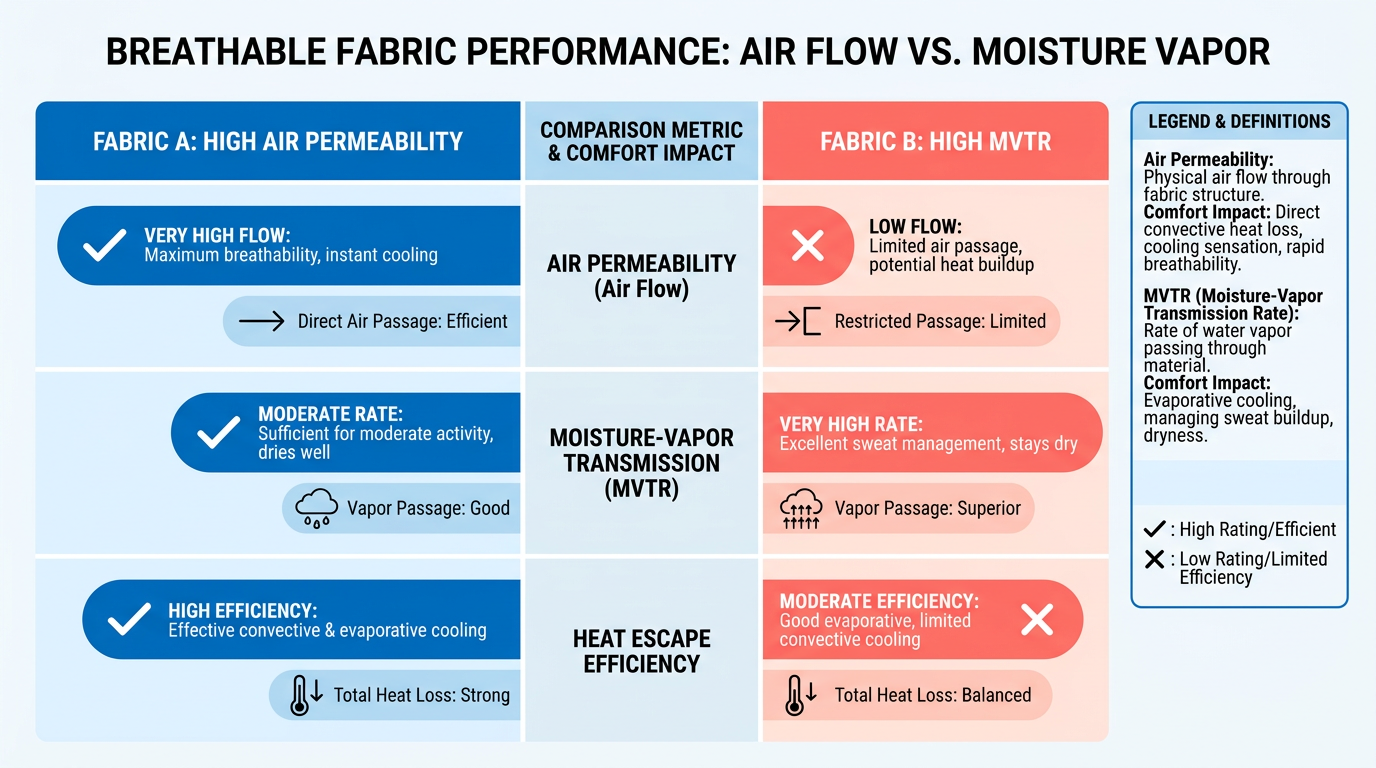
What determines a fabric's airflow
Air permeability is the volume of air flowing through a fabric per second, driven by how open the construction is. Looser knits breathe better. Tighter, denser ones choke airflow.
The geometry of the knit is a primary factor. Testing knitted sportswear on a TEXTEST FX 3300 airflow tester, researchers found that expanding the loop length within the stitch pattern significantly raises the volume of air passing through, while increasing overall thickness restricts it.
That's where high-grade raw materials earn their keep. The long fibers of Pima cotton let spinners create fine, strong yarns that don't need dense, restrictive twisting. The finished textile holds its shape while keeping open pathways for air, unlike dense synthetic blends that lean on tight, compacted structures to stay put.
How to test air permeability at home
Hold the textile up to a direct light source. The amount of light coming through the weave gives you a practical read on its openness. You can also blow gently through the material against your hand to gauge how much resistance the structure puts up.
Treat these as screening tools, not lab results. Outdoor Guru's breakdown notes that even standardized lab tests vary between methods, so a home check gives you direction, not a precise number.
- Observe light penetration to estimate the relative openness of the weave.
- Feel the weight in your hand, since thicker materials naturally resist airflow more.
- Check the label for loose-knit or open-weave construction rather than assuming fiber content alone predicts airflow.
Does cotton actually breathe better?
The industry stays divided on this. Some textile experts note that standard cotton retains moisture and feels heavy during intense workouts, while others emphasize that natural fibers allow better air circulation than basic synthetics, as Locofast discusses.
The right choice depends on the metabolic demand of your activity. At low-to-moderate exertion, high-quality Pima cotton vents heat well and holds a comfortable microclimate. For extreme, high-sweat training, you'll want targeted mesh zones or ventilation panels to help the natural fibers handle the volume.
Moisture Management & Wicking Performance
Wicking is the mechanism that pulls liquid sweat off your skin and spreads it across a fabric's surface, where it evaporates. What confuses most shoppers is that wicking speed and moisture-vapor transmission rate measure two different processes, and you need both working in sync. A fabric can ace MVTR lab tests and still feel clammy if it doesn't physically move liquid away from contact zones.
That movement relies on capillary action, the physical force drawing liquid along the microscopic spaces in a textile. When moisture hits a fiber with natural affinity for water, like cotton, it gets drawn into the internal structure and pulled outward along the yarn. That lateral spread expands the liquid's surface area and speeds up evaporation. Fully hydrophobic synthetics block this internal absorption, so liquid sweat can pool on your skin instead of dispersing.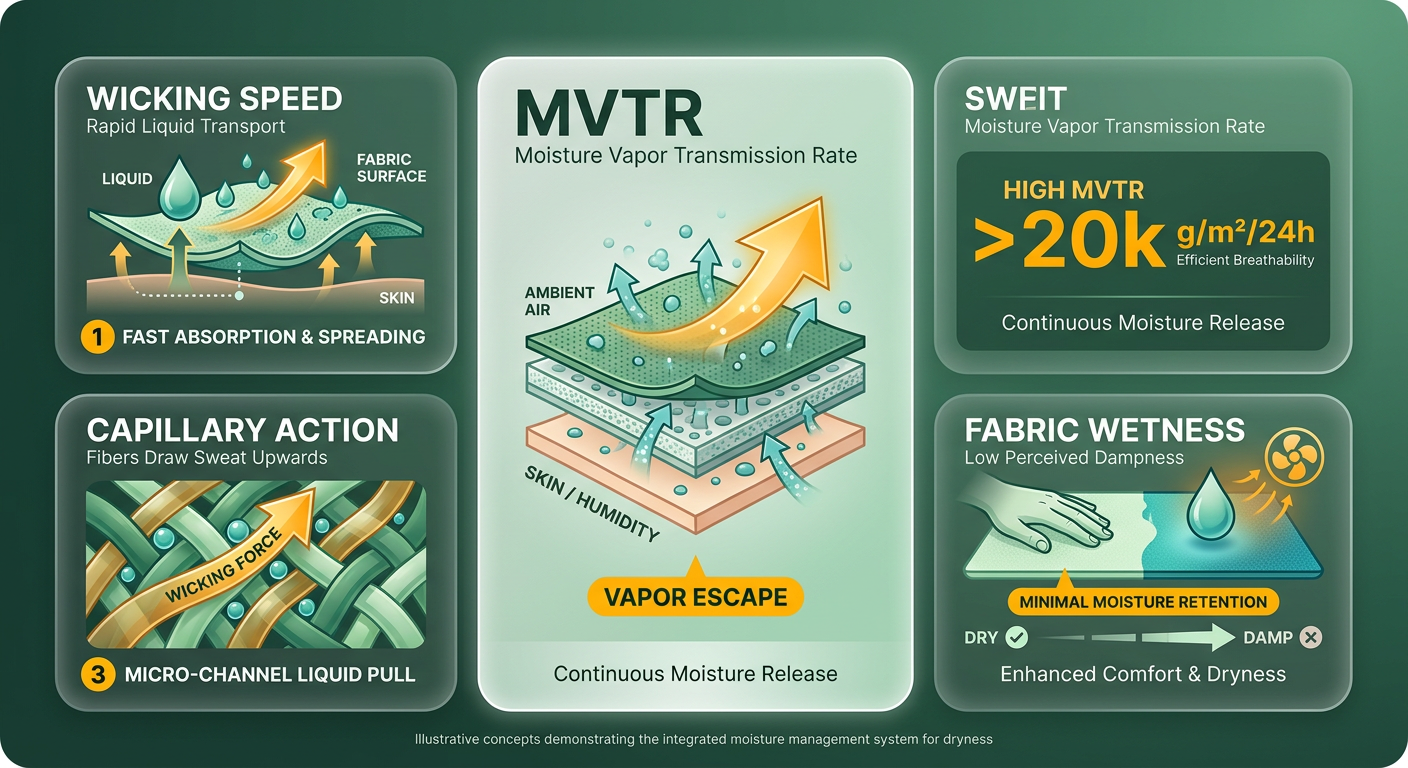
Why Pima cotton wicks when most cotton doesn't
Generic cotton tees trap heat because the fiber pedigree itself determines wicking behavior. Research comparing cotton varieties showed MVTR varied significantly even when the knit structure stayed constant. Longer-fiber cultivars consistently beat shorter upland varieties in lab tests. The useful part: the wicking difference isn't about yarn count or treatment. It's encoded in the fiber's staple length.
The gap comes down to fiber uniformity. Short-staple upland cotton produces yarns with more protruding fiber ends and irregular gaps, which interrupt the capillary path that moves liquid along the surface. Long-staple fibers pack together with fewer breaks, so each channel carries moisture farther before it stalls. The same research noted that "cotton offers next-to-skin comfort and hence is a preferred fiber for undergarments," but that comfort depends entirely on which cotton you're testing. A heavier knit made from a low-MVTR variety will feel damp and cling during a workout, no matter how the tag describes breathability.
There's a design lesson buried in this. Adjusting knit geometry can optimize airflow, but those structural changes don't dictate how fast a garment sheds moisture. A fabric engineered for low vapor resistance can still hold liquid for a long time if the fibers themselves don't move it laterally. The intrinsic properties of the fiber are the real drivers of drying performance, well ahead of the stitch patterns that get highlighted in marketing.
How to test wicking at home
Drop a quarter-size water spot on the fabric's inner surface and time how long the visible wet mark takes to shrink. Genuine wicking fabrics spread the spot horizontally within 10 to 15 seconds, then show a visible drop in wetness within two minutes. If the spot sits in place for 30 seconds before moving, the fabric lacks capillary action and will trap sweat against your skin.
Keep in mind that a drop test only evaluates liquid dispersion, not how easily water vapor diffuses through the dry textile. Standardized lab protocols like the Moisture Management Tester (MMT) or JIS L 1904 analyze both phases of moisture movement for a complete profile. A home test still verifies basic capillary function, and it's about as practical as it gets.
What care labels tell you about wicking
Labels claiming "moisture-wicking" without naming a test standard are marketing, not performance data. Look for references to ISO 15496 or ASTM E96, the breathability benchmarks. If the label lists a fabric blend, check the fiber order: the first-listed fiber dominates performance. A "cotton-poly blend" with 60% polyester will wick poorly because polyester's hydrophobic surface resists liquid spread.
Watch for finishing treatments too. Many synthetic performance fabrics rely on topical wicking coatings that wash out over time, so a shirt that pulls moisture well when new can fail the drop test after 20 to 30 wash cycles. A fiber that wicks by its natural structure keeps performing long after any surface treatment would have degraded. When a label says "engineered for moisture management" without citing how it was measured, you're reading a description of intent, not verified function. That distinction matters when you're choosing between a $30 generic tank and a Pima piece. One relies on a fiber selected for breathability. The other wicks because the marketing team said so.
Quick‑Drying Capability & Evaporative Cooling
How fast moisture evaporates from a garment directly shapes your thermal comfort. As sweat shifts from liquid to vapor, it absorbs and carries off body heat, the process known as evaporative cooling. If a textile holds water, it blocks that pathway and heat builds up. Drying speed is a critical, independent variable, and it deserves its own evaluation.
The common misconception is that a highly breathable fabric dries quickly on its own. It doesn't follow. Breathability concerns the passage of water vapor. Drying speed concerns the evaporation of liquid water from the surface. Studies on sportswear knits show that a fabric's physical structure doesn't correlate directly with its drying rate, even when that structure is highly optimized for vapor transmission. You have to address both, or you end up with a garment that stays wet and heavy.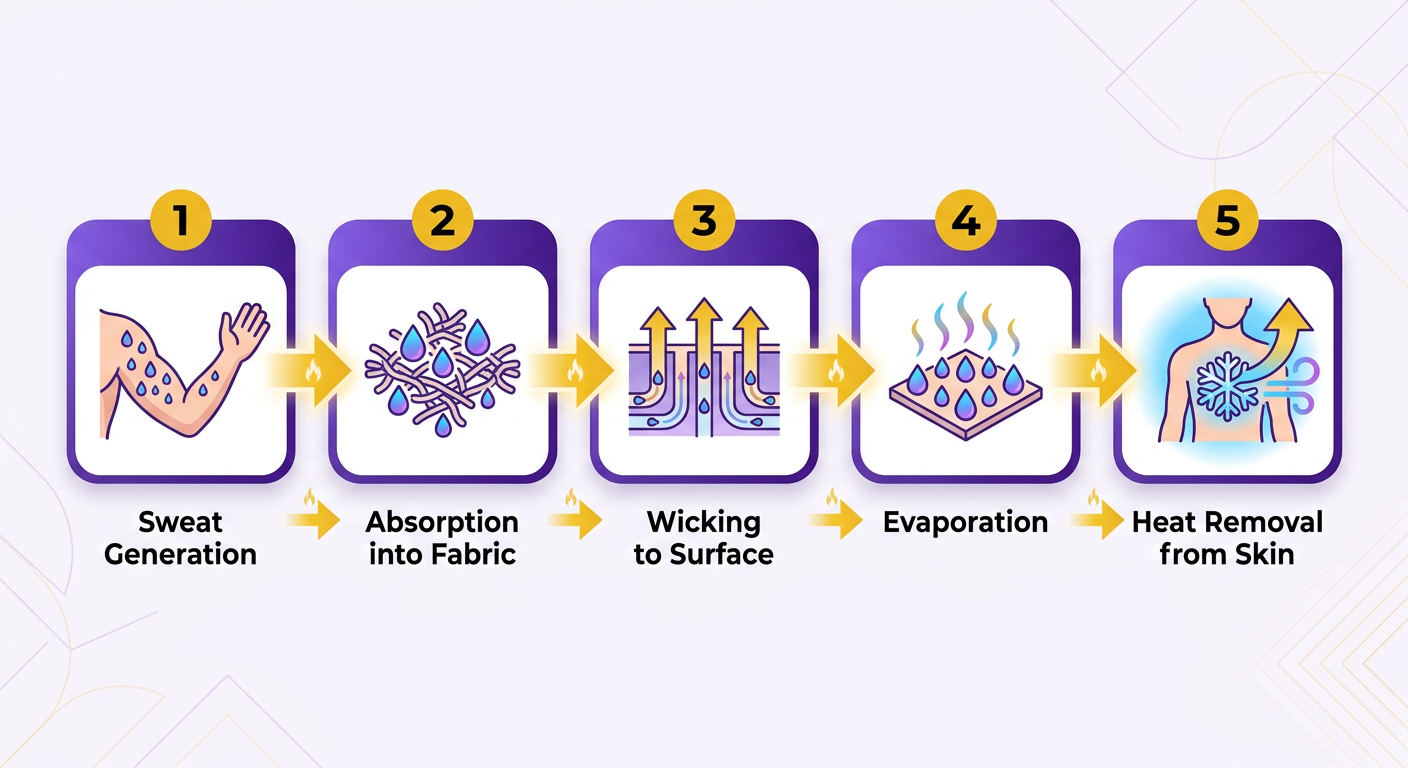
Quick-dry test you can run at home
Try a timed blotting test to compare fabrics before you buy. Dampen a small section until it's visibly saturated. Set the fabric on a flat surface in a room with stable temperature and moderate airflow, not right in front of a fan or heater. Weigh it on a kitchen scale every 15 minutes, or just time how long the damp patch takes to vanish. The faster surface moisture spreads and lifts away, the better that fabric supports evaporative cooling once you're moving.
For a simpler version, press a damp paper towel against the fabric for 10 seconds, then flip the fabric over and check how long moisture lingers on the surface. Still feel a wet spot after five minutes? That fabric will trap sweat during a workout. You want surface moisture that spreads and evaporates fast, not a puddle sitting against your skin.
Fiber composition and drying speed
Cotton's hydrophilic structure absorbs moisture deeply, which is exactly why cotton towels work so well. That same trait slows drying in activewear. Cotton's moisture regain sits at 7.0 to 8.5%, meaning the fiber can hold up to 8.5% of its dry weight in water before it feels wet. Polyester, with a moisture regain of just 0.4%, refuses to absorb liquid and instead spreads it across the surface where air carries it away. That's why polyester gym shirts dry in minutes while a cotton tee stays damp for an hour.
The catch is that cotton variety influences how moisture moves through the fiber at the microscopic level. A three-year study of 31 cotton pedigrees showed that varietal differences in staple length, fineness, and micronaire can shift moisture-vapor transmission rates enough to affect garment comfort. Pima cotton, grown in Peru under strict certification protocols, delivers longer staple fibers and finer micronaire than standard upland cotton. Those traits translate to a smoother fiber surface with less inter-fiber friction, so moisture migrates toward the fabric surface more efficiently.
How construction speeds surface drying
Drying speed depends heavily on how tightly a fabric is knit or woven, not just the fiber inside it. A dense, heavy jersey traps liquid between yarns and forces it to evaporate slowly, while an open knit exposes more surface area to moving air. Lighter weight helps too: a garment in the 120 to 160 gram-per-square-meter range dries noticeably faster than one at 220 grams, simply because there's less mass holding water. Compare two shirts of the same fiber, and the lighter, more open construction almost always wins on drying time. Look for single-jersey or pique knits over thick fleece-backed fabrics when quick drying matters most.
Evaporative cooling has a ceiling, though, set by humidity. Moisture only leaves the fabric if the surrounding air is less humid than the microclimate next to your skin. In a humid environment, even a quick-drying fabric struggles because the vapor has nowhere to go. That's not a fabric failure, it's a physics constraint. Skip fabrics marketed as "instant dry" or "zero moisture retention" when you're training in tropical or coastal climates. Look instead for ventilation panels or mesh inserts that create airflow channels to move humid air away from your body.
Fabric Construction, Knit Density & Openness
Fabric structure is a critical factor that gets overlooked because you can't easily read it off a retail tag. As a general rule, tighter knits restrict airflow and trap body heat, while looser constructions let it escape. Across garments, the physical knit pattern often shapes thermal comfort as much as the raw fiber does.
The physics of knit textiles explains it. When loops within a knit are elongated, the gaps between yarns expand, creating a more open structure that moves bulk air. Increase the overall weight and thickness instead, and those pathways narrow, raising resistance to vapor transmission and pushing the fabric to retain heat.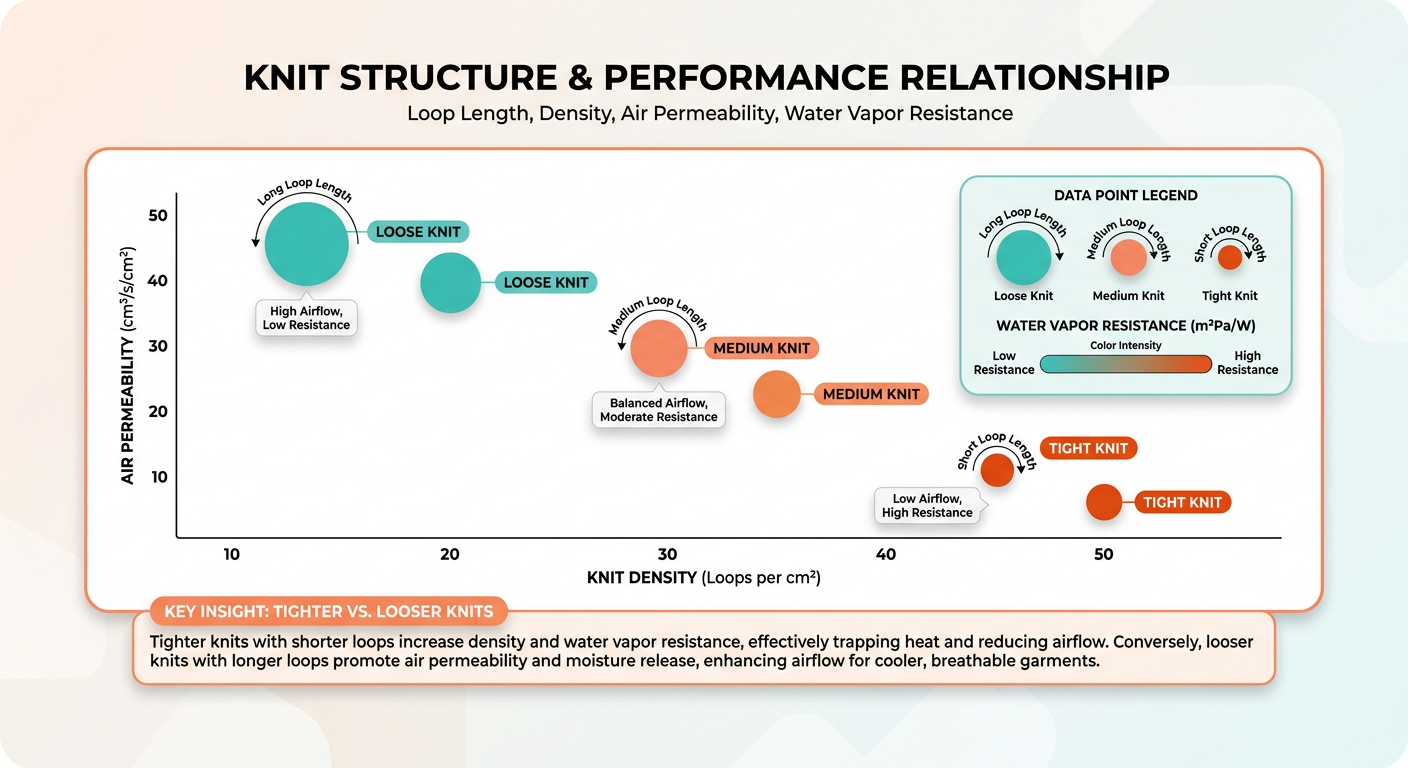
How knit density affects breathable fabrics
Stitch density sets the ceiling for ventilation. A high stitch count per inch packs the yarns tightly, creating a barrier that blocks bulk air movement. A looser gauge keeps open channels for heat to escape, making the garment far more air-permeable.
Density is only half the equation, though. An open structure needs a fiber that inherently moves vapor to reach its potential.
- Check the knit gauge first. A medium-weight, open-loop knit balances shape retention with airflow better than a dense compression knit.
- Weigh support against ventilation. Very thick fabric holds you in but raises vapor resistance, so you pay for structure with trapped heat.
Does construction beat fiber, or the other way around?
They're deeply interdependent. Some textile experts argue that structural design can occasionally offset fiber limits, pointing out that highly engineered synthetic knits can beat poorly constructed natural fabrics. A heavy, tightly woven natural textile can easily trap more heat than a lightweight, open-mesh synthetic.
Construction defines the maximum potential of a garment. Fiber quality determines how close it comes to reaching that potential. Long-staple fibers mean even comfortable, everyday knits keep good vapor transmission without leaning on synthetic chemical treatments, so you hold onto both performance and natural softness.
Your stitch-openness checklist
Judging stitch openness doesn't take lab equipment. Look closely at how the yarns are spaced and you can tell whether a garment will ventilate.
- Examine the stitch spacing. Gently stretch the fabric to see if there are clear, visible gaps between the loops.
- Use a magnifier or phone macro lens. Zoom in on the stitch pattern to spot whether loops sit open or packed shut.
- Look for engineered openings. Mesh zones or vented panels at high-sweat areas add airflow the base knit can't deliver on its own, since natural fibers breathe best in loose structures.
Skip the dense compression knit if heat escape is your priority. Save it for support-first workouts where airflow ranks second.
References
[1] Breathability: Its importance, mechanisms, & limitations - https://andrewskurka.com/breathability-its-importance-mechanisms-and-limitations/
[3] The Science of Breathability: What Makes a Fabric Cool? - Locofast - https://locofast.com/blog/?p=1245
[4] Breathable Fabric… How Do You Know if a Fabric is Breathable? - https://discoveryfabrics.com/blogs/threads-of-wisdom/breathable-fabric-how-do-you-know-if-a-fabric-is-breathable
[5] What is a breathable fabric and how is it measured? - Outdoorguru - https://outdoorguru.com/expertadvice/what-is-a-breathable-fabric-and-how-is-it-measured/
[6] Overview of Moisture Permeability and Breathability Testing in ... - https://www.testextextile.com/performance-textiles-testing-part-8-overview-of-moisture-permeability-breathability-testing/
[7] How Do You Measure the Breathability (R.E.T.) of a Material? - https://www.decathlon.com/blogs/sports-advice/how-do-you-measure-the-breathability-r-e-t-of-a-material?srsltid=AfmBOoofvw07-ZokhIPc_8GA9VHfepNi9iDAjlP062yzsAZdkW-DTah4
[8] (PDF) Relationship Between Cotton Varieties and Moisture Vapor ... - https://www.researchgate.net/publication/44235261_Relationship_Between_Cotton_Varieties_and_Moisture_Vapor_Transport_of_Knitted_Fabrics
[9] Cotton clothing comfort compared to polyester - Academia.edu - https://www.academia.edu/8151344/Cotton_clothing_comfort_compared_to_polyester
[10] (PDF) The effect of fabric's structure on the breathability and the drying ... - https://www.researchgate.net/publication/352792668_The_effect_of_fabric's_structure_on_the_breathability_and_the_drying_rate_Properties
Frequently Asked Questions
1. Can a fabric be breathable but still leave me soaked after a workout?
Yes. Breathability refers to how easily water vapor passes through the textile, whereas drying speed is a measure of how quickly liquid water evaporates from its surface. Because these two functions rely on different physical mechanisms, a garment can excel at venting vapor while still retaining liquid sweat for an extended period. It is important to evaluate both characteristics independently.
2. If cotton absorbs water, how can it wick sweat away from my skin?
Cotton pulls moisture away from the skin by drawing liquid directly into its fibers. Once absorbed, the water travels along the length of the yarn through capillary action, spreading across a broader surface area. This lateral distribution exposes more of the moisture to the air, facilitating evaporation. In contrast, non-absorbent synthetics can cause sweat to pool on the skin if they lack specialized surface textures to disperse the liquid.
3. Why does Pima cotton wick better than a regular cotton tee?
The performance advantage lies in the physical structure of the fibers. Long-staple cotton varieties produce highly uniform yarns with fewer microscopic breaks and loose ends. This creates continuous, uninterrupted pathways that allow capillary action to draw moisture smoothly across the fabric. Standard short-staple cotton contains many irregular fiber ends that disrupt this flow, causing moisture to stall and remain trapped near the skin.
4. Does a "moisture-wicking" label guarantee performance?
No. Generic performance claims are often used as marketing terms rather than indicators of verified testing. Additionally, many synthetic garments rely on temporary chemical finishes to achieve their wicking effects, which can gradually degrade and wash out over time. Choosing textiles made from fibers that naturally facilitate moisture movement ensures long-lasting performance that does not decline with laundering.
5. In a blend, which fiber actually controls how it performs?
The fiber listed first on the care label represents the majority of the fabric's composition and will dictate its primary performance characteristics. For example, a blend dominated by a non-absorbent synthetic will behave very differently from one composed mostly of natural, absorbent fibers. Always check the exact percentages rather than relying on the general name of the blend.
6. Will a quick-drying fabric keep me cool in humid or coastal climates?
Not necessarily. Evaporative cooling requires a vapor pressure gradient between the garment and the surrounding atmosphere. When the air is highly saturated with moisture, evaporation slows dramatically regardless of the fabric's technical capabilities. In these conditions, physical airflow is crucial, making garments with open mesh panels or ventilation zones much more effective at cooling than solid fabrics.
7. What fabric weight should I look for if drying speed matters most?
Prioritize lightweight, low-density knits. Fabrics with lower mass per square meter contain less physical material to hold onto water, allowing them to shed moisture far more rapidly than dense, heavy alternatives. Opting for single-jersey or open pique structures over thick, tightly packed knits will significantly reduce drying times.