5 Checks Before You Buy Pima Cotton Activewear: Sweat, Shape, Seams, Versatility
September 18, 2026
TL;DR
- Peruvian Pima fibers are extra long. That gives softness and strength, but not stretch recovery. Spandex is what snaps a garment back into shape.
- An 80/20 fabric blend is common activewear ratio. It gives four-way stretch and strong elastic recovery. Compression pieces use more spandex.
- Rating one garment against all five checks takes about 30 to 50 minutes, or 5 to 10 minutes per check.
- Flatlock and seamless construction show up in high-friction zones. Think inner thighs, underarms, and waistbands.
Skip the system and you'll waste money
Buying pima cotton activewear for women without a system is how you end up with a drawer full of sweat-soaked, saggy pieces you never wear. A five-point check fixes that. The checklist runs on five things that decide whether a garment works or fails: stretch and recovery, moisture management, breathability, durability, and fit retention, as the activewear fabric guide lays out.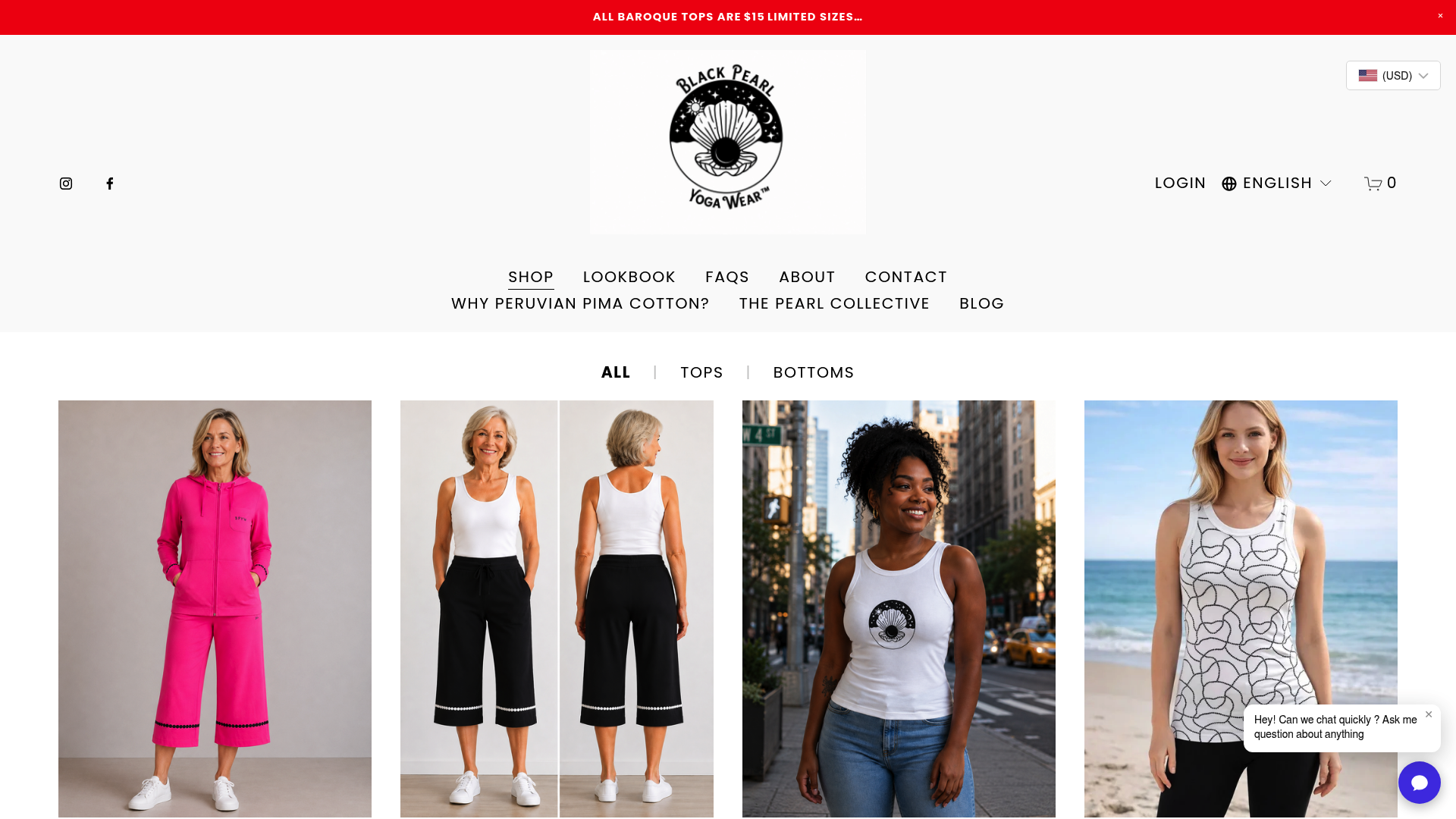
There's a reason this matters for our community. When you shop 100% certified Peruvian Pima, the fiber's provenance is the whole point. A synthetic look-alike can mimic the cotton hand feel, but it can't match the long, smooth fibers that make genuine Peruvian Pima soft, breathable, and built to last. The checks protect your comfort and that value at the same time.
Why sweat and shape are one decision
Pima is absorbent and soft. On its own, though, it lacks the spandex a tighter knit needs for real stretch recovery. Pair hydrophilic Pima with a stretch body fabric and you solve moisture and silhouette at once.
- Check the sweat handling. SELF's testers say to make the fitting room your playground: jump, twist, and keep the piece on an hour after. If it stays clammy, it fails.
- Check the shape retention. Look for a blended knit with spandex in the body. Straight 100% cotton holds moisture and dries slowly, which is why SELF and the sportswear buying guide both warn against it for anything high-sweat.
The honest limit: skip pure Pima for HIIT or hot running. It shines in low-intensity and lifestyle wear, not high-cardio heat.
What the seams and versatility checks catch
Repeated movement rubs at the inner thigh, waistband, and underarm. That's why the activewear development guide flags flatlock and seamless construction in high-friction zones. Versatile pieces earn their keep by working across more of your week.
- Check the seams. Run a finger along inner thighs and underarms. Flat or seamless beats bulky overlock every time.
- Check the versatility. A garment that survives yoga and still reads as street-ready is the most defensible buy. Studio-to-street is where Pima earns its place.
- Check authenticity. Confirm the label names genuine Peruvian Pima. This is the check that separates real, long-staple fiber from a synthetic imitation.
How long each check takes
Budget about 5 to 10 minutes per check in a fitting room or with the product page open. That's roughly 30 to 50 minutes total to rate a piece against all five points.
Score each check 1 to 5, then average for a "fit for purpose" star rating. Expect one trade-off: heavier, warmer fabric breathes less, so a cozy winter legging sacrifices some airflow. Name the trade-off before you buy and nothing surprises you later.
Check 1 – Sweat Management: Moisture‑Wicking & Breathability
Cotton absorbs; it doesn't wick. That's the whole tension with Pima in a sweaty session. It'll soak up moisture and hold it against your skin, which is why pure Pima stays clammy through interval work and hot yoga.
The fix is placement. Pair an absorbent Pima face with a spandex body knit and you get the soft hand where it touches skin, without asking cotton to do a job it can't. For anything high-sweat, though, keep expectations honest: Pima belongs in low-output movement and daily wear, not your hardest cardio.
- Wear-test it wet. SELF's protocol says to move in the fitting room, then keep the piece on for an hour. If it's still damp and cold against your skin, it fails the sweat check.
- Match the fabric to the intensity. Save pure cotton for yoga, walking, and errands. For sweat-heavy work, look for a blend built to move moisture.
Check 2 – Shape Retention: Stretch Recovery & Fit Longevity
Here's the uncomfortable math for anyone shopping pima cotton activewear for women: cotton alone can't hold your shape. Pima's extra-long fibers give you softness and strength. They don't give you stretch recovery. That job belongs to spandex.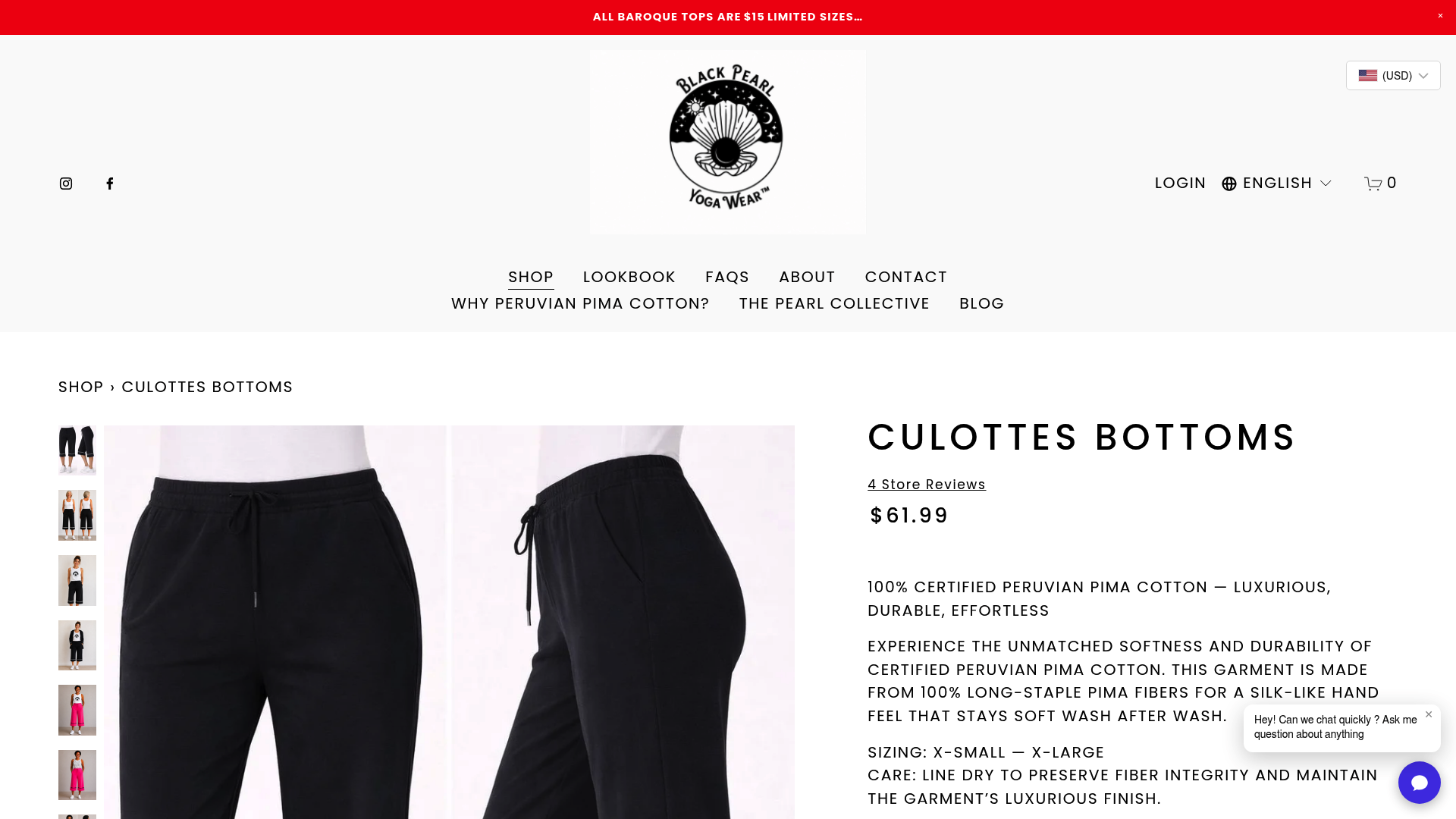
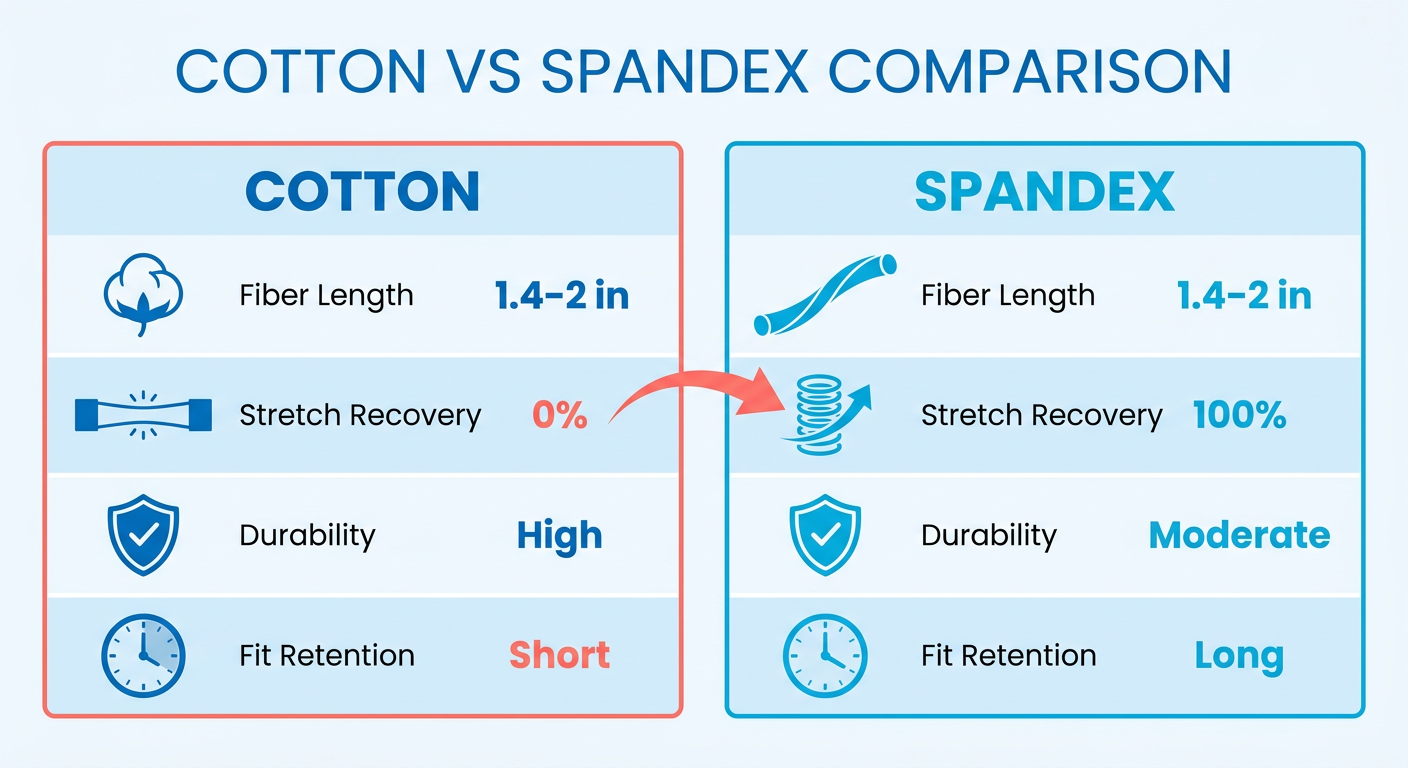
This protects your fit over time. A garment that sags after ten washes gets tossed, no matter how good it felt on day one. So the Pima activewear that actually lasts pairs absorbent Pima with a spandex-based body knit, not a synthetic look-alike that fakes the cotton feel and defeats the purpose.
The spandex percentage that decides your fit
Stretch recovery is engineered, not hoped for. The Spandex by Yard activewear guide names the 80/20 blend as the most common ratio, delivering four-way stretch with strong elastic recovery. Compression pieces climb higher, using more spandex and a tighter knit for controlled pressure.
That same blend decision you made for the sweat check pays off here. Absorbent Pima panels handle moisture; the spandex body handles shape. One fabric choice, two problems solved.
- Check the spandex content on the spec sheet before buying. A legging meant to hold compression needs a higher spandex ratio, not a token 5%.
- Watch for elastane recovery ratings when a brand lists them. A fabric that snaps back within seconds will outlast one that holds a stretched shape.
- Treat "4-way stretch" as a claim to verify, not a guarantee. The same guide warns that not all compression fabrics are equal; ask for consistent pressure data.
Knit structure and weight do the quiet work
Two garments can share the same fiber content and behave nothing alike. The reason is the knit. Tighter stitch density holds its silhouette longer; a loose jersey stretches out faster under load.
Fabric weight tells you what the piece was built for. Denser weaves and higher spandex content, as the activewear fabric guide explains, deliver compression and fit retention. A too-light fabric sold as a squat-proof legging is a fit-retention problem waiting to happen.
- Match fabric weight to your activity. Studio and yoga wear should have enough body to resist sagging.
- Look for a ribbed or high-density knit in waistbands and high-stress zones. These hold tension better than plain jersey.
Test it the way you'll wear it
You can read specs all day, but fit retention shows itself in motion. SELF's protocol says to make the fitting room your playground: jump, twist, run in place, then keep the piece on for an hour to feel how it settles.
For a quality-minded buyer, this test matters more, not less. Peruvian Pima's longer, smoother fibers produce stronger yarns that help garments keep their shape. That investment only rewards you if the garment moves with you and springs back.
- Do a squat-and-hold and a few jumping jacks in the fitting room. Watch for waistband roll and knee-bagging.
- Scan user reviews for shape complaints after multiple washes. Repeated "stretched out" mentions signal a knit or blend that skimped on recovery.
Check 4 – Versatility: Fabric Weight, Knit Structure & Style Flexibility
Versatility is where pima cotton activewear earns its keep. A piece that only works in the studio is a single-use purchase. A piece that carries you from a morning flow to errands to a coffee date is worth three times the closet space. Fabric weight and knit structure decide which one you get.
Weight is measured in GSM (grams per square meter), and it maps to activity: lighter knits suit low-output movement, heavier knits handle cooler conditions. As the activewear fabric guide from Spandex by Yard notes, fabric choice isn't one-size-fits-all. A high-intensity legging, a studio yoga pant, and a running jacket each have different priorities. Define your primary use case first, then pick the fabric that serves it. A fabric tuned for gentle floor work will feel thin under a running load, and a winter-weight knit will cook you in a hot studio.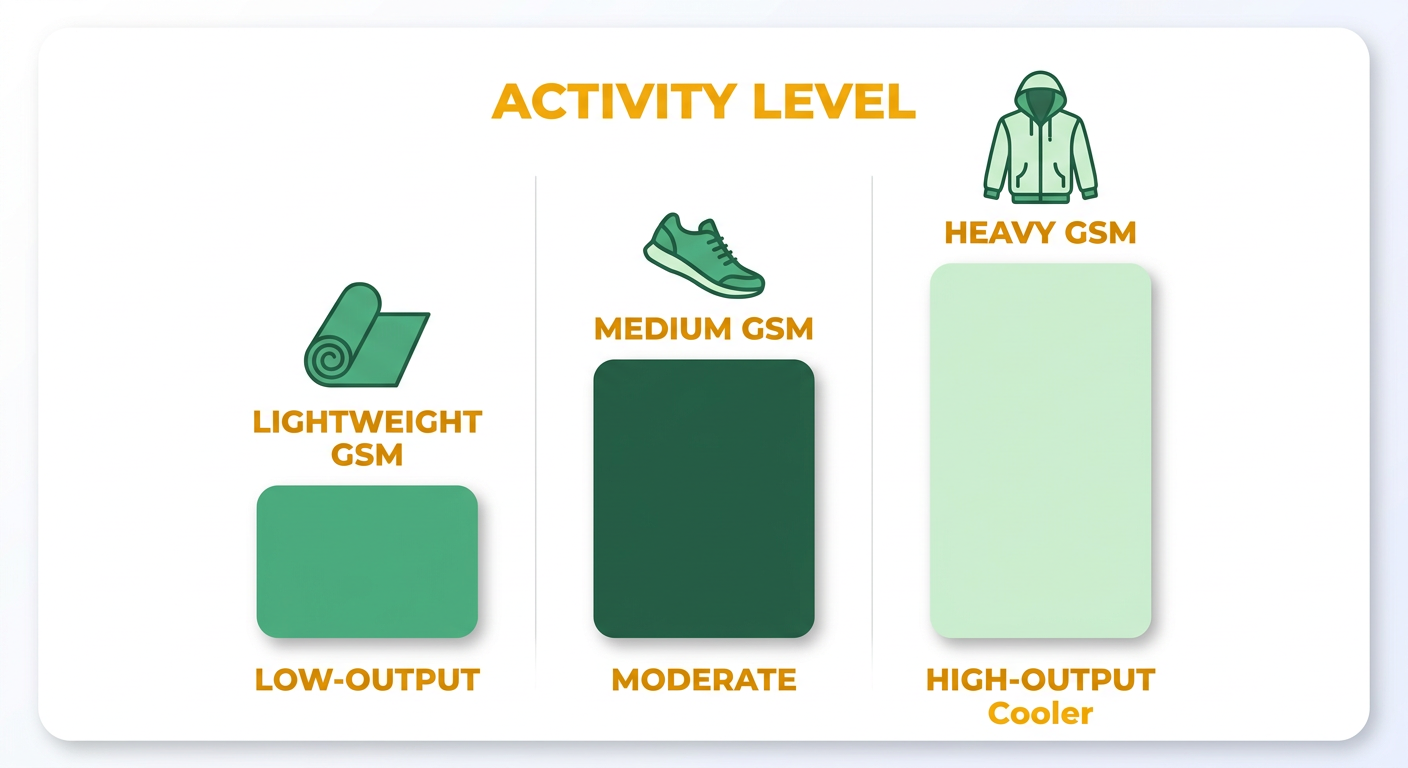
What GSM to match to your activity
Use GSM as shorthand for where a piece belongs. Light GSM suits warm-weather movement and layering. Mid-weight GSM works for most day-to-studio pieces. Higher GSM leans toward cool-season wear that traps heat.
Pima's slow-drying absorbency stops being a flaw the moment you place it strategically. Blend an absorbent Pima face with a spandex body knit and you get the soft hand where it touches skin plus the recovery that holds shape. For a mixed session, aim for a balanced mid-weight. Heavy enough to hold shape, light enough to move. Let your hardest regular workout set the floor.
- Match GSM to your primary activity. Pick the lightest weight that survives your hardest regular session, then check that it still holds opacity and shape.
- Verify the blend, not just the label. A soft Pima face over a spandex core gives you feel and recovery in one garment; higher spandex content, as the fabric guide notes, delivers more stretch and elastic recovery.
How to spot a real studio-to-street piece
Style flexibility comes from design details, not marketing copy. The sportswear selection guide recommends minimalist crossover pieces in neutral colors that read as both workout and casual wear. A cropped Pima-blend top over high-waist leggings lengthens the leg line and looks intentional at the cafe, not just the mat.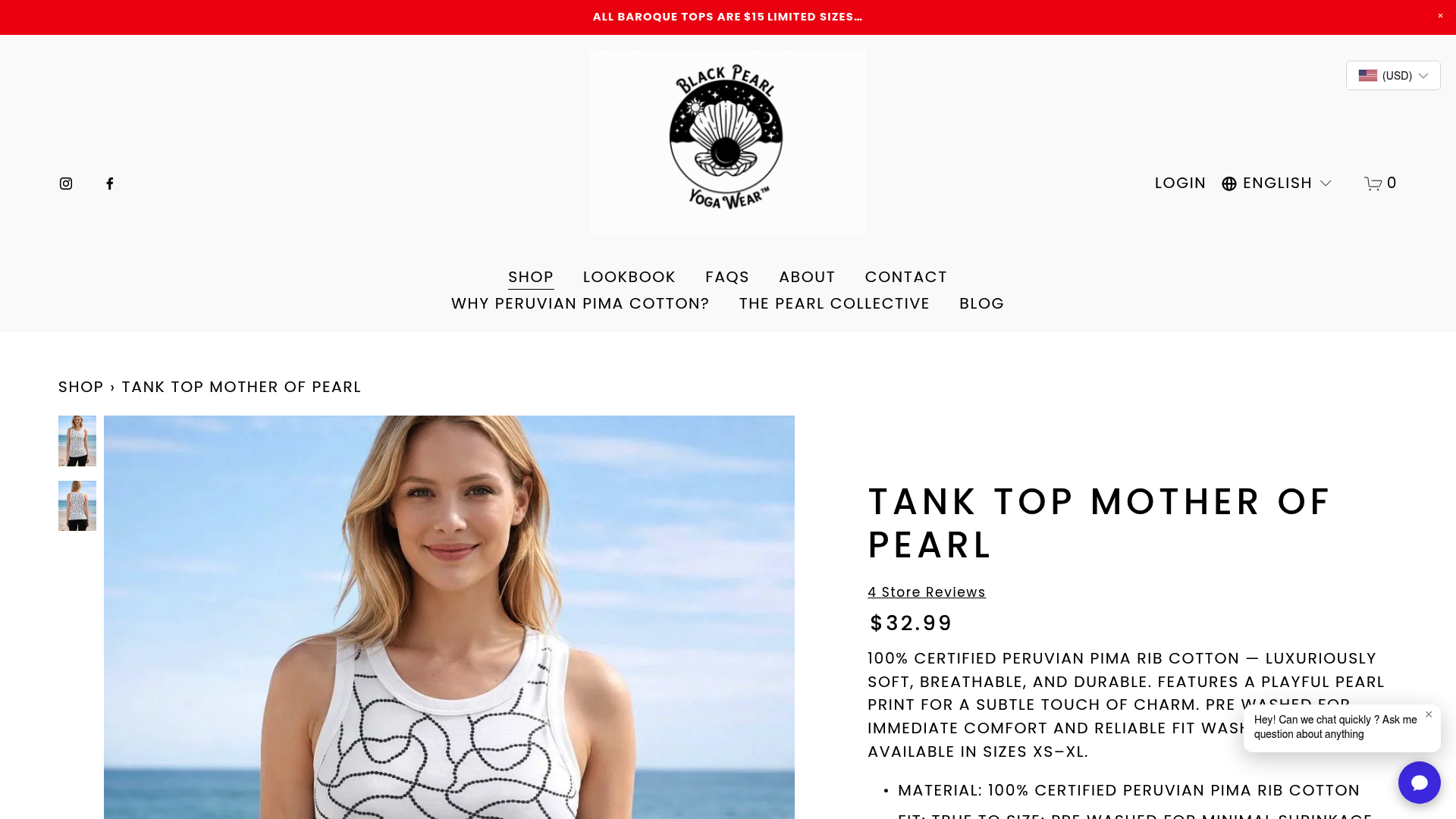
Color is a functional choice too. Light shades reflect heat in warm climates; darker tones hold warmth when the temperature drops. For layering across seasons, the same guide builds outfits around a wide-comfort waistband, a lightweight cover-up for pre and post class, and a shell for cooler days.
- Look for neutral palettes and clean lines. A 1–2 color base plus one accent mixes easily and reads as street-ready, doubling the wear you get per piece.
- Check for wide comfort waistbands and minimal seams. These keep a piece stable through inversions and comfortable through a full day out.
One stance for the buyer who cares about sourcing. A synthetic Supplex can mimic the cotton look and touch while wicking better, but that mimicry defeats the point. When your goal is supporting Peruvian Pima artisans, the fiber's provenance is the value, not just the feel. Look for transparent sourcing labels and mill traceability, since a piece that names its origin lets your purchase reach the hands that made it. Save the synthetics for the sprint.
Check 5 – Fabric Quality: Certified Peruvian Pima Cotton Details
Fabric quality is where the ethics behind Pima activewear stop being a marketing story and become something you can verify. Certification is the paper trail that proves your money reached a Peruvian grower instead of a factory printing "Pima" on a hangtag. Without that trail, the word means nothing.
Rarity is part of why this matters. Pima is a premium, extra-long-staple cotton that costs more than regular cotton because of its quality and durability, as Delicate Stitches notes. Paying that premium only makes sense when the provenance is documented. Otherwise you're funding the price of luxury cotton without the fiber.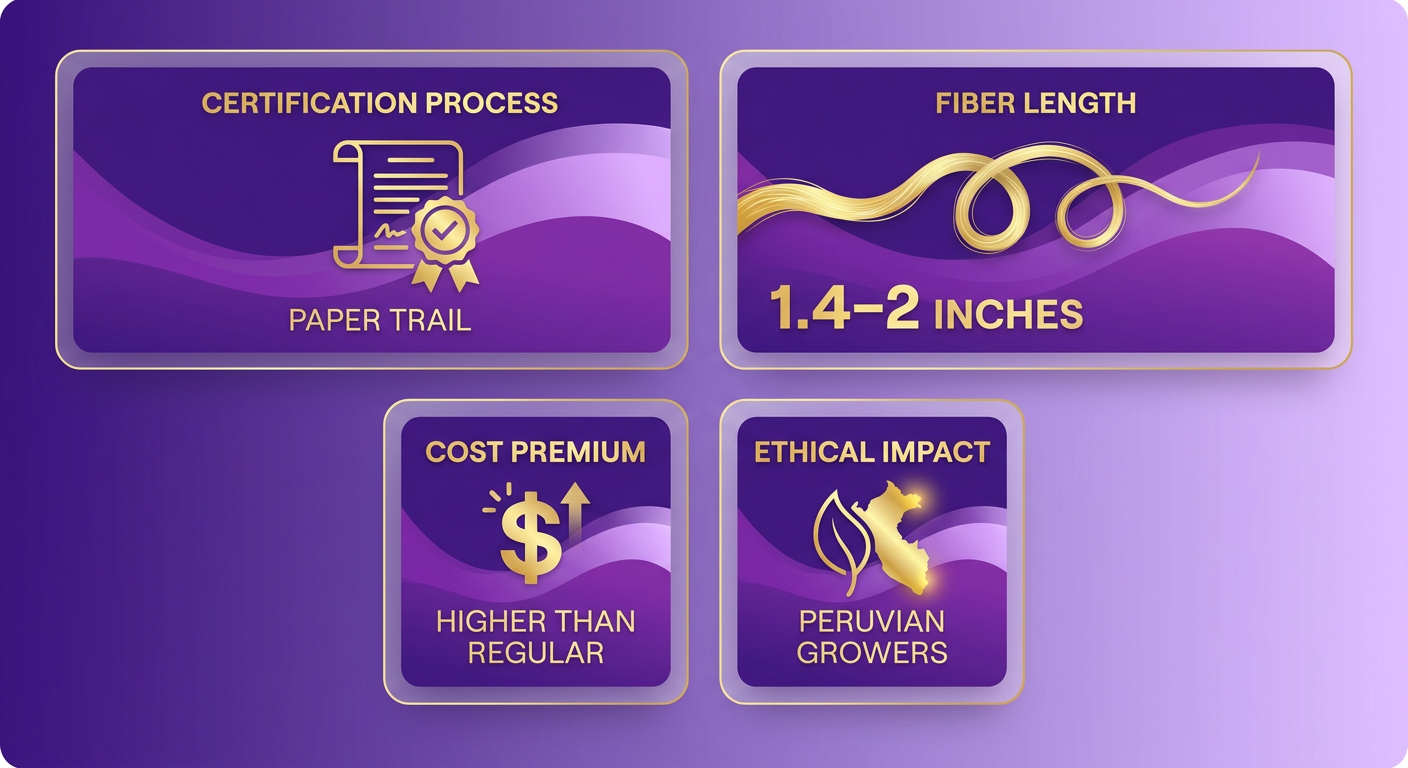
The certifications that prove provenance, not just softness
Certification standards confirm both authenticity and ethics: Supima, GOTS, BCI, and OEKO-TEX each verify a different layer of the supply chain, from organic growing methods to chemical safety. Some products carry certifications or trademarks indicating genuine Pima cotton, which is why checking the label matters, as Delicate Stitches explains.
- Verify a named certification (GOTS, OEKO-TEX, BCI, or Supima) rather than trusting the word "premium." Each one is an audited standard, not a self-applied claim.
- Look for a clearly specified fiber content on the tag. A precise label is how you separate genuine Pima from generic cotton.
- Ask where the certification was issued. A standard tied to a named Peruvian mill or cooperative carries more weight than a generic quality seal with no origin attached.
Provenance is the whole point for the ethical buyer
Here's the honest tension. Some activewear guides note that a synthetic like Supplex nylon can copy the cotton look and hand feel while adding synthetic performance. For a fair-trade shopper, that mimicry misses the entire reason to buy.
When your goal is supporting Peruvian artisans, the fiber's origin is the value, not just the texture. A look-alike knit delivers the feel and none of the livelihood. That's why brands willing to name their growing region and mill partners tend to be the ones you can actually trust.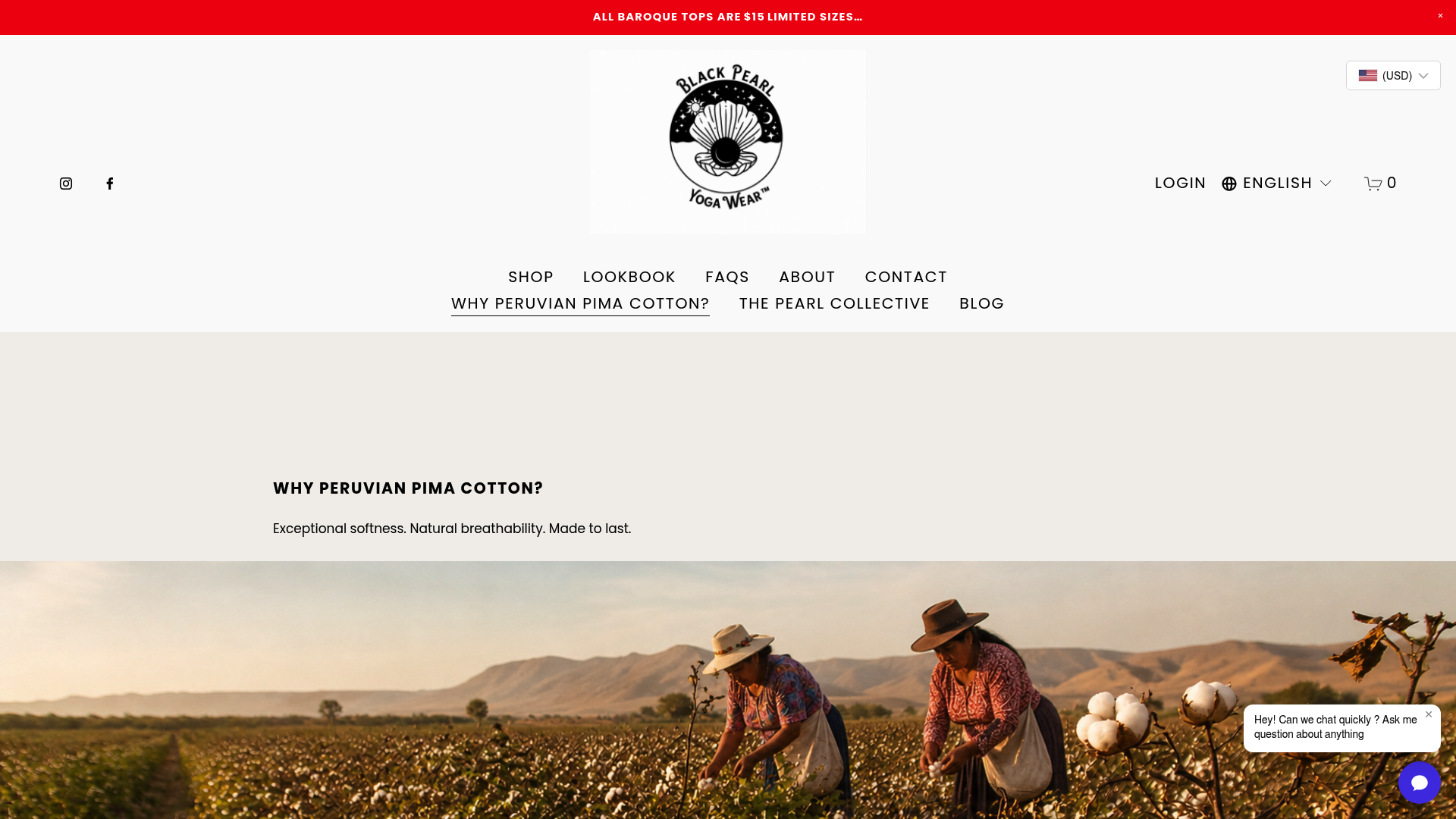
The name itself carries this history. Pima cotton's story begins thousands of years ago in Peru, where early civilizations cultivated naturally long cotton fibers, as Numi recounts. Those roots run deep. Buying certified honors that lineage; buying a synthetic copy erases it.
How to spot authentic Pima before you check out
You can confirm quality with your hands. Authentic Pima feels silky and smooth even before washing, carries a faint sheen from its long fibers, and sits in a tight weave that resists pilling, as Delicate Stitches explains.
- Rub the fabric between your fingers. Real Pima feels lightweight yet strong, never rough or scratchy.
- Tilt it toward light to catch the natural sheen that short-staple cotton can't fake.
- Check the weave density. A tight, even knit signals the durability that justifies the price and keeps the garment out of a landfill.
The bottom line on buying Pima activewear that lasts
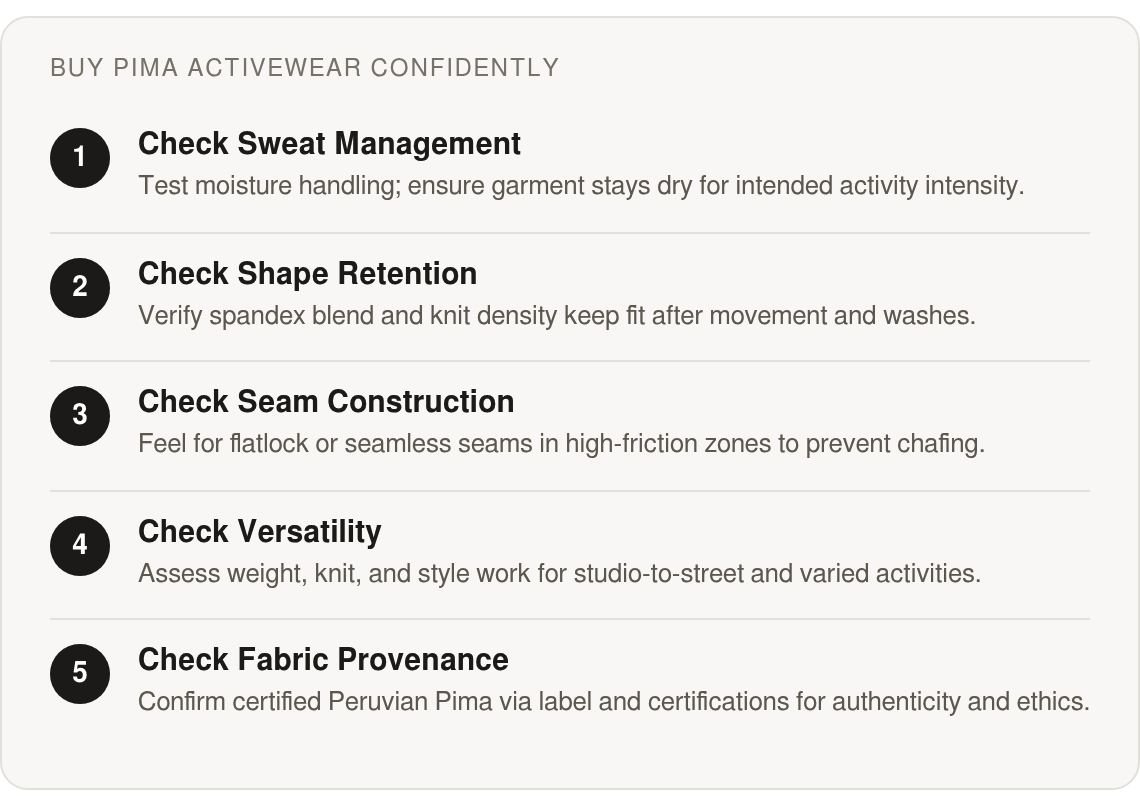
Five checks sound like a lot to remember at the shop. They aren't, once you turn them into a single pass through a garment. Here's how to run the whole thing, from the first click to the cart.
Print this, screenshot it, or keep it open in another tab while you browse.
What to check before you buy
Work through these in order. Skip none, but weight them toward what you actually do most days.
- Sweat reality check. Ask what you'll wear it for. For sweat-heavy interval training, cotton absorbs instead of wicks, so keep those pieces for low-output movement, yoga, and daily wear.
- Shape retention. Confirm the piece pairs Pima with a spandex-based body knit. Pure cotton won't hold its shape through repeated wear; the stretch fiber is what protects your fit.
- Seam and finish inspection. Look at the stitching and hand feel. Smooth, strong yarns pill less, so a piece that already feels rough or uneven won't improve with washing.
- Versatility test. Picture three settings: studio, errands, coffee. If it only works in one, it's a single-use buy. Match the knit weight to your climate and activity.
- Provenance proof. Trace the fiber to a named source with a certification you can verify online. A hangtag word costs the brand nothing; a mill name, a batch record, or a grower's region is what a serious seller actually publishes.
How to turn the checks into a decision
Rate each check quickly. Give it a yes, a no, or a maybe.
Two or more clear "no" answers means put it back. A "no" on provenance alone is enough to walk away, because that check is the whole reason to pay a Pima premium in the first place.
Before you decide, note your top priority. Sweat control and style pull in different directions, and knowing which matters more today makes the call obvious.
This is where a grounded checklist beats a generic fabric guide. A single garment can shed a lot of surface fuzz in the first handful of washes, so the check that reads a seam today predicts the piece you'll still reach for in six months. Shop by these five passes and softness you can feel and quality you can keep stop being marketing lines. They become the outcome of buying with intent, alongside a community that values the same thing.
References
[1] How to Spot Authentic Pima Fabric in Stores - Delicate Stitches - https://delicatestitches.com/blog/pima-fabrics/how-to-spot-authentic-pima-fabric-in-stores
[2] What Is Pima Cotton Fabric? How It's Different - Numi - https://wearnumi.com/blogs/women-undershirts/what-is-pima-cotton?srsltid=AU7gw4UnAWryCu7vTdyxyUbrTSQ_MPFh2C0Li6yO93LY43DrbX4SQK_p
[3] Best Fabric for Activewear, Gym & Yoga (Spandex Guide) - https://spandexbyyard.com/pages/activewear-fabric-guide?srsltid=AU7gw4Uu_efl-_4oSaafGkLZeZA1yEhQ2x2bkzoOX0BG0yE_sNxQDilB
[4] Moisture-Wicking vs. Cotton Training Apparel - REP Fitness - https://ca.repfitness.com/blogs/guides/moisture-wicking-vs-cotton-training-apparel
[5] Moisture Management in Performance Fabrics: How Activewear Keeps ... - https://sportek.com/blogs/news/moisture-management-in-performance-fabrics-how-activewear-keeps-you-drymoisture-management-performance-fabrics-moisture-wicking-activewear?srsltid=AU7gw4VR-OgCiExyxOxio7F6PLAd5til3O_uKUzxphqEDvOF86AVCvLg
[6] Gym Outfit Essentials: A Product Development Guide for Activewear ... - https://www.spftex.com/news/gym-outfit-essentials-a-product-development-guide-for-activewear-brands/
[7] Tips For Choosing Sport Clothes: How To Choose Sportswear That Sells - https://www.bdseamless.com/resources/tips-for-choosing-sport-clothes/
[8] Complete Guide to Organic Activewear Materials - https://damselflyorganicclothing.com/blogs/journal/complete-guide-to-organic-activewear-materials?srsltid=AU7gw4W-1mw5zTa3w0M3oc1mcahCnsgpPch_CmAYNQpAPrn6xTsOZjLJ
[9] What to Look for When Buying Activewear | SELF - https://www.self.com/story/what-to-look-for-when-buying-activewear
[10] What is Pima Cotton Fabric: Properties, Varieties, Uses & Global Market - https://www.fibre2fashion.com/market-intelligence/texpro-textile-and-apparel/textile-guide/10533/pima-cotton-fabric
Quick Questions, Straight Answers
1. Can I wear pima cotton activewear for hot yoga or heavy cardio?
Skip pure pima for hot yoga, HIIT, or heavy running. Cotton absorbs sweat rather than wicking it, staying clammy under high heat. Pima excels in low-intensity movement, studio work, and lifestyle wear. For sweat-heavy sessions, reserve synthetic-based pieces instead.
2. Does a higher spandex percentage always mean better activewear?
Higher spandex suits compression pieces needing controlled pressure, but it isn't universally better. An 80/20 blend delivers four-way stretch with strong recovery for most activities. A token 5% spandex won't hold compression, so match the ratio to your activity rather than maximizing it.
3. How can I tell genuine Peruvian Pima from a synthetic imitation in a store?
Rub the fabric between your fingers—real pima feels silky and smooth even before washing, never scratchy. Tilt it toward light to catch the natural sheen short-staple cotton can't fake, and check for a tight, even weave that resists pilling.
4. Is GSM more important than fiber content when choosing a versatile piece?
Both matter for different reasons. GSM (grams per square meter) determines where a piece belongs—light for warm-weather layering, mid-weight for day-to-studio versatility, and higher GSM for cool seasons. Fiber content and blend determine feel and recovery. Pick the lightest GSM surviving your hardest regular session.