Why Peruvian Pima Cotton Outshines Cheap Plastic Apparel
November 15, 2026
Quick Summary
You wash your yoga pants on Monday and they look new. By the tenth wash, they have pilled and gone dull. Pima cotton activewear is meant to close that gap. Pima is a long-staple cotton, and its fibers run about twice as long as regular cotton fibers, so there are fewer loose ends to pill.
| Option | Softness (fiber length) | Durability | Microplastics | Textile waste | Yoga temperature | Headline tradeoff |
|---|---|---|---|---|---|---|
| Generic polyester/plastic | ⭐⭐ Smooth but synthetic | ⚠️ Synthetic fibers wear differently than natural cotton | ❌ Sheds synthetic microfibers with each wash | ⭐ Petroleum-based, non-renewable | ❌ Traps heat | Common, but plastic-based |
| Standard Peruvian Pima cotton | ⭐⭐⭐ Extra-long fibers, exceptionally soft and smooth | ⭐⭐⭐ Longer fibers produce stronger, more durable yarns | ✅ Natural fiber, no plastic shedding | ⭐⭐⭐ Hand-picked, less waste and chemicals | ⭐⭐⭐ Naturally breathable, keeps you comfortable during movement | Premium natural cotton; rarer than conventional cotton |
| Black Pearl Yoga Wear | ⭐⭐⭐ 100% certified Peruvian Pima cotton | ⭐⭐⭐ Smooth fibers resist pilling, maintaining appearance over time | ✅ Natural fiber, no plastic shedding | ⭐⭐⭐ created in Peru from certified Pima, hand-harvested to protect fiber quality | ⭐⭐⭐ Designed to allow air circulation during workouts and everyday wear | Certified Pima; designed to transition from yoga to everyday life |
Harvest method matters as much as the fiber. Machine picking tears and yellows the fibers, which costs softness, so hand-picked Peruvian Pima holds its feel better. Black Pearl's pieces are made in Peru from 100% certified Peruvian Pima cotton, carefully hand-harvested to protect those long, smooth fibers. That is what helps the fabric stay soft, vibrant, and resistant to pilling through regular wear and washing.
TL;DR
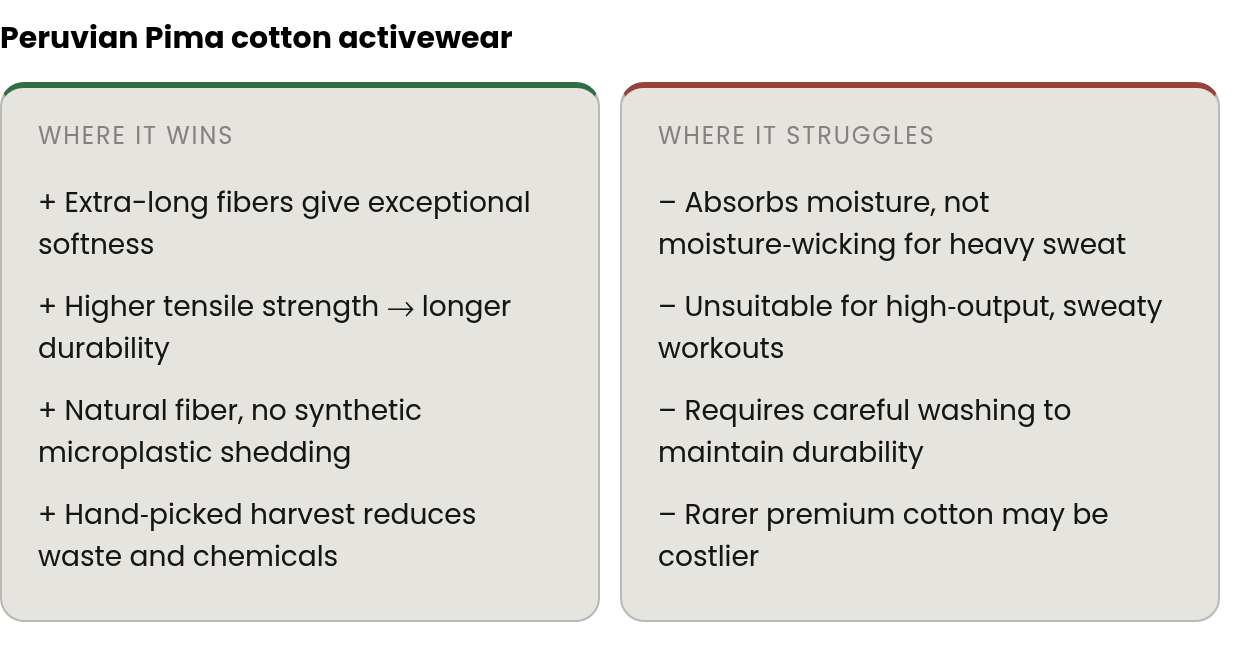
Peruvian Pima cotton is prized because its extra-long fibers create a smoother, stronger yarn with fewer weak points than conventional cotton. That structure helps explain why Pima feels unusually soft against skin and why it is often chosen for premium everyday apparel. It is also a natural alternative to petroleum-based activewear, which matters if you are trying to reduce plastic exposure in your wardrobe. Pima works best for yoga, lounging, travel, and low-to-moderate sweat movement — breathable and absorbent, but not a sweat-wicking performance fabric. For long, high-output sessions, you may prefer technical gear designed specifically to move moisture away from the body. Peruvian Pima also carries a long agricultural history in northern Peru, where climate and cultivation methods have helped define its reputation.
Why Pima Cotton Is Not the Same as Your Average Activewear
Pull on your favorite leggings after a hot class, and they should feel soft, not sticky. That moment is where Pima cotton activewear earns its place. Pima is a natural fiber, so it sidesteps the plastic base behind most of the problems that come with synthetic workout clothing.
Your practice heats up, and so does what you ask of your fabric. Heat and sweat test a garment far more than a quiet stretch does. Peruvian Pima cotton's natural breathability allows air to circulate, helping you stay comfortable during movement, relaxation, and everyday activities.
Synthetics dominate the activewear rack because they are easy to engineer, cheap to scale, and familiar to shoppers. Pima cotton takes a different route. Instead of chasing a plastic performance feel, it leans into softness, air flow, and a closer connection to natural material.
The skin-feel difference is immediate. Synthetic activewear sits directly against your body during your most heated moments, while Pima cotton offers a gentler surface that many people prefer for slower classes and all-day wear.
Sources disagree on how cotton handles sweat. Gazelle Sports rates cotton best for low-sweat activities. Intelligent Threads says Pima outperforms performance synthetics on temperature regulation. Both can be right for different classes. Pima suits slow flows, restorative holds, and everyday wear. For a long, sweaty run, skip cotton.
| Polyester activewear | Pima cotton activewear | |
|---|---|---|
| Fiber base | Petroleum-based plastic | Natural cotton |
| Shedding | Releases synthetic fibers during laundering | Does not rely on synthetic plastic fiber |
| Heat | Can feel warm or clingy depending on the knit | Better suited to breathable, lower-output movement |
Knit-Lab Peru places Pima in a broader sustainability context, especially when cultivation and harvest choices reduce damage before spinning begins. Pima fabric has been found in northern Peru dating back to 6000 BC.

How That Softness Actually Gets Into the Fabric
Softness is the first thing most people notice about Peruvian Pima cotton. It does not have the slick, artificial feel of many synthetic leggings, and it does not have the rougher touch that can show up in lower-grade cotton after repeated washing.
That softness comes from fiber quality. Longer cotton fibers can be spun into smoother yarn because there are fewer broken ends poking out of the finished fabric. Fewer rough points mean less scratchiness, which matters when clothing moves with you through stretches, twists, and seated poses.
For yoga wear, this is not just a comfort bonus. Fabric sits close to the skin at the waist, hips, thighs, shoulders, and underarms. In those areas, texture becomes noticeable quickly. A smooth cotton surface can feel easier to wear through a full class and more comfortable afterward when you keep the same outfit on for errands, travel, or recovery.
Pima is also worth considering if you dislike the plastic hand-feel of conventional activewear. Many performance fabrics are engineered to feel sleek, but that sleekness can turn clammy when body heat rises. Pima feels more familiar: soft, breathable, and natural against skin.
We use certified Peruvian Pima cotton at Black Pearl because that skin-friendly quality is central to the garment, not an afterthought. The goal is clothing that supports movement without the fabric becoming the thing you keep noticing.
Breathability: What the Fabric Can and Cannot Do
The last hot class you took — by the third sequence the mat feels slick, the room feels close, and your activewear either stays light or starts to cling.
Three fabric terms get mixed up on tags. Breathability is how easily air moves through the weave. Absorbency is how much water the fibers hold. Moisture-wicking is a separate claim: the fabric pulls sweat off your skin and spreads it out to dry. Gazelle Sports' activewear guide says cotton absorbs and holds moisture, which makes it a poor pick for heavy sweating.
Another buying guide ranks Pima cotton above performance synthetics for temperature regulation. Both views can hold. Pima's longer fibers may behave differently from standard cotton, but we have no lab data showing Pima wicks sweat. We call our Pima pieces breathable and absorbent, and we skip the wicking claim.
| Material | Breathability | Absorbency | Moisture-wicking | Lab data for heat |
|---|---|---|---|---|
| Polyester | Varies by weave | Not measured here | Claimed; stays warm when wet, per Gazelle | Not in our sources |
| Pima cotton | Good air flow, per buying guide | Holds moisture | Not shown | Missing |
| Black Pearl Pima pieces | Same as Pima cotton | Same as Pima cotton | Not claimed | Missing |
For class planning, match the fabric to the session. Pima makes sense when comfort, softness, and air flow matter more than staying dry at all costs. Think gentle heat, mobility work, restorative practice, Pilates-style movement, or a day when your yoga clothes double as your everyday outfit. When the workout is built around prolonged sweat, the limitation is clear: cotton absorbs moisture and keeps it longer than true wicking fabric.
Durability and Pilling: What the Fiber Numbers Actually Say
Think about the leggings you reach for most. They have probably been washed dozens of times. Pima cotton activewear is designed to outlast that routine, and the fiber is where the difference starts.
Pima's reputation for durability comes from its staple length and the smoother yarn that length makes possible. Shorter cotton leaves more loose ends in the yarn, and those loose ends become weak points as a garment is worn, washed, stretched, and folded.
The strength gap has a number behind it. Fair Indigo's breakdown reports 4.28 N/tex for Pima against 3.11 N/tex for regular cotton, about 30% stronger. Tensile strength measures the pulling force a fiber takes before it breaks.
The same source says Pima garments should last well more than 30% longer with proper care. That is a brand estimate, not a lab result, so treat it as a direction rather than a guarantee. Skip hot water and high heat drying, and see our guide to washing organic athleisure.
Harvest quality affects the yarn before a garment is even cut and sewn. When fibers arrive at spinning in better condition, the finished fabric has a better chance of keeping its smooth hand, strength, and clean surface over time.
| Durability factor | Regular cotton | Pima cotton |
|---|---|---|
| Fiber length | Shorter staple | Extra-long staple |
| Tensile strength | Lower measured value | Higher measured value |
| Tear and fray resistance | Baseline | Less likely to tear or fray |
| Expected lifespan | Baseline | Longer with proper care, based on brand guidance |
A few things stay off this table. The sources give no figures for pilling, fading, or shape retention, so we do not promise them as measured outcomes. If you wear a piece only once a month, the longer lifespan may never matter, and a cheaper option can be a reasonable choice.
Black Pearl Yoga Wear: What Certified Pima Means in Practice
We built our line around Pima cotton activewear for a reason that goes deeper than softness. Peruvian Pima is genuinely rare. Grown in the warm coastal valleys of northern Peru, where the conditions produce exceptionally long, smooth fibers unlike anything regular cotton can match. That is not marketing heritage. It is agricultural fact.
Hand-Harvesting Is What Preserves the Fiber's Strength
Most brands talk about the finished fabric and skip the moment that makes the fabric possible. Harvesting is one of the earliest quality-control steps in the life of a cotton garment. When the fiber is handled carefully at that stage, the later steps, spinning, knitting, cutting, sewing, and washing, start from a stronger foundation.
For Black Pearl Yoga Wear, that matters because yoga clothing is not static. It bends, stretches, compresses, recovers, and gets laundered often. The advantage of Peruvian Pima is not only that it feels beautiful on day one; it is that the fiber quality supports a better garment over time.
Fair Indigo's breakdown of Pima vs. Supima notes that Pima's durability advantage becomes especially relevant through repeated washing cycles. For yoga wear you wash weekly, that matters more than the number on a hang tag. Following care instructions, cool water, low heat, is the simplest way to protect that longevity piece after piece.
What We Can and Cannot Confirm
The general material advantages above are well supported by independent sources. What we would encourage you to verify independently: any specific certifications, sourcing chain details, or community-impact claims connected to our label. Knit-Lab Peru's overview of Pima benefits explains the broader supply chain context well, and cross-checking brand-specific claims against those standards is worth your time.
The Pima edge is real. Whether we have fully earned every claim around it is something you should hold us to.
References
[1] Pima vs Supima cotton. What's the difference? - https://www.fairindigo.com/blogs/news/pima-vs-supima-cotton-whats-the-difference?srsltid=AYCX9vIsmnyQQYdSDC1kHJta7_7UewTeRSXKMtfxwsqvlcTE2z4VlbhP
[2] Benefits of Pima Cotton Fabric | Knit-Lab Perú - https://www.knitlabperu.com/post/benefits-pima-cotton
[3] Pima Cotton vs Regular Cotton: What Parents Need to Know - https://www.lilaandhayes.com/blogs/news/pima-cotton-vs-regular-cotton?srsltid=AYCX9vI9Q7pdbvYx8tELkGIA7xrTzUtVPFjjn8HvLN0Xk3POoziZpo6L
[4] The Difference Between Conventional Cotton and Pima ... - https://www.anaandzac.ca/blogs/ana-zac-journal/difference-between-conventional-cotton-and-pima-cotton
[5] 8 Non-toxic Leggings for a Microplastic-free Workout - https://www.implasticfree.com/non-toxic-leggings/
[6] How to Choose a Yoga Outfit for Flexibility & Coverage - https://www.intelligentthreads.com/blogs/news/how-to-choose-yoga-outfit-flexibility-coverage?srsltid=AYCX9vKH84qiNOhJVkPuvPlL8TtlgP1bGgkrdGhP-8Odi6bLcvj9A-kU
[7] About Activewear Materials: The right fabric for your workout - https://gazellesports.com/blogs/news/all-about-activewear-materials?srsltid=AYCX9vIs23ywjeSaoy1-LwBp_rDFIp-m-t73AAAP46jdeOhURkCuqECs
[8] Best Non-Toxic Activewear Brands in 2026: An Honest, ... - https://everyrep.com/best-non-toxic-activewear-brands/
Frequently Asked Questions
1. Is Pima cotton a good choice for hot yoga specifically, or only for cooler, gentler classes?
Pima cotton can work in heated yoga when the pace is measured and comfort matters more than staying completely dry. It is breathable and soft, but it absorbs moisture rather than performing like a technical wicking fabric. For vigorous classes built around sustained sweat, choose based on whether you prioritize dryness or natural fiber comfort.
2. Does the hand-picking method actually change how the fabric feels after washing, or is it just a sourcing story?
It is more than a sourcing story. Gentler harvesting helps protect fiber quality before spinning, which gives the finished yarn a better starting point. That does not make the garment indestructible, but it does support the smoothness and durability people associate with premium Peruvian Pima cotton.
3. If I already own synthetic leggings, what's the actual harm in continuing to wear them?
You do not need to throw out clothing you already own. The more practical shift is to be intentional about what you buy next. Synthetic leggings are plastic-based, while Pima cotton offers a natural-fiber alternative for yoga, lounging, and everyday movement. If reducing plastic in your wardrobe is a priority, replacing worn-out synthetic pieces with Pima is a sensible place to start.