Pima Cotton vs Synthetics: Which Fabric Fits Your Workout Intensity?
October 19, 2026
What You Need to Know
- Cotton absorbs moisture into its fibers, while polyester repels it. That is why cotton can feel damp after a hard session.
- Controlled heat-stress studies show synthetic shirts kept body temperature lower than cotton during longer workouts by releasing moisture faster.
- Pima cotton's long fibers resist pilling better than regular cotton, but they lose shape over time. Polyester-spandex blends maintain elasticity through repeated washing.
- Sweat sitting on skin doesn't cool the body. Evaporation into air does. Trapped moisture increases discomfort during physical activity.
- Pure spandex garments degrade quickly, but spandex blended with polyester maintains stretch recovery through multiple wash cycles for compression wear.
The Real Trade-Off: Softness vs Speed
Pima cotton feels soft against your skin. That's not marketing; it reflects the fiber structure. The extra-long fibers create a smoother surface than regular cotton, and the difference is easy to feel. But that softness comes with limits.
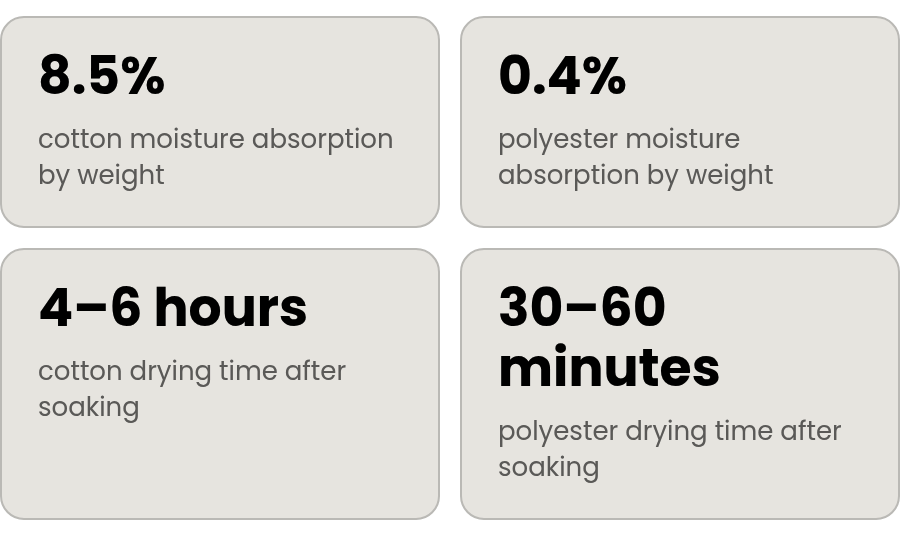
Cotton pulls water into the fiber wall through hydrogen bonding. Polyester repels it and spreads it across the surface instead. One absorbs, one moves. When you're sweating lightly—a brisk walk, easy stretching, errands in athleisure—that absorbency feels like comfort. Push into a heated vinyasa class or a 5K run, and suddenly you're wearing a damp shirt that won't let go.
The gap shows up in lab tests and real workouts. Cotton holds more moisture by weight than polyester. Under heat stress, synthetic shirts kept body temperature lower than cotton over longer sessions, because synthetics release moisture instead of trapping it. Sweat sitting on your skin doesn't cool you—it has to evaporate into the air. When fabric traps moisture against your body, rising skin wetness correlates directly with increasing discomfort during activity.
How Fabrics Handle Sweat Differently
Pima cotton's structure pulls moisture in and holds it. Polyester's hydrophobic surface repels water and spreads it through capillary action. That's why a cotton tee feels damp against your skin during a run, while a synthetic layer stays drier to the touch. Polyester spreads moisture across a wider area faster than cotton, which absorbs liquid more slowly and holds it closer to your body.
Cotton dries far more slowly than polyester after a soaking workout. Another data set shows regular cotton taking 45+ minutes to dry versus advanced synthetics. Pima cotton's longer fibers make it softer and stronger than regular cotton, but they don't change the drying time.
When Cotton Actually Works
Short, gentle sessions in moderate conditions let you enjoy Pima's softness without the sweat penalty. A 20-minute yoga flow or a casual walk on a mild morning won't generate enough sustained moisture for drying speed to matter. In those scenarios, Pima's refined hand against your skin is what you notice, not the dampness.
Push that session longer or crank up the intensity, and the gap becomes obvious. A cotton shirt that feels most comfortable when dry becomes the least comfortable option once you start sweating hard. There's one exception worth noting: in hot, dry climates—desert hiking at a moderate pace—cotton's moisture retention can actually help. The trapped water acts like a personal evaporative cooler, and the fabric allows enough airflow to make that work. But take that same tee into a heated studio for an hour-long HIIT class, and you're wearing a wet blanket.
The danger zone is cold conditions. Cotton loses its insulating power when wet, and if you're outdoors with damp fabric clinging to your skin, your core temperature can drop fast.
Breathability Isn't the Same as Moisture Management
Cotton's reputation as breathable fabric is accurate but incomplete. Breathability measures how well water vapor—not liquid sweat—passes through fabric. Synthetic shirts kept body temperature lower than cotton shirts in longer workouts under heat because synthetics release moisture instead of trapping it.
Fabric weight and porosity affect breathability. Thicker fabrics and tighter weaves reduce vapor transmission regardless of fiber type. Fabrics with smaller skin-contact areas and more surface texture create air pockets that improve breathability even when the base fiber isn't particularly porous.
Stretch and Shape Retention
| Fabric Type | Stretch & Recovery | Durability | Best Workout Use |
|---|---|---|---|
| Pima Cotton | Loses shape over time; longer fibers resist pilling | Stronger than regular cotton; described as durable | Casual training, warm-weather yoga, low-impact movement |
| Polyester/Nylon Blends | Minimal stretch alone; resists pilling and maintains elasticity through repeated washing | High abrasion resistance, quick-dry performance | Running, cycling, high-intensity interval training |
| Spandex Blends | Superior stretch recovery when paired with durable synthetics | Pure spandex loses elasticity with wear; blended versions last longer | Leggings, compression wear, fitted training gear |
When you choose blends with elastane or spandex, you're betting on fabric that bounces back after every stretch. Synthetic blends maintain shape over time, while cotton-based fabrics tend to relax and lose their original fit with repeated wear and washing. That's the difference between leggings that sag early and ones that hold their shape through repeated training.
Pima cotton is noticeably softer and more durable than standard cotton, but it still loses shape more readily than synthetic-spandex blends. Cotton fibers don't recover from being stretched the way polyester or nylon do. When you stretch cotton, it stays stretched. Adding elastane helps somewhat, but the recovery won't match synthetic constructions over the long term.
Pure spandex loses elasticity with wear, while blended spandex paired with durable synthetics lasts longer.
Care and Longevity
Keeping Pima cotton functional over time means treating the fabric's strengths and limits honestly. Cotton activewear dries more slowly than synthetics, which means a damp garment left in the hamper develops odor faster. Air it between sessions rather than tossing it straight into the washer.
Cotton can last, but you'll notice the fit loosen and the waistband soften faster than with synthetic leggings. If you bought Pima for the soft drape, prepare for it to get softer still. If you bought it for compressive hold, you'll be washing and replacing sooner.
We recommend skipping fabric softener—it coats fibers and reduces wicking. Cold water and a short spin preserve both the cotton structure and any elastane blend. Lower moisture absorption and faster drying make synthetic garments easier to manage between workouts, but odor may require appropriate washing or odor-control treatments.
Strategic Use: Where Pima Cotton Fits Your Routine
Pima's luxury feel often helps when your workout stays gentle—light yoga, walking, easy stretching, or casual athleisure errands. A lightweight, open-weave cotton top can breathe differently from a thick, tightly knit one. In these scenarios, you're not generating enough sustained sweat for moisture management to dominate the experience.
But once you cross into sustained high-output territory—long runs, cycling intervals, heated vinyasa—Pima cotton works better when used strategically rather than head-to-toe. Some designs pair absorbent Pima panels in high-sweat zones (underarms, back) with breathable synthetic layers elsewhere. For targeted sweat protection—say, an underarm shield in an otherwise synthetic top—Pima's absorption matters more than wicking alone.
We've also seen polyester-dominant blends with a small cotton fraction outperform pure cotton in comfort tests. The small cotton fraction adds enough hydrophilic pull to start moisture transport without the slow-drying penalty of higher cotton content. As cotton percentage increases, drying time rises.
Comfort tests show that polyester-cotton blends can be more comfortable than pure cotton across different levels of thermal sensation. That dose of cotton changes how the fabric glides against damp skin without sacrificing the structural durability of the synthetic base. Pure Pima cotton feels softest when you're dry, but synthetic-dominant blends win once sweat enters the picture.
What We Know About Black Pearl's Pima Line
We offer Pima cotton designs meant for comfort, but we're clear about where the research stops. None of the sources we reviewed verify our Peruvian Pima sourcing, organic or fair-trade certifications, third-party lab testing, customer reviews, pricing structure, or community initiatives. What the research does show is how Pima cotton compares to synthetics on moisture, stretch, and durability, and how workout intensity decides which fabric wins.
How to Choose Based on Your Workout
Fabric choice isn't one-size-fits-all. It's an intensity dial, and construction moves the dial too. A thick, tightly knit cotton shirt traps more heat than a light, porous one. A heavy synthetic can feel hotter than an airy cotton layer. Low-output sessions let you enjoy Pima cotton. High-output sessions demand synthetics or strategic blends.
A simple at-home test can help: place a water droplet on the fabric and watch how fast it spreads. Faster spread signals better wicking. But wicking speed alone doesn't guarantee fast drying—check how long the damp spot takes to disappear. Moisture management and drying speed scale with sweat output and session length. Once heat output keeps you sweating steadily, the fabric that releases moisture faster wins. Softness and breathability matter more in lower-sweat activities.
Knowing where that line sits for your routine is what makes the difference between comfort and clamminess.
References
[1] 5 Best Fabrics for Durable Athletic Wear - Greatness Wins - https://greatnesswins.com/blogs/news/best-fabrics-durable-athletic-wear?srsltid=AU7gw4X8jLUKurJao2N7wR9j-3TAqXi603RKyDa8RWhvfqO3mCcpX-Cc
[2] What Is Pima Cotton Fabric? How It's Different - Numi - https://wearnumi.com/blogs/women-undershirts/what-is-pima-cotton?srsltid=AU7gw4WIi6IeYExKD8f4mGlxywbWTylVJ6Q2lRlinJ2DyI5U1S11uV1z
[3] Cotton Activewear vs Synthetic: What's Really Better? - NeceSera - https://www.necesera.com/blogs/activewear/cotton-activewear-vs-synthetic?srsltid=AU7gw4WxsNjr__jDoOi1Tg5S_sLJSxb6AiAWg0soM25RTEhjQmiNNZXT
[4] Cotton vs. Synthetic: What's Best for Workout Gear? - ISSA - https://www.issaonline.com/blogs/safety-and-injuries/cotton-vs-synthetics-why-the-natural-choice-may-not-be-cotton?srsltid=AU7gw4WlC3P7uedd9oTvt4NPmdI1iWX2KrDGwD8mrl0EKN4Zklk6Tkr7
[5] Cotton vs synthetic: What's best for outdoor activities? - RevolutionRace - https://www.revolutionrace.com/campsite/cotton-vs-synthetics
[6] Do synthetic-natural fiber blends dry and wick better? - Backpacking Light - https://backpackinglight.com/forums/topic/4461/
[7] Moisture-Wicking Fabrics: The Science of Staying Dry - sansansun - https://sansansports.com/moisture-wicking-fabrics-performance-sportswear/
[8] Compare Polyester Fiber and Cotton for Moisture Wicking Efficiency - https://eureka.patsnap.com/report-compare-polyester-fiber-and-cotton-for-moisture-wicking-efficiency
[9] The One Simple Trick to Tell Whether a Fabric Is Actually Moisture-Wicking - https://www.facebook.com/GOODHOUSEKEEPING/posts/the-one-simple-trick-to-tell-whether-a-fabric-is-actually-moisture-wicking-find-/1395426972455152/
[10] [PDF] Don't Sweat it - https://www.acs.org/content/dam/acsorg/education/resources/highschool/chemmatters/documents/dont-sweat-it.pdf
[11] (PDF) Comfort aspects of sportswear base fabrics:A review - ResearchGate - https://www.researchgate.net/publication/339201309_Comfort_aspects_of_sportswear_base_fabricsA_review
[12] Evaluation of thermal and moisture management properties on knitted ... - https://www.researchgate.net/publication/49794907_Evaluation_of_thermal_and_moisture_management_properties_on_knitted_fabrics_and_comparison_with_a_physiological_model_in_warm_conditions
[13] Moisture management and thermal absorptivity properties of double ... - https://www.researchgate.net/publication/258195907_Moisture_management_and_thermal_absorptivity_properties_of_double-face_knitted_fabrics
FAQ
1. Why does cotton feel great at first but uncomfortable once I start sweating hard?
Cotton absorbs moisture into its fiber structure through hydrogen bonding, pulling sweat away from your skin initially. But once saturated, it holds that water much longer than synthetics instead of releasing it. The damp fabric clings to your skin, trapping heat rather than venting it, which is why comfort drops sharply as sweat output increases during intense sessions.
2. Can I wear Pima cotton leggings for hot yoga or will they lose their shape too quickly?
Pima cotton leggings work for hot yoga if you value softness over compression, but expect the fit to relax faster than synthetic blends. Cotton fibers don't recover from being stretched as well as polyester or nylon, so they tend to stay stretched after repeated use. Adding elastane helps temporarily, but blends with higher cotton content still tend to lose shape faster than synthetic blends, especially in humid, high-sweat environments.
3. If polyester dries faster, why do some activewear blends still include cotton at all?
Small amounts of cotton in a mostly-polyester blend improve comfort against damp skin without sacrificing quick-dry performance. These blends can feel more comfortable once perspiration starts, because the cotton fraction changes how fabric glides over wet skin. As the cotton percentage rises, drying time climbs noticeably and the comfort advantage fades during longer sessions.
4. Does breathability alone keep me cool, or is moisture speed more important during workouts?
Breathability allows air circulation, but moisture speed determines how quickly sweat evaporates off your skin—and evaporation is what actually cools you. A breathable cotton shirt that holds water won't cool you as effectively as a less-breathable synthetic that releases moisture faster. During extended workouts under heat stress, synthetic shirts kept body temperature lower than cotton precisely because they moved moisture faster.
5. When would I actually want cotton's slower drying time instead of synthetics?
In hot, dry climates during moderate-pace activities like desert hiking, cotton's moisture retention acts as an evaporative cooler. The trapped water sits in the fabric, and dry air moving across it pulls heat away from your skin. That advantage only works when humidity is low and your pace stays steady—crank up intensity or add humidity, and that same dampness becomes a liability.