Why Cotton Leggings Sag at the Knees: Knit Density, Elastane, and Weight
November 18, 2026
Knit Density: What Holds Your Leggings' Shape
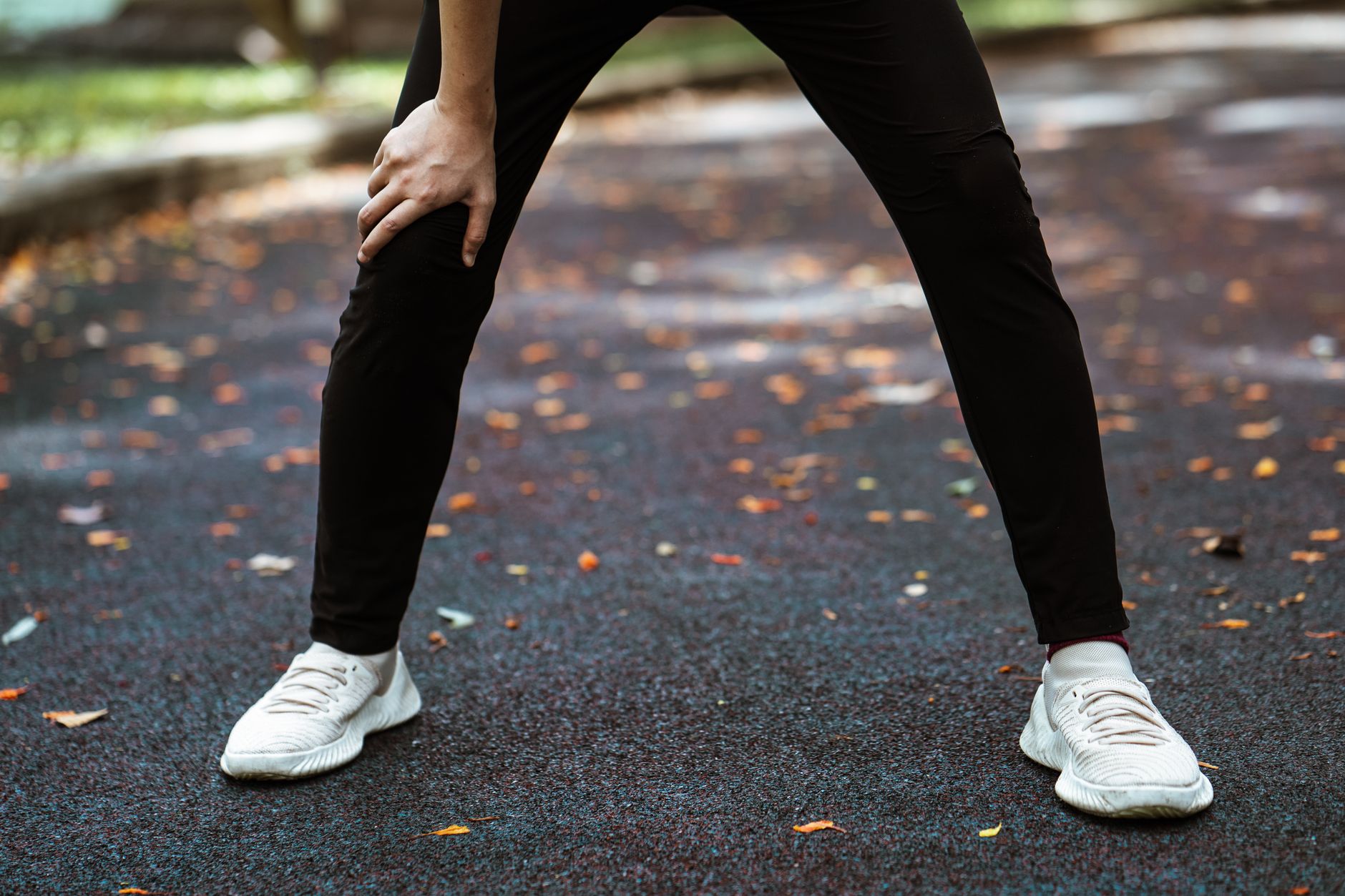
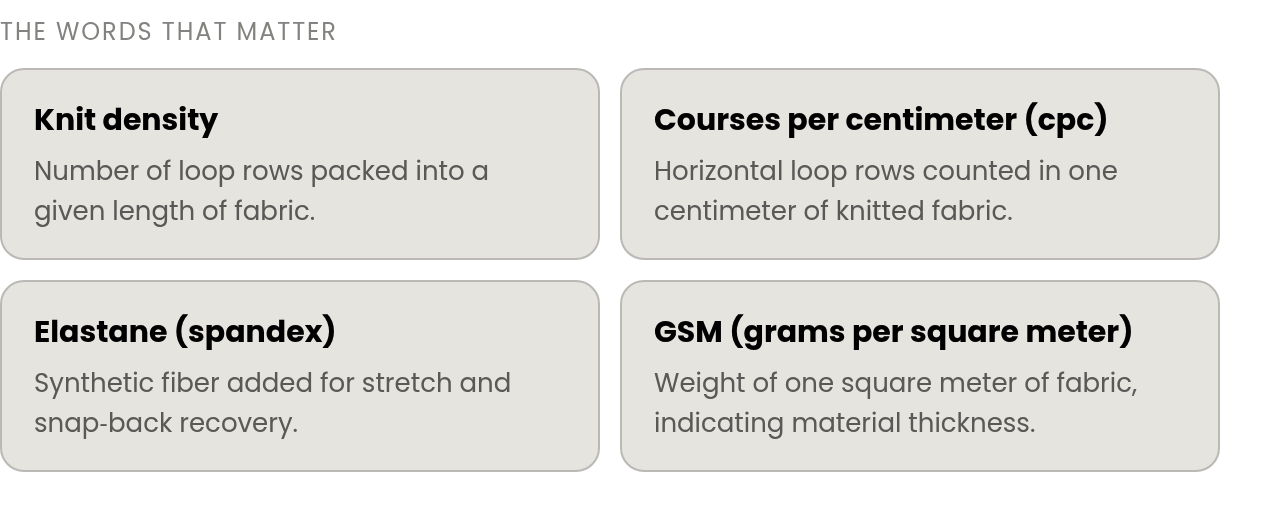
You pull on your favorite pair in the morning, and they hug every curve. By lunch, a soft pouch has formed at each knee. That pouch has a structural cause, and it starts with how tightly the loops in the fabric sit together. When we compare cotton leggings for women, knit density is the first number we look for. Every knit is built from rows of interlocking loops. Density tells you how many of those rows fit into a set length.### What Is Knit Density in Cotton Leggings? Courses per centimeter (cpc) is the number of horizontal loop rows in one centimeter of fabric. More courses mean shorter, tighter loops. Tighter loops have less room to slide out of place when you bend your knee. Think of cpc as the frame your leggings lean on to keep their shape.Textile engineer Dereje Sitotaw used cpc as one of seven measurements in his study of cotton and cotton/elastane knits. He tested five structures: single jersey, 1x1 rib, 1x1 interlock, single pique, and two-thread fleece. Each one was made twice, once in 100% cotton and once in 95% cotton/5% elastane. Across all five fabrics, adding elastane changed loop length, cpc, stitch density, and tightness. So a small amount of stretch fiber can change how a knit is built, as well as how it stretches.### Does a Tighter Knit Mean Less Knee Sag?For plain jersey, yes. In research on plated plain knits, the single jersey with no elastane had the lowest tightness and the worst bagging.Read that alongside Sitotaw's work and a pattern shows up. Density looks like the main defense against sag, and elastane is one way to raise it. One caveat: that bagging test covered jersey only. We won't claim rib or interlock sags less based on it.Washing plays a part too. A University of Kentucky legging study checked leggings after 1, 5, 10, and 20 washes. Every sample was a nylon/spandex blend, though. If you're hoping for wash data on cotton, this study can't give it to you.## Elastane Blend: Stretch That Snaps Back You sit cross-legged on the floor with your morning tea, stand up, and your leggings spring right back into place. That little snap-back comes from elastane, and a small amount does a lot.Elastane (also sold as spandex) is a synthetic fiber blended in for stretch and recovery. Research on elastane chemistry says its structure lets it stretch to 100-600% of its original length without permanent deformation. In cotton leggings for women, that recovery is meant to pull the knee back into shape after every squat.### How Much Elastane Do Cotton Leggings Need?Less than you might think. Elastane sits at 1-5% by weight in cotton and wool products, while polyester or nylon sportswear blends often reach 20%, as Van Belleghem and colleagues note.Those small amounts still change a lot. In Uyanik and Kaynak's bagging tests, the jersey with full elastane bagged least, at the opposite end from the elastane-free version. Because elastane also tightens the knit, it can push fabric weight up. So when you see a high GSM (grams per square meter, a measure of fabric weight), check the fiber label before you give the cotton all the credit.### Does Elastane Cause Pilling?The evidence is thin. That makes it hard to say how the finding applies to cotton blends. For now, we'd treat it as an open question.## Weight & Drape: Breathable or Supportive?You hold two pairs of leggings up to the window. One lets a little light through. The other feels almost like a soft sweatshirt in your hands. That difference has a number, and it shows up on more spec sheets than you'd expect.That number is GSM: how much one square meter of the fabric weighs. When you compare cotton leggings for women, GSM tells you how much material is packed into the cloth. Higher means more fiber in every square meter.### Fabric Weight Follows the Knit GSM rarely moves on its own. Tighter loops pack more yarn into the same space, and elastane draws loops closer together, so both tend to push weight up. We read GSM as a clue to how the fabric was built. On its own, it can't promise smooth knees.Weight changes how your leggings feel, too. A heavier knit is designed to feel opaque, smooth, and held-in. A lighter one breathes more easily and drapes softer, but it gives the knee less material to hold its shape.So skip buying on GSM alone. A heavy fabric with loose loops and no elastane will still bag. For hot classes or summer walks, a lighter knit with good density and a touch of stretch should serve you better than the thickest pair on the rack.## Cut and Seams: Where the Knee Strain Goes You drop into a deep squat to grab something off the floor and feel the crotch seam pull tight. That tension travels down the leg and lands at the knee.Fabric does most of the work against sag. The cut and stitching decide where the strain ends up. Check construction second, after knit density, elastane, and weight. Good design spreads stress around, but it can't rescue a loose, low-density knit. If the fabric fails those earlier checks, pass on the pair, however clever the seams look.### Which Construction Details Help Cotton Leggings Keep Their Shape?A diamond-shaped gusset is a small inset panel at the crotch. In general garment construction, it gives your hips more room to move, so the knee doesn't have to supply extra stretch when you lunge or sit cross-legged.Seam placement matters as well. Flat-lock seams lie flat against your skin and are designed to stretch with the fabric. A raised, stiff seam can force the cloth beside it to stretch harder. Seams that curve away from the kneecap leave your busiest bending zone as one smooth piece.Some designs add a reinforced knee panel: a second layer or a denser fabric over the joint. It's meant to resist stretch-out in that one spot during yoga, gardening, or anything with a lot of kneeling. For walks and errands, you can happily do without it.## Real‑World Test: Black Pearl’s Pima Cotton Leggings You fold into a low lunge, hold it for five slow breaths, and rise. The real test of any pair is how the knee looks after that. And again after the tenth wash.What we can show you is limited, and we'd rather say so. Our pieces are 100% certified Peruvian Pima cotton, so the elastane advice above doesn't apply to them. Their knee recovery rests on the knit and on your care routine. We haven't commissioned an independent wash test, and our reviews talk about feel more than knees.
How Do You Keep Pima Cotton Leggings Smooth at the Knee?Be gentle with the knee zone on laundry day. Cold water, turning the pair inside out, and no dryer heat are all meant to help 100% cotton keep its loops in place. Without elastane to pull the fabric back, how you dry matters as much as how you wash.- Wash cold and inside out, with garments of similar weight.
- Lay flat to dry. A wet pair hung by the waistband stretches under its own weight.
- Rotate pairs so the knees get a rest between wears.Our care guide for organic athleisure walks through the full routine.
References
[1] AN EVALUATION OF THE PERFORMANCE OF LEGGINGS ... - https://uknowledge.uky.edu/cgi/viewcontent.cgi?article=1016&context=mat_etds
[2] Courses per centimeter (cpc) of knitted fabrics made from 100% cotton... - https://www.researchgate.net/figure/Courses-per-centimeter-cpc-of-knitted-fabrics-made-from-100-cotton-and-cotton-elastane_fig3_325447820
[3] Strength, fatigue and bagging properties of plated plain knitted ... - https://www.researchgate.net/publication/335452889_Strength_fatigue_and_bagging_properties_of_plated_plain_knitted_fabrics_containing_different_rates_of_elastane