Sensitive Skin Needs More Than Organic: The Case for Certified Pima Cotton
November 18, 2026
What the labels can actually prove
You know the feeling. A top looks soft on the hanger, and two hours later every seam itches. For eczema-prone skin, the word on the label matters less than what that label can prove.When you shop luxury cotton athleisure for women, we suggest two checks. How long is the fiber? And who certified the claim? In the table below, "Not found" means none of our sources supported a value.
| Fabric type | Certification status | Fiber length | Typical feel | Breathability rating | Best for |
|---|---|---|---|---|---|
| Organic cotton | GOTS "organic" needs ≥95% certified organic fiber; "made with organic materials" needs ≥70% | Not found (organic describes farming) | Not found | Not found | Shoppers who want processing controls |
| Conventional (Upland) | None; USDA classing gives no sensitive-skin grade | 0.9–1.1 in | Short fibers can rub | Not found | Well-made budget basics |
| Pima / Supima | Supima: trademarked US-grown Pima; plain "Pima" less regulated | 1.4–1.6 in | Smooth, soft, less pilling | Not found | Daily wear on reactive skin |
| Egyptian | No consumer-verifiable grade | Not found per label | Fine, silky (ELS grades) | Not found | Only with traceable ELS sourcing |
| Superfine merino | Not found | Not found | Non-itchy | High thermal and moisture buffering (reported) | Cool-weather base layers |
| Lyocell | Not found | Not found | Reported as preferred over cotton in a study | Not found | Trial pieces |
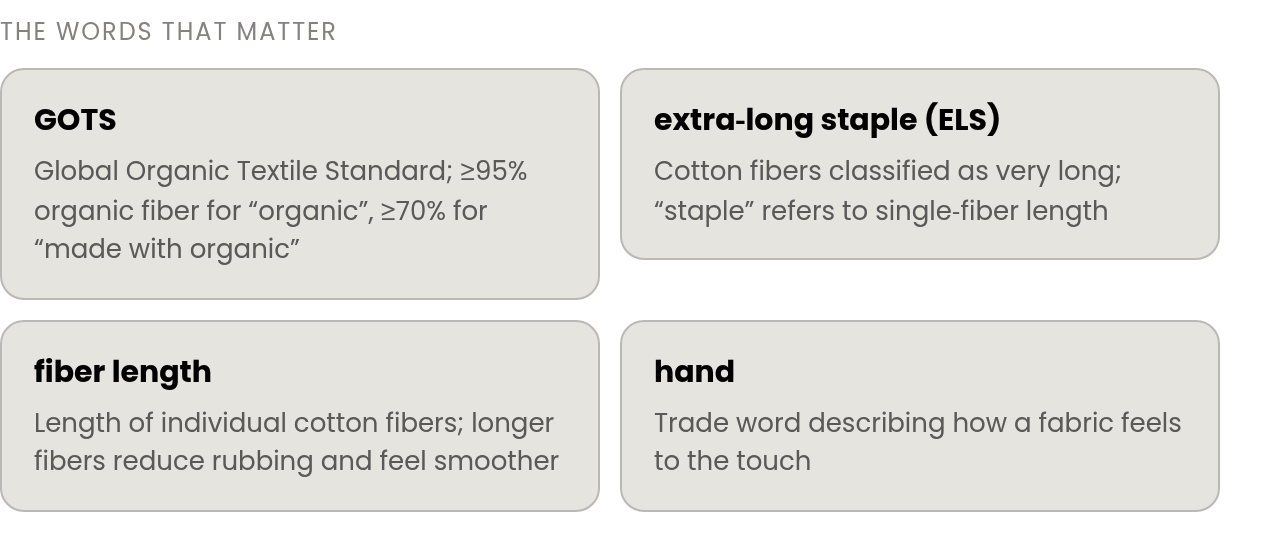
A few terms first. Upland is the everyday cotton in most basics. ELS stands for extra-long staple, and "staple" simply means the length of a single cotton fiber. GOTS is the Global Organic Textile Standard.What each row tells you:
- Organic: The GOTS thresholds cover how cotton is farmed and processed. They say nothing about how smooth the yarn is.- Upland: Short fibers expand and contract, rubbing delicate skin.- Pima/Supima: Longer fibers leave fewer loose ends sticking out, so less fiber pokes at your skin.- Egyptian: A "100% Egyptian" label can hide fiber that isn't extra-long staple.- Merino and lyocell: In a 2020 evidence review, superfine merino didn't cause itching, and the evidence on lyocell was thin.### Which fabric comes out ahead for eczema-prone skin?Certified Pima, on the evidence you can actually check. It has the longest fiber in the table. It has a trademark, Supima, that verifies what's inside.If you want the gold-standard version, look for organic Pima carrying a GOTS label too. You get the smooth fiber plus controls on how it was processed. It's rare, so check for both labels rather than assuming one implies the other.Two caveats shape that pick. Pima's length answers the short-fiber rubbing problem, but only if the garment is well made, so feel the seams and the inside face before you commit. And if heat and sweat under winter layers are what set off your flares, superfine merino may have better moisture‑buffering than many cottons examined.## Why "organic" alone won't protect sensitive skin You pull on a soft-looking organic tee for a morning class. By the cooldown, the skin along your collarbone prickles and burns. The tag said organic. So what went wrong?The word itself. "Organic" describes how the cotton was grown. It tells you nothing about fiber length or how the fabric moves against your body. As one organic Pima maker points out, Pima can be grown conventionally or organically. The two labels answer different questions, and your skin needs both answered.### What actually sets off eczema-prone skin?Friction, first. Some reviews suggest thick, coarse wool may cause itching, while ultra-fine merino appears less likely to. How thick and smooth the fiber was mattered more than what the fiber was called.Cotton has the same weak spot. Short cotton fibers expand and contract as you move, and that constant tiny rubbing irritates delicate skin. Dyes add a second risk on top.This is why we put fiber length ahead of any organic claim for friction-prone skin. Longer fibers give a smoother surface. Long staple is a head start. It isn't a promise.### How do organic and Pima labels compare on skin triggers?
| Skin trigger | What "organic" tells you | What certified long-staple Pima adds | What you check yourself |
|---|---|---|---|
| Fiber friction | Nothing; it covers farming | Longer fibers, fewer protruding ends | Rub the inner face along your forearm |
| Dyes and finishes | GOTS limits chemical inputs, including dyes | Only if it's also GOTS certified | Certification on the finished garment |
| Dampness | Not addressed | No Pima-specific moisture test found | Lightweight knit; change out of sweaty layers |
| Seams and tags | Not addressed | Not addressed | Flat seams, printed labels |
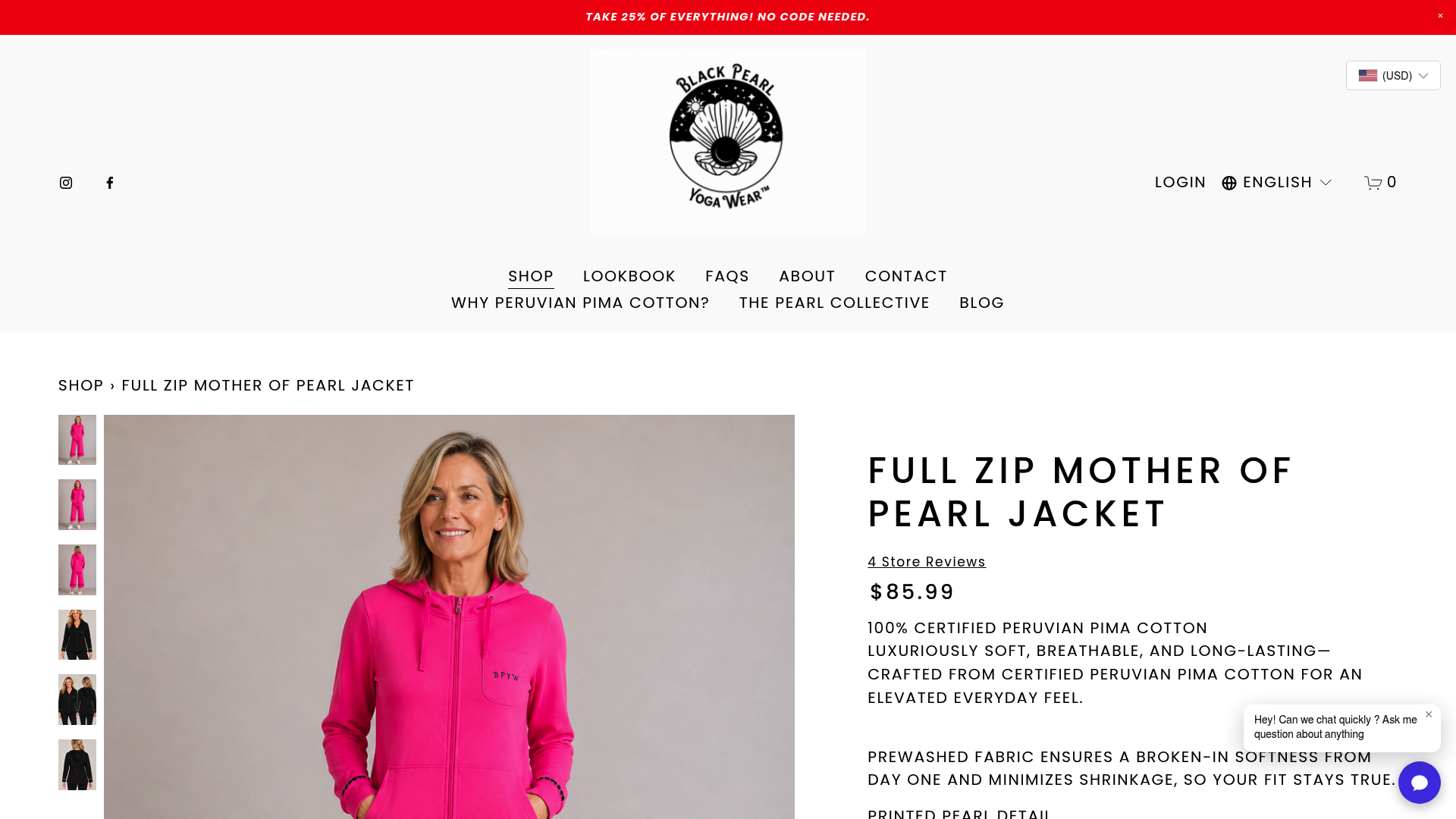
Fiber length won't solve every flare. If your eczema tracks with sweat more than rubbing, Pima's long fibers probably won't do much on their own, since we found no moisture testing on Pima specifically. For friction-driven itch, though, fiber length is the first thing we'd check.## Certified Peruvian Pima cotton: the difference you can feel Close your eyes and run your fingertips over two white tees. One feels faintly fuzzy. The other feels smooth, almost cool.Much of that comes down to how long each cotton fiber was before it was spun into yarn. If you're shopping luxury cotton athleisure for women with sensitive skin, that's a useful place to start. Pima fibers run 1.4 to 1.6 inches, compared with 0.9 to 1.1 inches for everyday Upland cotton, according to this Pima buyer's guide. Peruvian Pima often goes past 38 mm.Peru has deep roots here.
Why do longer fibers feel softer on reactive skin?Picture yarn as thousands of fibers twisted together. Shorter fibers mean more ends poking out and more joins where the yarn can weaken. Longer fibers mean fewer of both. You feel that as a smoother surface that's slower to pill, those little fuzz balls that build up after washing. Skin that flares with friction simply has less to catch on.Some sellers push this further. Mood Fabrics calls Pima hypoallergenic. We wouldn't go that far, and the clinical sources don't either. A longer staple shrinks the short-fiber problem. Dyes, seams and finishes are still in play.### Which labels prove what you're buying?We found no official "certified Peruvian Pima" standard. "Peruvian Pima" names an origin and a fiber type, and a garment tag alone can't confirm either. Each of these labels checks one piece of the story.
| Label | What it verifies | What it leaves open |
|---|---|---|
| "Made in Peru" tag | Country where the garment was made | Where the fiber was grown, fiber length |
| GOTS organic Pima | Organic fiber plus processing controls | Garment construction |
| OEKO-TEX® Standard 100 | Finished fabric tested for listed harmful substances | Fiber type, origin, farming method |
For reactive skin, OEKO-TEX is worth looking for. It covers the dyes and finishes that fiber length can't fix.Be a little skeptical of lovely product copy. One maker, Skin, works with small family-owned partners in Peru and describes its GOTS organic Pima as soft and breathable. That's a description, not a test result.Fabric density is murky too. The only figures we found were for sheets, not apparel. We found no GSM data, meaning grams per square meter, a measure of fabric weight, for athleisure. So a thread count or weight claim on its own tells you little about softness.## The bottom line on luxury cotton athleisure for eczema-prone skin You're in the fitting room, holding a tag covered in words: soft, natural, premium, organic. Your skin cares about only a few of them.The case for long staple goes beyond first touch. Longer fibers overlap better during spinning, which this sensitive-skin buying guide connects to stronger, more even yarn. Or & Zon's Pima guide adds that fewer joins between fibers mean fewer weak points, so the fabric is meant to hold its smoothness wash after wash. That matters for pieces you'll live in.### What should you check before you buy?
| Check | Why it matters | Where to look |
|---|---|---|
| Stretch blend | Most athleisure mixes cotton with elastane or spandex, and a larger synthetic share leaves less cotton touching your skin | Fiber percentages on the content label |
| Certification grade | GOTS "organic" and "made with organic materials" set different thresholds | Certificate or product page |
| Yarn type | Ring-spun yarn can give fabric a notably soft hand, though neither yarn type nor fiber length measures how your skin will respond | Product details |
| Seams and finish | A badly made garment with a premium cotton name can feel rougher than well-made Upland | Inside the garment, against your forearm |
"Hand" is the trade word for how a fabric feels to the touch. Ring-spun yarn is twisted more tightly and finely than standard yarn.### Is certified Pima right for your skin?The sources pull in two directions. One organic Pima maker credits certified Pima with documented chemical controls and durability. The CottonGood guide counters that fiber type alone doesn't decide comfort. We think both are right. For our certified Peruvian Pima pieces, we treat that durability as skin safety: holding smoothness longer should mean fewer replacements, and fewer replacements mean fewer new dyes, seams, and finishes to test on reactive skin. The fiber gives you an edge only when the construction keeps up with it.So be honest about your triggers. If your flares come from a specific dye, a scratchy elastic waistband, or a printed tag, Pima won't fix any of those. Sort out the construction first. Then let the fiber do its quiet work.When you're ready, browse our certified Pima pieces at Black Pearl Yoga Wear and run them through the same checklist. Read the label. Feel the seams. Check the inside face against your forearm. That's the standard we want you to hold us to.
References
[1] Luxurious Pima Cotton Fabric by the Yard - https://www.moodfabrics.com/collections/pima-cotton-fashion-fabrics?srsltid=AYCX9vLlGJY9z8eLmcoS7ltcPDWiK_BcBAH7jAuUHukfhRQ1iNxfbnEn
[2] Best Cotton for Sensitive Skin: Buying Guide - https://cottongood.com/buying/sensitive-skin/
[3] The Quiet Luxury of Organic Pima Cotton - https://skinworldwide.com/blogs/in-your-skin/the-quiet-luxury-of-organic-pima-cotton?srsltid=AYCX9vJ49ov8R1P6ktpePOXbsMiTrKGg-wotPVnmW7mKk82hOVYahP5D
[4] What Is Pima Cotton? Honest Buyer's Guide vs Supima & Egyptian (2026) - https://orezon.co/blogs/bedding-materials/pima-cotton?srsltid=AYCX9vJCHpZbun-4vT-X9KiM-deQxwdfcVoYSKyT5um7shFEO4Da65Jc
[5] Organic Cotton vs Bamboo vs Synthetic for Sensitive Skin - https://juliemay.co.uk/blogs/juliemay-blog/organic-cotton-vs-bamboo-vs-synthetic?srsltid=AYCX9vJEwr3WFj-s-Jx4TlukHYVGHahr1LP68X1oZZitdjVOMj-lFOZf
[6] Fabric Selection in Atopic Dermatitis: An Evidence-Based Review - https://pubmed.ncbi.nlm.nih.gov/32440827/
[7] (PDF) Types of cotton and their significance - https://www.researchgate.net/publication/398072171_Types_of_cotton_and_their_significance
[8] Fabrics for atopic dermatitis - https://www.researchgate.net/publication/5337607_Fabrics_for_atopic_dermatitis