Check Fiber %, Flat Seams, and Squat Opacity Before Buying Peruvian Pima Cotton Activewear
November 11, 2026
Before we get into it, the short version:
- Check whether the piece is 100% cotton for breathability or a cotton-spandex blend for stretch and shape recovery.
- Flat seams should feel smooth when touched inside-out, with no scratchy ridges or visible puckering after the first few washes.
- Squat opacity testing requires bright, consistent lighting because dim fitting-room conditions hide fabric transparency that appears during deep stretches.
Decoding Fiber % in Peruvian Pima Cotton
Before you buy Peruvian Pima cotton activewear, pull up the product description and look for a fabric-content line you can actually compare. The label should make it clear whether the piece is built primarily for natural softness and airflow or whether it includes an elastic component for movement. That information changes how the garment behaves during yoga, walking, lounging, or higher-sweat training.
What the Label Actually Tells You
A clear fiber breakdown is your first filter. If a product page says "premium Pima cotton blend" but doesn't list the percentages, that's a red flag. Vague phrasing like "cotton-spandex mix" or "stretch cotton" hides the actual composition, and you're left guessing what you're really getting. Transparent brands publish the exact ratio in a spec table near the size chart.
The composition line also tells you what kind of performance to expect. A pure cotton garment usually has a softer, more breathable feel but less snap-back after being stretched. That can be ideal for restorative practice, travel days, and low-friction layering. A Pima-and-elastane fabric is better suited to repeated bending, squatting, and recovery after wear, especially in leggings or fitted tops where shape retention matters.
When Feel Isn't Proof
You can stretch a garment over your hand and gauge its give, but that home test won't replace a clear fiber-content label. A fabric with noticeable rebound likely includes an elastic yarn, while cotton without that added fiber behaves differently under tension. Touch can help you compare softness, but it cannot confirm cotton origin or staple length.
If the Pima claim matters to you, check whether the brand provides documentation beyond the hero copy. Marketing phrases at the top of a product page are easy to write; a complete material specification is harder to fake.
For more on keeping your Pima pieces in shape after you've verified the blend, we've covered care practices that protect softness without breaking down the fiber over time.
Spotting Flat Seams: Comfort & Durability
When you're shopping for Peruvian Pima cotton activewear online, zoom in on product photos and look for low-profile seam lines that sit flush against the fabric. Flat seams—also called flatlock seams—run in clean, parallel rows rather than bulky ridges. You'll see them along side panels, inseams, and waistbands, and they're designed to reduce the friction that can irritate your skin during movement.
If the product description mentions "flatlock stitching" or "flat seams," that's your first cue. But product language alone isn't enough. Inspect the close-up images for seams that look smooth and minimal, not raised or puckered. A seam that creates visible bulk or texture in the photo will likely feel that way against your body.
Running Your Own Tactile Check
Once you receive the garment, turn it inside out and run your finger slowly along the seams. A quality flatlock finish should feel low and even, without a hard edge that catches under your fingertip. If you notice a rough join, a raised thread path, or a bulky intersection where panels meet, that spot can become irritating during a yoga flow or long walk. The best construction fades into the garment; weaker construction keeps calling attention to itself.
For durability, skip any claim about specific wash-cycle counts—those aren't standardized test results. Instead, inspect the seam after early wear and laundering. Look for skipped stitches, loose threads, fraying, or distortion along the seam line. Also check high-stress areas, such as the inner thigh and waistband, where tension exposes weak stitching first. A durable seam remains even and secure instead of opening into visible gaps or thread breakage.
Testing Squat Opacity: A Simple Home Check
When you squat in Peruvian Pima cotton activewear, the fabric across your glutes stretches significantly beyond its resting state. That stretch is where opacity breaks down—and why a pair of leggings can look perfectly fine on a hanger but turn see-through at the bottom of a deep squat. Before you buy, you need a controlled check that simulates real movement under real lighting.
Run the At-Home Squat Check
Stand in front of a mirror or prop your phone at hip height with a timer running. Use the same strong light source for every garment you test so the comparison is fair. Perform a full squat, a forward hip hinge, and a deep lunge. Check the fabric across your seat, upper thighs, and any high-tension zone. If you can identify skin tone, underwear color, or a pattern through the fabric, the leggings fail the test.
You can also stretch the fabric taut over your hand and hold it toward a bright background. If you see your knuckles or skin tone clearly, that fabric will thin out during movement. This hand-stretch test is useful for comparing samples side by side, but it doesn't replace the on-body squat. Hand tension varies too much to be your final standard, so treat it as a pre-screen rather than proof. A phone flashlight held directly behind the fabric can create an unrealistic result—use it only to compare identical conditions, not as your pass-fail benchmark.
Use Fabric Density and Knit Structure as Buying Clues
Opacity depends on fabric density more than color alone. Fabric weight, measured in grams per square meter (GSM), affects coverage during stretch—lighter-weight fabrics are more prone to transparency, particularly in paler shades. Anything below 240 GSM is likely to show skin when stretched. When a product page lists GSM, use it as your first filter—but if it doesn't, look for interlock knit construction instead. Interlock uses two needle sets to create a double-face fabric that resists transparency, while single jersey knit is thinner and more prone to showing skin during stretch.
If a Peruvian Pima cotton activewear piece includes a small percentage of stretch fiber, that fiber is there to maintain shape and allow movement. The ratio matters for compression and recovery, but density and construction type tell you more about opacity than fiber content alone. Look for both fabric weight and knit type when evaluating coverage.
What to Look for Before You Buy
Before you add anything to your cart, run through these checks. Each one filters out a common failure point that only shows up after you've already paid.
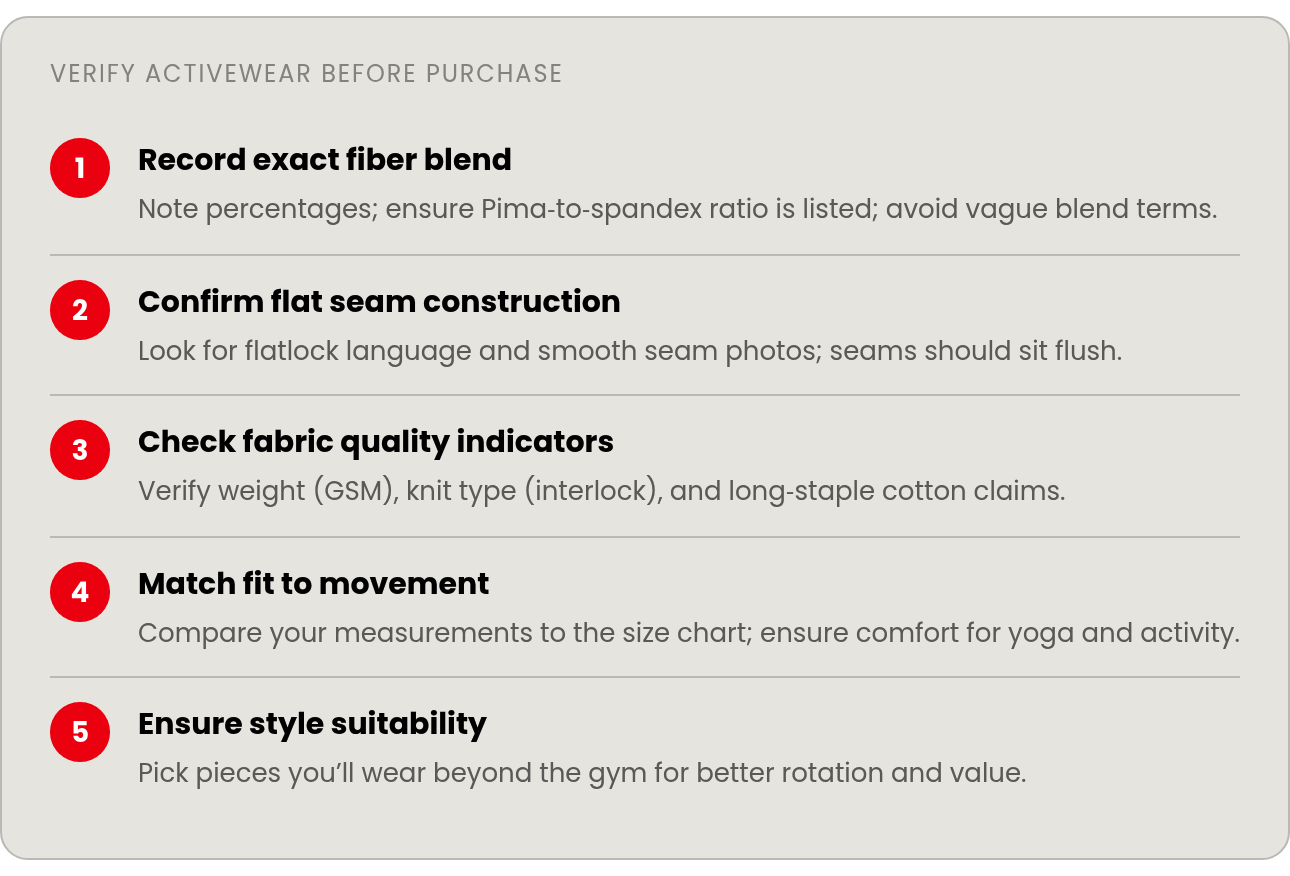
Record the exact fiber blend. Pull up the product description and write down the percentages. Look for Peruvian Pima activewear that lists the exact Pima-to-spandex ratio rather than vague "cotton blend" language. If a brand won't tell you what's in the fabric, they're hiding something. Test this with a simple question to customer service—if they dodge or reply with marketing language instead of numbers, move on.
Confirm flat or flatlock seam language. Scan the product photos for seams that sit flush rather than raised. Look for terms like "flatlock stitching" or "low-profile seams" in the description. If you see puckered ridges in the close-ups, you'll feel them during movement.
Look for fabric-quality indicators. Check for fabric weight mentioned anywhere on the page, interlock knit construction, or specific construction details the brand shares about how the garment is built. If the brand only shows the leggings on a model standing still, that's intentional.
Match the fit to your movement. Activewear that's too tight can dig in or feel constricting. Too loose and it shifts mid-session. Size charts matter here—measure your hips and waist rather than guessing based on your jeans size.
Pick a style you'll actually wear. If it only works for the gym, it won't get enough rotation to justify the cost. We build our collection around pieces that transition from your morning flow to errands to coffee with a friend, not just the hour you're on the mat.
Your final verification checklist: Product name, stated fiber content with percentages, seam construction details, any breathability or construction claims, and return policy terms. If any field is missing or vague, ask before you buy.
References
[1] How to Select the Best Fabric for Yoga Pants for Your Brand - https://mfgmerch.com/best-fabric-for-yoga-pants/
[2] How to Choose Women's Leggings: Fit, Fabric & Function - https://actawear.com/blogs/news/how-to-choose-womens-leggings-fit-fabric-function?srsltid=AYCX9vIuJoSnYQOJkh-XGqORQ9c7kYTE_8tiTnR9q7rES7LB5uAX4yo2
[3] How Tight Should Gym Leggings Fit? Snug in 2026 - https://tlfapparel.com/blogs/news/how-tight-should-gym-leggings-fit?srsltid=AYCX9vIqxM3WKz5SVyXhDZ0815jyjX8Ccy8NFkthkLpeeFtfooCfMe5B
[4] How to Tell If Leggings Are Squat-Proof: 3 OEM Tests - https://diguanapparel.com/blogs/insights/squat-proof-leggings-oem-opacity-tests?srsltid=AYCX9vIRAOkbx8zQs_sreIzwSw8vtqfVeChMLDpqYZVfv1jMMOZNySLI
[5] Squat Proof Leggings: How to Tell in 10 Seconds | PILLAR - https://pillarathletics.com/blogs/the-pillar-post/how-to-tell-if-leggings-are-squat-proof?srsltid=AYCX9vI6Fqo0G_bnVYLrWhYHUtO3NUHn-h_k6G8rvteH2EI8N6_QtWFS
[6] Which Leggings Are Squat-Proof and Not See-Through? - https://evolvefitwear.com/blogs/posts/which-leggings-are-squat-proof-and-not-see-through?srsltid=AYCX9vKy0uBWWHB5_zpog_Eepe8XRboCZkfp2ofsUNvS4q3wzragys1F
[7] Best Squat-Proof Leggings That Actually Work in 2026 - https://violatethedresscode.com/blogs/news/best-squat-proof-leggings-that-actually-work?srsltid=AYCX9vJeE9J8vg1-UXWf1D895EZs0tyHT42Bk8tMWBtMVvr91Q3qytea
[8] (PDF) Apparel Quality Standards in Garment Construction - https://www.researchgate.net/publication/399665392_Apparel_Quality_Standards_in_Garment_Construction
Frequently Asked Questions
1. Can I trust a brand that lists "95% Pima cotton, 5% spandex" without showing a certification or mill disclosure?
Treat that as a useful starting point, not the whole answer. The ratio explains stretch and recovery, but the Pima claim still depends on sourcing transparency. If origin matters to you, ask the brand for supporting details before you buy.
2. If flat seams feel smooth when the garment is new, does that mean they'll stay comfortable after multiple washes?
Not automatically. New stitching can feel fine at first, then reveal weak construction once the fabric has been worn, stretched, and laundered. Pay closest attention to high-friction areas such as the inner thigh, crotch gusset, side seam, and waistband.
3. Why does fabric weight matter more than color when I'm checking for squat opacity?
Color can help, but it cannot compensate for a thin or open knit. Denser fabric and a more stable knit structure keep coverage more consistent when the garment is stretched, which is why material specs are more reliable than judging opacity from a still product photo.