Natural Fiber Activewear That Handles Sweat Without Clinging or Odor
October 18, 2026
Key Takeaways
- Cotton is often described as absorbing moisture into the fiber itself rather than spreading it across the surface, which may reduce conditions linked to odor. However, the documented odor mechanism begins when bacteria break down sweat compounds on fabric.
- Hemp activewear can absorb 12-30% of its weight without feeling damp, according to one supplier source, and may dry faster than cotton in humid conditions.
- Merino wool is often described as holding moisture vapor inside the fiber, while the outside stays relatively dry. That is different from surface wicking.
- Polyester's quick-dry edge may fade in hot yoga studios, where high humidity can slow evaporation from any fabric.
- Some natural-activewear brands add up to 10% synthetics for stretch while aiming to keep breathability Ecocult.
- Pima cotton is often valued for its longer staple length and smooth hand, but it is still not a polyester-style wicking fiber.
Why natural fiber activewear matters for hot yoga
When you're sweating through a hot yoga flow, the fabric can start to stick. That clammy, clingy feeling is hard to ignore. Synthetic activewear often leaves moisture on the surface, which can create that wet-layer sensation.
Your body makes two kinds of sweat: eccrine and apocrine. Eccrine glands, spread across nearly your entire body, release thin, watery sweat that cools you down. Apocrine glands, concentrated in your underarms and groin, produce a thicker fluid containing proteins and lipids. Neither type smells when it first reaches your skin. According to an NIH review, odor only forms when bacteria on fabric break down those proteins, which is why a favorite pair of leggings can still smell after a wash (PMC).
How natural fibers handle moisture without clinging
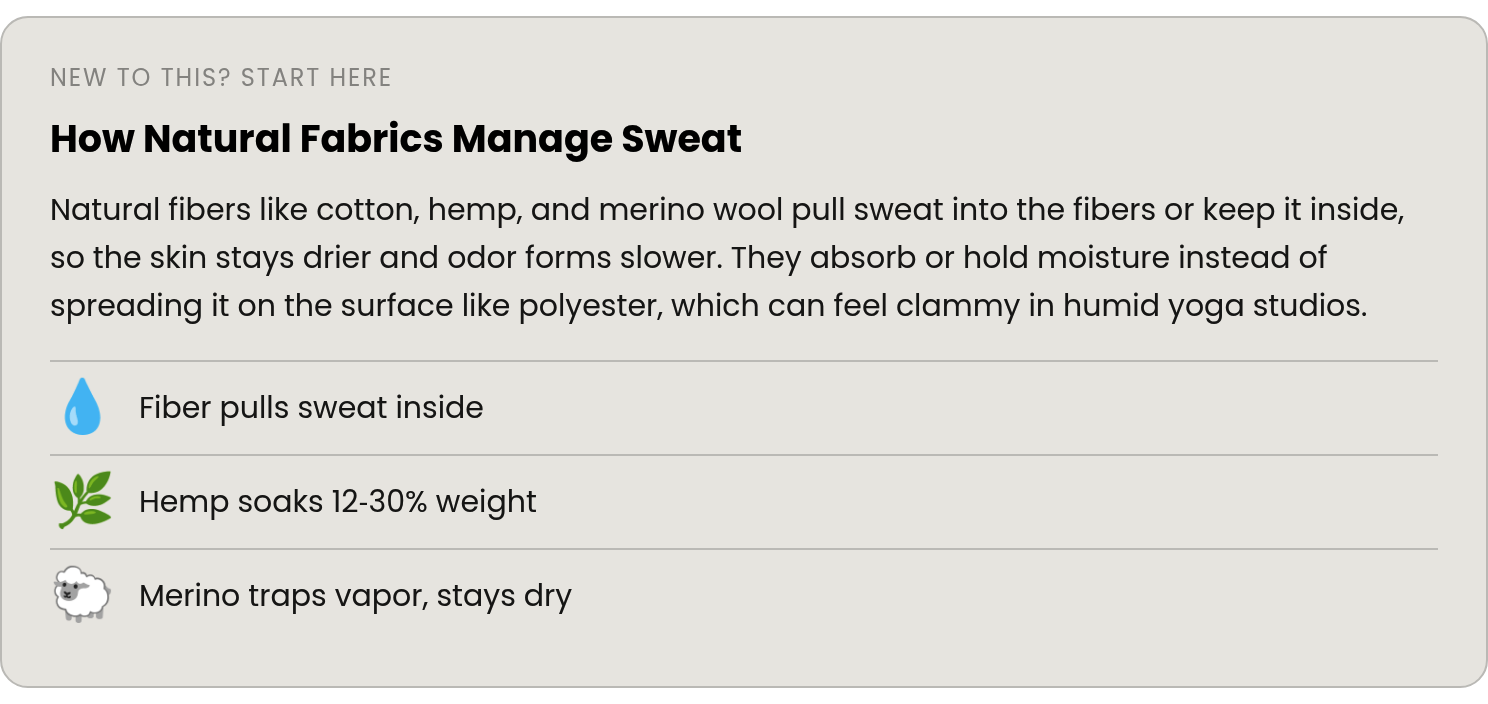
Pima cotton activewear is often described as working differently from polyester. Cotton pulls moisture into the fiber itself, away from your skin, rather than spreading it across the surface. Hemp performs especially well in humid conditions, with one source reporting that it can absorb 12-30% of its weight without feeling damp and may dry faster than cotton.
Merino wool manages moisture another way. The fiber is often described as taking in moisture vapor and holding it inside while the outer surface stays relatively dry. Bamboo-derived fabrics can behave differently depending on processing; some may feel less clingy when saturated.
The tradeoff is slower drying. Natural fibers generally dry more slowly than synthetics, which are designed to shed water rather than absorb it. In hot yoga, though, high humidity limits evaporation regardless of fabric choice. Sweat can bead on the skin while a synthetic garment stays pressed against the body (Sportek).
What the research can actually tell us about odor and sustainability
Absorption is only one part of odor. Cotton is often described as moving moisture into its structure. Polyester is often described as spreading it through channels meant to speed evaporation. These are hypotheses about fabric structure, not a definitive explanation for why one fiber smells different from another. When the surrounding air is already humid, that difference may change how wet the garment feels and where moisture remains.
Some natural-activewear brands add up to 10% synthetics for stretch without sacrificing breathability. Ecocult also notes Community Clothing sources organic cotton from a family-owned California farm and manufactures entirely in the U.K., while Bold Will uses Oeko-Tex-certified hemp and organic cotton, with factories in Greece and Portugal.
The environmental tradeoffs are more nuanced. Cotton biodegrades and regrows, but conventional cotton farming often uses a lot of water. Hemp may require less water and fewer pesticides, depending on cultivation. Bamboo can grow quickly, but processing varies by manufacturer.
| Fiber | Moisture Absorption | Drying Speed | Odor Resistance | Environmental Notes |
|---|---|---|---|---|
| Pima Cotton | Described as high; absorbs into fiber | Moderate | Often reported as good | Depends on farming; biodegradable |
| Hemp | 12-30% weight per one supplier report | Fast relative to cotton | Often described as very good | May use fewer inputs depending on cultivation |
| Merino Wool | Described as holding vapor in fiber | Moderate | Often described as excellent | Renewable, but impacts vary |
| Bamboo | Varies by processing | Fast | Often described as very good | Depends on processing |
| Polyester | Very low; sheds water | Very fast | Often reported as poor | Petroleum-based; may shed microplastics |
Pima cotton does not keep sweat off your skin or prevent all odor. The research doesn't support a single winner for hot yoga. What matters is matching fiber properties to your priorities: absorption versus drying speed, comfort versus durability, sustainability versus stretch.
Natural fiber showdown: how they actually breathe
Natural fibers manage sweat in different ways. Absorption pulls liquid into the fiber. Wicking moves it along a surface. Vapor management handles humidity without making the fabric feel soaked. Those distinctions matter when you choose Pima cotton activewear.
Cotton absorbs. It doesn't wick fast.
Cotton can hold a large amount of water. That capacity keeps sweat inside the fiber instead of pooled on your skin. However, cotton fabric can turn heavy and remain damp. Pima cotton's longer staple length is often cited for a smoother hand and more even yarn, but it is not a polyester-style wicking fiber.
Cotton's slower drying is still its main limitation. In a humid studio, the ability to absorb liquid may matter more than a faster evaporation rate that the air can't support anyway.
Merino holds moisture in the fiber, not on your skin
Merino wool's crimped structure can trap air pockets between fibers, which may help it insulate even when wet. The wool fiber may absorb moisture vapor without feeling saturated. The downside is care. Merino may need prompt washing and careful handling, and it may not release odors as easily as some other fibers. Merino makes sense if you wash gear promptly and follow the care label.
Hemp and bamboo move liquid differently than you'd expect
Hemp fibers can feel stiffer than cotton, which may leave space between yarns and improve airflow in a knit. Bamboo viscose changes based on processing. Mechanically processed bamboo may behave more like a plant fiber, while chemically processed bamboo rayon may develop a silkier hand feel.
The research does not provide model-specific data comparing bamboo-based activewear fabrics. Processing is the meaningful difference.
Odor resistance is not antimicrobial performance
Eccrine and apocrine sweat start out odorless. The smell develops when bacteria on the fabric break down proteins and lipids over time. Natural fibers may resist odor differently from synthetics, but that's not proof of antimicrobial action.
Some hypotheses about odor differences point to synthetic wicking surfaces spreading sweat across a wide outer area, cotton moving more moisture into the fiber core, or merino holding vapor deeper in its structure. Those patterns may reduce conditions linked to odor, but they don't sterilize anything. Be careful with claims that hemp or bamboo are "naturally antibacterial". Peer-reviewed studies draw a clear line between odor resistance and lab-confirmed antimicrobial activity.
Black Pearl Yoga Wear lists its Pima cotton activewear for women as certified Peruvian Pima cotton; the product page highlights breathability, softness, and moisture-regain properties.
Where synthetics win—and where they don't
Polyester is designed to move sweat quickly. The problem is where that moisture goes. In a hot yoga room, high humidity can slow evaporation, and moisture may remain on the fabric surface rather than leaving the garment. Some performance-fabric explainers describe this surface-spreading effect.
Stretch is another tradeoff. Black Pearl's women's garments are listed without synthetic content, designed to move through poses and transitions. Natural fibers can be constructed for movement through knit patterns, diagonal weaves, and plant-based elastics. For compression-level support in high-impact work, a small synthetic percentage may be useful. For a lower-impact hot-yoga flow, drape and breathability may matter more.
Odor builds faster on synthetic surfaces
Odor can persist in synthetic workout clothing even after washing. One possible explanation is that the same channels that move moisture can also retain bacteria and the compounds created when bacteria break down sweat proteins. Cotton's different moisture behavior may help explain why it often releases odor more readily in the laundry.
Skip fabric softener on performance pieces because it can coat fibers and interfere with moisture movement. For stubborn odor in synthetics, hydrogen peroxide applied to sweat zones before washing may help more than hot water. Wirecutter notes hot water isn't effective for killing odor-causing bacteria on these fabrics (Wirecutter). Cotton may not trap odor the same way. Learn more about keeping organic athleisure fresh without losing softness.
Washing, drying, and odor: what actually keeps fabrics fresh
Rinse a damp sports bra after hot yoga and hang it to dry, and you give bacteria less time to settle in. Sportswear odor research ties the smell to bacteria breaking down sweat compounds trapped in fabric, not to the sweat itself. Wet gear left balled up gets harder to freshen later.
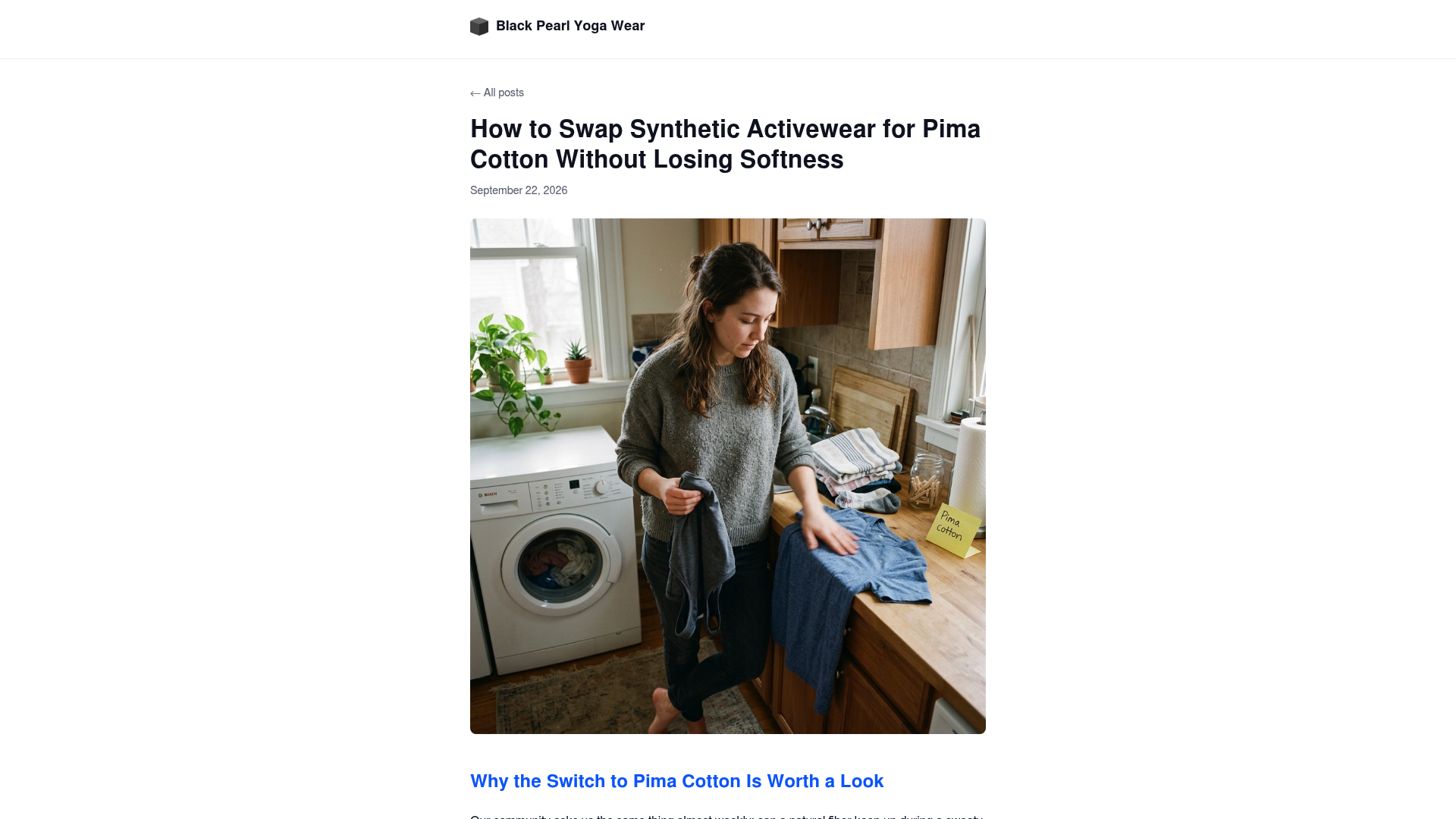
Fabric-specific care advice for Pima cotton activewear is thinner than for synthetics. The basics are cold water, no fabric softener, and not too much detergent. Excess product can leave a residue that holds moisture and odor, like a film on performance fibers.
What works for synthetics—and what's missing for natural fibers
Cold water helps protect synthetic fabrics. Some equipment managers describe cold water as a way to prevent heat damage to polyester and spandex blends, not as a reliable bacteria killer. Fabric softener is mostly discussed for synthetics because it can coat fibers and interfere with moisture movement.
For cotton, bamboo, and merino, the research offers no comparable antimicrobial maintenance studies. Existing care instructions focus more on durability and shape retention than on odor chemistry.
Regular machine cleaning and wiping the drum and gasket may also help reduce residues; follow the machine manufacturer's instructions. Turning garments inside-out helps detergent reach the inner surface where sweat collects.
The bottom line on natural fiber activewear for hot yoga
Natural fibers are different. Pima cotton is often valued for softness and absorbency. Bamboo can feel lighter and may dry quickly, depending on how it was processed. Merino may handle temperature shifts well but can cost more and need careful washing. Hemp is durable and may feel stiffer at first.
Who should choose what
If you're choosing for frequent hot yoga and want a top that can go from class to errands, Black Pearl's certified Peruvian Pima cotton is one option. Its product page emphasizes softness and breathability. Bamboo-derived fabrics may be worth considering when reducing drying time between classes matters, though processing varies. Merino may suit outdoor workouts in changeable weather. Hemp may be worth considering when long-term durability is your first concern.
Polyester still has a place for extreme stretch, compression, or cold-weather layering. Black Pearl's collection is built around 100% certified Peruvian Pima cotton; the product page describes a breathable, polished feel from mat to casual outings without looking like gym wear. The best choice depends on your practice, your laundering habits, and the balance of softness, support, and drying speed you actually prefer.
References
[1] 13 Plastic-Free, Natural Activewear Brands That Are Sustainable - Ecocult - https://ecocult.com/plastic-free-sustainable-activewear-natural-fibers-organic/
[2] Sweat and odor in sportswear – A review - PMC - NIH - https://pmc.ncbi.nlm.nih.gov/articles/PMC10391722/
[3] Workout Clothes Stink. Here's How to Clean Them. | Reviews by Wirecutter - https://www.nytimes.com/wirecutter/reviews/how-to-clean-workout-clothes/
[4] Moisture Management in Performance Fabrics: How Activewear Keeps ... - https://sportek.com/blogs/news/moisture-management-in-performance-fabrics-how-activewear-keeps-you-drymoisture-management-performance-fabrics-moisture-wicking-activewear
[5] Top 5 Natural Fibers for Breathable Sportswear | Wooter - https://wooter.com/articles/top-5-natural-fibers-for-breathable-sportswear/
Common Questions
1. Can I wear Pima cotton activewear for workouts other than hot yoga, or does it only work in heated studios?
Pima cotton may be suitable for low- to moderate-intensity activities where comfort and breathability matter more than compression. It can work well for Pilates, barre, walking, casual runs, and strength training. For high-impact exercise or very long sessions, consider whether the garment's support and drying time match the activity.
2. Why does my polyester workout gear still smell after washing, but my cotton pieces don't have the same problem?
The difference may be related to how each fiber handles moisture and retains residue. One explanation is that polyester's channels can hold bacteria and odor compounds, while cotton's structure may release odor more readily during laundering. Prompt rinsing, thorough drying, and avoiding fabric softener can help limit buildup in synthetic garments.
3. If I need some stretch for inversion poses, should I avoid natural fibers entirely or look for a specific blend percentage?
You do not need to avoid natural fibers. Some natural-activewear brands add up to 10% synthetics for stretch, while knit construction and diagonal weaves may provide movement without added elastane. Pure Pima cotton may suit lower-impact flows; compression-oriented or high-impact activities may justify a small synthetic blend.