3 Questions: Can Black's Pima Cotton Activewear Survive Workout, Commute, Coffee Date Without Change?
November 12, 2026
TL;DR
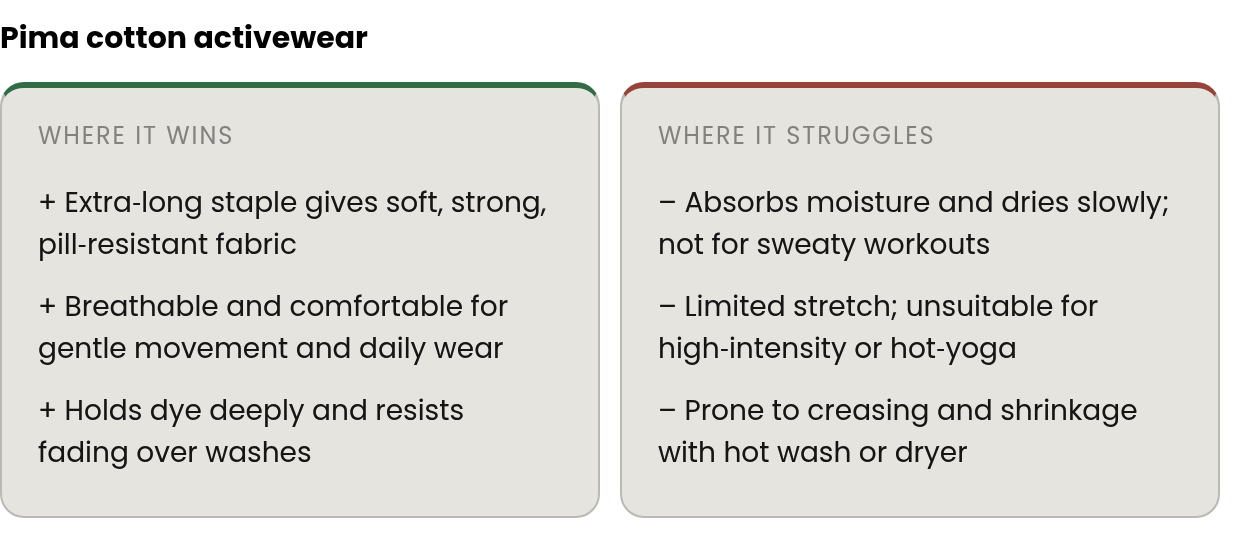
Pima cotton is an extra-long-staple fiber, meaning each strand measures at least 1 3/8 inches. That's nearly double the 3/4-inch length of common cotton. Longer fibers leave fewer loose ends poking out of the yarn, so you get less pilling where fabric rubs, like the inner thigh and underarm.
Stretch depends on the blend. Pima blends for low-impact lifestyle wear typically carry about 15% spandex, while high-intensity support leggings run 25% or more. Cotton soaks up moisture and dries slowly. Polyester takes in very little water and lets sweat evaporate faster. One yoga fabric sourcing guide says neither Pima cotton nor Modal suits hot yoga or high-intensity training.
Fiber isn't the whole story, though. Knit structure, fabric weight, and cut shape airflow and warmth as much as fiber content does, and sometimes more than the label lets on.
The Short Answer: One Outfit, Three Stops
You know the moment. Class ends, you roll up your mat, and the day still holds a commute and a coffee date. Can one outfit carry all three without a quick change in a bathroom stall?
For gentle days, yes. Our Pima cotton activewear starts with an extra-long-staple fiber, as this Pima cotton explainer lays out, and that's why the fabric can feel soft, strong, and quietly polished. Take the Tank Top Logo or the Yin/Yang tank, zip the Full Zip Mother of Pearl Jacket over it, and walk it through a short yoga flow, a commute, and a coffee date.
| Scenario | Comfort metric | Style metric | Durability/care metric | Quick verdict |
|---|---|---|---|---|
| Short yoga flow | Breathable on skin, but not built for soaked-through training | Tank lies flat under the jacket | Stretch depends on spandex share and knit | Yes for gentle flows; skip heated or high-output classes |
| Commute walk | Lets air through during light movement | Jacket reads as a layer, not gym gear | Gentle washing helps keep the fit | Yes |
| Coffee date | Soft, breathable cotton is meant to feel easy when you sit and linger | Natural sheen looks polished | Expect some creasing; wash gently | Yes, after a quick crease check |
Every piece is made from 100% certified Peruvian Pima cotton, designed to move with you from the mat to the rest of your day.
Where Pima Cotton Activewear Stops
These pieces are designed for low-sweat days. Spin, heavy lifting, or a heated studio call for something else: a technical synthetic built to shed sweat fast and bounce back under repeated strain.
When you shop, read past the fiber label. A cotton vs polyester guide gives cotton the edge for airflow during light movement, but it adds a caveat that cuts both ways. Knit and weight matter as much as fiber. Check both, because they decide how airy a top feels and how well bottoms hold their shape.
Question 1: Can It Handle a Real Workout?
Ten minutes into a slow flow, you notice the fabric before you notice the sweat. It moves with you, soft and a little cool. Then the instructor cues one more round of sun salutations, and the real question shows up. What happens when this gets damp?
We'd rather be upfront. Cotton is a thirsty fiber, as our studio-to-desk edit explains. That thirst is part of why it feels breathable on your skin. It also means it isn't pretending to be a slick performance knit.
Where Pima Cotton Feels at Home in Class
Gentle to moderate movement is its home ground. Pima's long staple, as this Pima cotton guide describes, spins into a smoother yarn than ordinary short-fiber cotton. That smoother surface is what helps the knit feel clean against your skin instead of fuzzy or scratchy. A Tuesday flow sits comfortably inside that range.
There's a quieter bonus, too. Because Pima breathes, it's meant to stay comfortable long after class ends, not just during it. We won't promise odor control. Still, a slower-drying natural layer can be a fair trade when the class is gentle and your next stop is a desk, not another workout.
When to Reach for Synthetics Instead
Stretch is the real limit. A manufacturing guide to yoga fabrics files Pima cotton blends under low-impact lifestyle wear, not serious support gear. Our fabric is designed for ease. Not compression.
So for hot yoga, spin, or HIIT, wear a technical piece. A soaked cotton layer stays soaked, and no fiber story changes that. Save the Pima for afterward.
Question 2: Does It Stay Comfortable on the Commute?
The walk from the studio door to the train platform is the honest test. Ten minutes of stride, a bag strap over one shoulder, maybe a jacket on. None of it is athletic. All of it decides whether a piece earns a second wear.
What we've learned from that stretch of the day: commute comfort is never one property. It's several, and they pull against each other.
What Decides How You Feel on the Platform
Fiber gets all the credit, but it doesn't work alone. Fabric structure, cut, and how freely air moves through the knit all change how warm or clammy you feel while you wait. A loose tank that lets air move under a jacket can feel better than a tight one in a fancier fiber.
Recovery (how well fabric springs back after stretching) is the sleeper issue. Cotton on its own doesn't snap back the way a stretch fiber does, which is part of why sourcing guides put Pima blends on the lifestyle end of activewear. On a commute, that may show up as a little softening where you bend, especially after sitting. An easy cut helps the piece look intentional even when the fabric relaxes.
Can a Lightweight Knit Still Be Opaque?
One fabric sourcing guide draws its line at 240 GSM (grams per square meter, a measure of fabric weight), warning that anything lighter can go see-through in a squat. Plenty of good studio-to-desk knits sit below that number. Weight only tells you grams at rest. Coverage comes from how densely the fabric is knit and how it fits, so an interlock (a thick, double-layered knit) covers where a thin single jersey won't. As PuraKai's fit notes put it, a cotton label alone doesn't guarantee coverage.
Durability is where Pima earns its keep on the way to work. The smoother yarn surface helps the fabric hold up to the everyday rub of straps, seats, and repeat wear. We won't claim it's wrinkle-proof. A jacket folded into a bag will crease, so hang it once you arrive. And if your commute is a sweaty bike ride, that's synthetic territory.
Question 3: Will It Pass at a Coffee Date After the Gym?
The latte arrives, you catch your reflection in the café window, and a small worry slips in. Do you look like you just left class?
Pima cotton activewear has a quiet edge here. A soft sheen reads as intentional. Matte, stretchy synthetics tend to read as gym.
Color helps too. Pima guides note that the dense fiber holds dye deeply and resists fading through repeated washing. That matters more than it sounds. A black tank that stays truly black looks deliberate on its tenth wear, while faded charcoal gives away where you've been.
Three Small Swaps Do Most of the Work
These are our own styling suggestions:
- Layer up. Zip the Full Zip Mother of Pearl Jacket over the Tank Top Logo or Yin/Yang tank, or reach for a soft cardigan.
- Add one simple piece of jewelry. A slim pendant or small hoops carry a tank from studio to café.
- Change your shoes. Polished flats or clean leather sneakers do more for the look than any top.
The tanks sit at the easier end of our lineup, so one is a low-stakes way to try the look before you commit to the jacket. For a fuller walkthrough, see our gym-to-dinner outfit guide.
Polished Doesn't Mean Unwrinkled
Here's what we can promise. Our tank tops are made from pre-washed cotton, a finish meant to hold the fit you chose and head off shrinking in the wash. The tank you size today should fit the same way after laundering. That's a promise about fit, not about smoothness.
One Pima explainer describes Pima as often more wrinkle-resistant than common cotton. Often. We have no evidence our finish stays crisp after an hour of forward folds, though. If creases would bother you on a first date, bring the jacket. It covers the parts that worked hardest in class.
The Bottom Line on Making Pima Cotton Activewear Last
You check the care label before the first wash, not after. That one habit says a lot about how long a piece stays in your rotation.
Pre-washing is meant to help a tank keep its fit after its first trip through the machine. Keeping that fit is up to you. Cool water, a gentle cycle, and low dryer heat hold the shape where it started. Hot water and a hot dryer invite shrinkage back in. Cotton is simply more likely to shrink, crease, and need careful washing than a synthetic knit.
Strength is where the fiber buys you time. Pima's extra-long staple helps make a fabric that's strong and pill-resistant, and one textile guide argues that garments built on it outlast regular cotton equivalents. That's slow fashion in practice, not as a slogan.
Where Stretch Falls Short
Cotton fiber itself only stretches about 3 to 9 percent before it breaks, and it gives that length back slowly once tension lets go. The springiness you feel in a knit comes from the loop structure and from any stretch yarn spun in beside the cotton, not the cotton alone.
Plain jersey is the slackest knit. A ribbed knit pulls in narrower and snaps back further because of how its loops interlock, which is why hems and cuffs get ribbed while body panels usually don't. Over time, repeated stretching at the knees and hips, thigh rub, and washing all pull a knit out of shape.
So if you want compression or a squat-proof second skin, look elsewhere. Buy cotton for loose tanks, culottes, and layering pieces that don't fight your body.
How to Care for It, Wash by Wash
Wash it less. Air a tank out between wears and spot-clean small marks. When it does go in, turn it inside out, use cool water, and skip high heat in the dryer. Hang it or lay it flat instead. Just don't hang a soaking-wet knit by thin straps, since the weight can drag the shoulders out of line.
Wherever the sewn-in label differs from advice you read online, including ours, follow the label. Care is unglamorous, and that's the point. The pieces still in your drawer years from now will be the ones washed gently, dried cool, and bought for the job they actually do.
References
[1] How to Select the Best Fabric for Yoga Pants for Your Brand - https://mfgmerch.com/best-fabric-for-yoga-pants/
[2] What is Pima cotton and how is it different? - https://www.fairindigo.com/blogs/news/what-is-pima-cotton-and-how-is-it-different?srsltid=AYCX9vK7XLwNRmBjtJoS_Ow_VBjK9GP9DrUaUsdLzFgq2j0ly2BFEdFB
[3] Guide to Pima Cotton - https://www.radsourcing.com/blog/pima-cotton/
[4] Cotton vs Polyester for Activewear: Which Fabric Is Better? - https://fabricandflow.com/blogs/news/cotton-vs-polyester-for-activewear?srsltid=AYCX9vLuq86ChfQNBf812-3dFB4N6g2cLimNvGgD7oBuAPGoYwKG3SIV
[5] Best Fabric for Leggings: What Your Label Won't Tell You - https://orbasics.com/blogs/stories/best-fabric-for-leggings?srsltid=AYCX9vKoX1nKLJMrKaBsXKU5PU8a08TUn8y-yWOkNXbb6ft6aovIfjTE
[6] Cotton Yoga Leggings: Stretch, Breathability, and Best Uses - https://purakai.com/blogs/threads-of-change/5-reasons-cotton-leggings-are-perfect-for-yoga-amp-everyday-wear?srsltid=AYCX9vIOeE_2Jcz3AMLQRNhvhylarVhgLFFCLHrd3ek0Kf3y3ijta2cO
[7] I Tested Natural Fiber leggings: Cotton vs Wool vs Bamboo! - https://www.youtube.com/watch?v=wnw3uvxNp4I&vl=en
[8] Pima Cotton Activewear for Women: 7 Studio to Desk Picks - https://blog.bpyogawear.com/7-pima-cotton-pieces-that-work-from-studio-to-desk-4241
FAQ
1. How can you tell if Pima cotton leggings will stay opaque when you squat?
Do the mirror test in the actual size you plan to wear. Bend, squat, and check the fabric under tension, especially in black or dark shades that can look solid while standing. If you want firm compression and total coverage through deep movement, choose a performance legging instead of relying on cotton alone.
2. Why do cotton leggings get baggy at the knees, and does it last?
Knees are high-bend zones, so they show relaxation sooner than a waistband or hem. The effect is usually most noticeable after sitting, kneeling, or moving through repeated poses. A more relaxed silhouette makes that softening less obvious than a tight, body-hugging cut.
3. Does "pre-washed" mean you can toss your Pima tank in a hot wash?
No. Pre-washed helps reduce the surprise of first-wash shrinkage, but it does not make cotton heat-proof. Treat it like a favorite tee: cool wash, gentle handling, and no punishing dryer cycle unless the care label specifically allows it.
4. Do you need to wash Pima cotton activewear after every gentle class?
Not automatically. If the class was light and the tank still feels fresh, let it air before deciding. The goal is to avoid unnecessary laundering without pretending cotton has built-in odor technology.
5. Will a black Pima cotton tank fade into charcoal over time?
It can stay polished longer when you treat color as part of the care routine. Wash dark pieces inside out, keep the water cool, and avoid high heat so the black finish has the best chance of staying rich.